Fresh Semolina Fileja
By America's Test KitchenPublished on April 7, 2020
Time
1½ hours, plus 30 minutes resting
Yield
Makes 1 pound
Ingredients
Before You Begin
You can find fine semolina (sometimes labeled semola rimacinata) in most Italian markets and in some well-stocked supermarkets. Conventional semolina is too coarse. This recipe was developed using a 4.5-quart stand mixer. If using a 7-quart stand mixer, you will need to double the recipe so the dough is properly kneaded.
Instructions
- Whisk flour and salt together in bowl of stand mixer, then stir in warm water. Using your hands, knead dough in bowl until shaggy, dry ball forms and no dry flour remains, about 3 minutes. If dry flour remains, add up to 2 teaspoons extra water, 1 teaspoon at a time, until flour is absorbed. (Dough will still be very dry and barely hold its shape.)
- Using dough hook, knead dough on medium speed until smooth and elastic, 10 to 12 minutes. (Dough may break into smaller pieces while kneading.) Transfer dough to clean counter and knead by hand to form uniform ball. Wrap tightly in plastic wrap and let rest for 30 minutes or up to 4 hours.
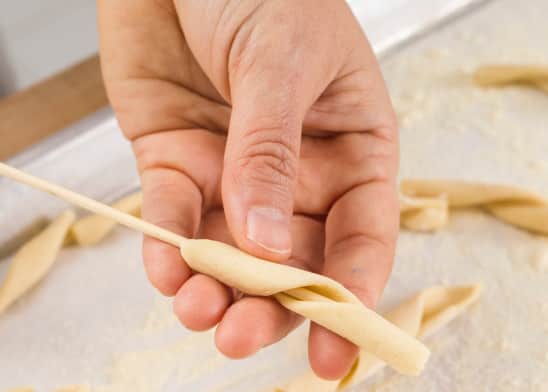
- Liberally dust 2 rimmed baking sheets with fine semolina flour. Following photos in “Shaping Fileja,” transfer dough to clean counter, divide into 16 pieces, and cover with plastic wrap. Stretch and roll 1 piece of dough into ¼-inch-thick rope, then cut rope into 3-inch lengths.
- Working with 1 dough length at a time, position at 45-degree angle to counter edge. Place thin wooden skewer at top edge of dough, parallel to counter. Arrange palms of your hands at ends of skewer, apply even pressure against dough, and roll toward you in fluid motion. (Dough will coil around skewer.)
- Slide fileja off skewer onto prepared sheets. Dust skewer with flour as needed if dough begins to stick. Repeat rolling, cutting, and shaping with remaining dough pieces. (Fileja can be kept at room temperature for up to 30 minutes, refrigerated for up to 4 hours, or chilled in freezer on baking sheet until firm, then transferred to zipper-lock bag and frozen for up to 1 month. If freezing, do not thaw before cooking.)


Time
1½ hours, plus 30 minutes restingYield
Makes 1 poundIngredients
Test Kitchen Techniques
Ingredients
Test Kitchen Techniques
Ingredients
Test Kitchen Techniques
Why This Recipe Works
In southern Italy, pasta is usually made from nothing more than water and hard durum wheat, making this variety more rugged than its eggy counterpart. The logic: Eggless doughs made with rougher semolina flour hold on to and absorb sauces better so the pasta becomes infused with the sauce's flavor rather than the sauce remaining a separate entity. By contrast, a dough made from all-purpose flour and water was gummy and the resulting pasta tasted like boiled dough. For the perfect chew, we used warm water rather than cold, which jump-started gluten development, and we gave the dough a generous knead in a stand mixer.


2 Comments