Cheddar and Black Pepper Bread
By Anne WolfPublished on January 27, 2022
Time
4½ hours, plus 13½ hours rising, resting, and cooling
Yield
Makes 1 loaf
Ingredients
Sponge
⅔ cup (3⅔ ounces/104 grams) bread flour ½ cup water, room temperature⅛ teaspoon instant or rapid-rise yeastDough
2⅓ cups (12¾ ounces/361 grams) bread flour 1¼ teaspoons instant or rapid-rise yeast 1¼ teaspoons coarsely ground pepper, divided1 cup water, room temperature2 teaspoons table salt 8 ounces (227 grams) cheddar cheese, shredded (2 cups), room temperature, divided2 disposable aluminum pie platesBefore You Begin
Look for a cheddar aged for about one year. (Avoid cheddar aged for longer; it won't melt well.) Use the large holes of a box grater to shred the cheddar. If you own a round banneton, you may use that instead of a towel-lined colander; either way, enclosing the proofing dough in a plastic garbage bag protects it from forming a tough skin. If you don't have a baking peel, use a rimless or overturned baking sheet to slide the bread onto the baking stone. If you don't have a baking stone or steel, you can use a preheated rimless or overturned baking sheet; however, the crust will be less crisp. This recipe uses lava rocks to achieve a bakery-style loaf. For the best texture and height, we don't recommend omitting them.
Instructions
- Stir flour, room-temperature water, and yeast in 4-cup liquid measuring cup with wooden spoon until well combined. Cover tightly with plastic wrap and let sit at room temperature until sponge has risen and begins to collapse, about 6 hours (sponge can sit at room temperature for up to 24 hours).
- Whisk flour, yeast, and ¾ teaspoon pepper together in bowl of stand mixer. Stir room-temperature water into sponge with wooden spoon until well combined. Using dough hook on low speed, slowly add sponge mixture to flour mixture and mix until cohesive dough starts to form and no dry flour remains, about 2 minutes, scraping down bowl as needed. Cover bowl tightly with plastic and let dough rest for 20 minutes.
- Add salt to dough and knead on medium-low speed until dough is smooth and elastic and clears sides of bowl, about 5 minutes. Reduce speed to low; slowly add 1 cup cheddar, ¼ cup at a time; and mix until just incorporated, about 30 seconds. Transfer dough to lightly greased large bowl or container, cover tightly with plastic, and let rise for 30 minutes.
- Using greased bowl scraper (or your fingertips), fold dough over itself by gently lifting and folding edge of dough toward middle. Turn bowl 45 degrees and fold dough again; repeat turning bowl and folding dough 6 more times (total of 8 folds). Cover tightly with plastic and let rise for 30 minutes. Repeat folding and rising every 30 minutes, 3 more times. After fourth set of folds, cover bowl tightly with plastic and let dough rise until nearly doubled in size, 1 to 1½ hours.
- Mist underside of large linen or cotton tea towel with water. Line 5-quart colander with prepared towel and dust evenly with flour. Transfer dough to lightly floured counter (side of dough that was against bowl should now be against counter). Press and stretch dough into 10-inch square, deflating any gas pockets larger than 1 inch. Sprinkle remaining 1 cup cheddar evenly over dough, leaving ½-inch border. Roll dough away from you into snug cylinder. Pinch seam closed. Turn cylinder seam side up and roll away from you into snug spiral, ending with tail end on bottom. Pinch side seams together to seal. Using your cupped hands, drag dough in small circles on counter until dough feels taut and round and all seams are secured on underside of loaf. (Some cheddar may become exposed.)
- Place loaf seam side up in prepared colander and pinch any remaining seams closed. Loosely fold edges of towel over loaf to enclose, then place colander in large plastic garbage bag. Tie, or fold under, open end of bag to fully enclose. Let rise until loaf increases in size by about half and dough springs back minimally when poked gently with your knuckle, 30 minutes to 1 hour (remove loaf from bag to test).
- One hour before baking, adjust oven racks to lower-middle and lowest positions. Place baking stone or steel on upper rack, place disposable pie plates filled with 1 quart lava rocks each on lower rack, and heat oven to 450 degrees. Bring 1 cup water to boil. Remove colander from bag, unfold edges of towel, and dust top of loaf with flour. (If any seams have reopened, pinch closed before dusting with flour.) Lay 16 by 12-inch sheet of parchment paper on top of loaf. Using 1 hand to support parchment and loaf, invert loaf onto parchment and place on counter. Gently remove colander and towel. Transfer parchment with loaf to baking peel.
- Carefully pour ½ cup boiling water into 1 disposable pie plate of preheated rocks and close oven door for 1 minute to create steam. Meanwhile, using sharp paring knife or single-edge razor blade, make two 7-inch-long, ½-inch-deep slashes with swift, fluid motion along top of loaf to form cross. Sprinkle top of loaf with remaining ½ teaspoon pepper.
- Working quickly, slide parchment with loaf onto baking stone and pour remaining ½ cup boiling water into second disposable pie plate of preheated rocks. Bake until crust is dark brown and loaf registers 205 to 210 degrees, 35 to 40 minutes, rotating loaf halfway through baking. Transfer loaf to wire rack; discard parchment; and let cool completely, about 3 hours, before serving.
for the sponge
for the dough


Time
4½ hours, plus 13½ hours rising, resting, and coolingYield
Makes 1 loafIngredients
Sponge
Dough
Test Kitchen Techniques
Ingredients
Sponge
Dough
Test Kitchen Techniques
Ingredients
Sponge
Dough
Test Kitchen Techniques
Why This Recipe Works
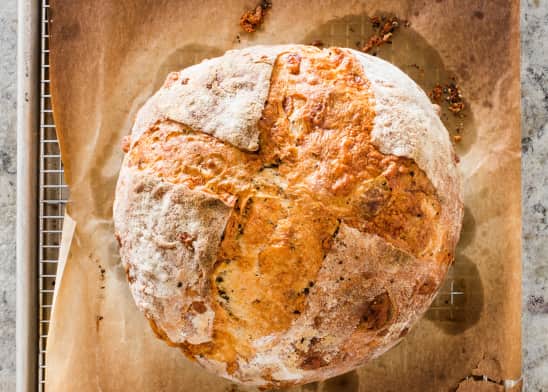
Its rusticity makes you want to tear it into generous chunks to dunk into a bowl of tomato soup. Making a bread this cheesy isn't as simple as just kneading the generous amount of shredded cheddar into the dough, because the fatty cheese will coat the gluten strands, preventing them from linking up into a strong network. To achieve a sturdy and flavorful crumb with pockets of melted cheese, knead just half of the cheese into the dough and then roll in the remaining cheese jelly roll–style before shaping the dough into a round loaf.






16 Comments