America's Test Kitchen LogoCook's Country LogoCook's Illustrated LogoAmerica's Test Kitchen LogoCook's Country LogoCook's Illustrated Logo

No-Knead Rustic Loaf

By Camila Chaparro & Hannah Fenton

Published on November 5, 2023

Time

Total Time 13¾ hours

Yield

Makes 1 loaf

No-Knead Rustic Loaf

Ingredients

2¾ cups (15⅛ ounces/429 grams) bread flour 1½ teaspoons table salt ¼ teaspoon instant or rapid-rise yeast ¾ cup plus 2 tablespoons (7 ounces) water, room temperature½ cup (4 ounces) mild-flavored lager, room temperature1 tablespoon distilled white vinegar

Before You Begin

We use a mild American lager, such as Budweiser; strongly flavored beers will make this bread taste bitter. While we prefer the flavor that beer adds, you can substitute an equal amount of water. You will need a bowl that is at least 9 inches wide and 4 inches deep to cover the dough in step 6. To see these steps in action, watch our videos on folding and shaping our No-Knead Rustic Loaf.

Instructions

    make dough

  1.  Whisk flour, salt, and yeast together in large bowl. Using rubber spatula, fold water, beer, and vinegar into flour mixture, scraping up dry flour from bottom of bowl and pressing dough until cohesive and shaggy and all flour is incorporated.
  2. first rise

  3.  Cover bowl tightly with plastic wrap and let sit at room temperature for at least 8 hours or up to 18 hours.
  4. fold and rest

  5.  Using greased bowl scraper or your wet fingertips, fold dough over itself by lifting and folding edge of dough toward middle and pressing to seal. Turn bowl 90 degrees and fold dough again; repeat turning bowl and folding dough 6 more times (for a total of 8 folds). Flip dough seam side down in bowl, cover with plastic, and let rest for 15 minutes.
  6. shape dough

  7.  Lay 18 by 12-inch sheet of parchment paper on counter and spray lightly with vegetable oil spray. Transfer dough seam side up onto lightly floured counter and pat into rough 9-inch circle using your lightly floured hands. Using bowl scraper or your floured fingertips, lift and fold edge of dough toward center, pressing to seal. Repeat 5 more times (for a total of 6 folds), evenly spacing folds around circumference of dough. Press down on dough to seal, then use bench scraper to gently flip dough seam side down. (Watch one of our test cooks demonstrate this folding step in this video.)
  8. Using both hands, cup side of dough farthest away from you and pull dough toward you, keeping pinky fingers and side of palm in contact with counter and applying slight pressure to dough as it drags to create tension. (If dough slides across surface of counter without rolling, remove excess flour. If dough sticks to counter or hands, lightly sprinkle counter or hands with flour.) Rotate dough ball 90 degrees, reposition dough ball at top of counter, and repeat pulling dough until taut round ball forms, at least 4 more times. Using your floured hands or bench scraper, transfer dough seam side down to center of prepared parchment. (Watch one of our test cooks demonstrate this shaping step in this video.)
  9. second rise

  10.  Cover dough with inverted large bowl. Let rise until dough has doubled in size and springs back minimally when poked gently with your finger, 1 to 2 hours.
  11. Thirty minutes before baking, adjust oven rack to middle position, place Dutch oven with lid on rack, and heat oven to 475 degrees. Using sharp knife or single-edge razor blade, make one 6-inch-long, ½-inch-deep slash with swift, fluid motion along top of loaf. Carefully remove hot pot from oven and, using parchment as sling, gently transfer dough to hot pot. Working quickly and reinforcing score in top of loaf if needed, cover pot and return to oven.
  12. bake

  13. Reduce oven temperature to 425 degrees and bake loaf in covered pot for 30 minutes. Remove lid and continue to bake until loaf is deep golden brown and registers at least 205 degrees, 10 to 15 minutes. Using parchment sling, carefully remove loaf from hot pot and transfer to wire rack; discard parchment. Let cool completely, about 3 hours, before slicing.
No-Knead Rustic Loaf
Photography by Daniel J. van Ackere. Styling by Chantal Lambeth.

Time

Total Time 13¾ hours

Yield

Makes 1 loaf

Ingredients

2¾ cups (15⅛ ounces/429 grams) bread flour
1½ teaspoons table salt
¼ teaspoon instant or rapid-rise yeast
¾ cup plus 2 tablespoons (7 ounces) water, room temperature
½ cup (4 ounces) mild-flavored lager, room temperature
1 tablespoon distilled white vinegar

Test Kitchen Techniques

Ingredients

2¾ cups (15⅛ ounces/429 grams) bread flour
1½ teaspoons table salt
¼ teaspoon instant or rapid-rise yeast
¾ cup plus 2 tablespoons (7 ounces) water, room temperature
½ cup (4 ounces) mild-flavored lager, room temperature
1 tablespoon distilled white vinegar

Test Kitchen Techniques

Ingredients

2¾ cups (15⅛ ounces/429 grams) bread flour
1½ teaspoons table salt
¼ teaspoon instant or rapid-rise yeast
¾ cup plus 2 tablespoons (7 ounces) water, room temperature
½ cup (4 ounces) mild-flavored lager, room temperature
1 tablespoon distilled white vinegar

Test Kitchen Techniques

Why This Recipe Works

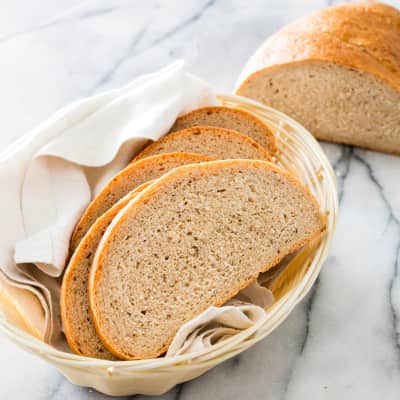
Not only is it possible to make a bakery-quality rustic loaf for your home table, it's easier than ever with our new and improved no-knead rustic bread that is truly no knead. (Our almost no-knead bread recipes still produce great results. But this recipe reflects our updated method we developed for our book Everyday Bread.) Instead of kneading our exemplary loaf, we make a very wet dough and rely on a rest and some structure-building folds to slowly develop a strong gluten network—one that can support a dramatic open crumb initiated by baking the bread in the humid environment of a preheated Dutch oven. While handling wet doughs can be a real challenge, a long built-in rest allows the dry ingredients to absorb a lot of the moisture. And our fear-free folding method is extra forgiving.

Before You Begin

We use a mild American lager, such as Budweiser; strongly flavored beers will make this bread taste bitter. While we prefer the flavor that beer adds, you can substitute an equal amount of water. You will need a bowl that is at least 9 inches wide and 4 inches deep to cover the dough in step 6. To see these steps in action, watch our videos on folding and shaping our No-Knead Rustic Loaf.

Instructions

    make dough

  1.  Whisk flour, salt, and yeast together in large bowl. Using rubber spatula, fold water, beer, and vinegar into flour mixture, scraping up dry flour from bottom of bowl and pressing dough until cohesive and shaggy and all flour is incorporated.
  2. first rise

  3.  Cover bowl tightly with plastic wrap and let sit at room temperature for at least 8 hours or up to 18 hours.
  4. fold and rest

  5.  Using greased bowl scraper or your wet fingertips, fold dough over itself by lifting and folding edge of dough toward middle and pressing to seal. Turn bowl 90 degrees and fold dough again; repeat turning bowl and folding dough 6 more times (for a total of 8 folds). Flip dough seam side down in bowl, cover with plastic, and let rest for 15 minutes.
  6. shape dough

  7.  Lay 18 by 12-inch sheet of parchment paper on counter and spray lightly with vegetable oil spray. Transfer dough seam side up onto lightly floured counter and pat into rough 9-inch circle using your lightly floured hands. Using bowl scraper or your floured fingertips, lift and fold edge of dough toward center, pressing to seal. Repeat 5 more times (for a total of 6 folds), evenly spacing folds around circumference of dough. Press down on dough to seal, then use bench scraper to gently flip dough seam side down. (Watch one of our test cooks demonstrate this folding step in this video.)
  8. Using both hands, cup side of dough farthest away from you and pull dough toward you, keeping pinky fingers and side of palm in contact with counter and applying slight pressure to dough as it drags to create tension. (If dough slides across surface of counter without rolling, remove excess flour. If dough sticks to counter or hands, lightly sprinkle counter or hands with flour.) Rotate dough ball 90 degrees, reposition dough ball at top of counter, and repeat pulling dough until taut round ball forms, at least 4 more times. Using your floured hands or bench scraper, transfer dough seam side down to center of prepared parchment. (Watch one of our test cooks demonstrate this shaping step in this video.)
  9. second rise

  10.  Cover dough with inverted large bowl. Let rise until dough has doubled in size and springs back minimally when poked gently with your finger, 1 to 2 hours.
  11. Thirty minutes before baking, adjust oven rack to middle position, place Dutch oven with lid on rack, and heat oven to 475 degrees. Using sharp knife or single-edge razor blade, make one 6-inch-long, ½-inch-deep slash with swift, fluid motion along top of loaf. Carefully remove hot pot from oven and, using parchment as sling, gently transfer dough to hot pot. Working quickly and reinforcing score in top of loaf if needed, cover pot and return to oven.
  12. bake

  13. Reduce oven temperature to 425 degrees and bake loaf in covered pot for 30 minutes. Remove lid and continue to bake until loaf is deep golden brown and registers at least 205 degrees, 10 to 15 minutes. Using parchment sling, carefully remove loaf from hot pot and transfer to wire rack; discard parchment. Let cool completely, about 3 hours, before slicing.

Gift This Recipe

Enjoyed this dish? Let others know by sharing it as a gift recipe.

Keep Exploring

This is a members' feature.