Gimbap 김밥 (Seaweed Rice Rolls)
By Sarah Ahn & Nam Soon AhnPublished on March 28, 2025
Time
2¼ hours, plus 1 hour soaking
Yield
Serves 4 to 6
Ingredients
Before You Begin
Make sure to buy dried seaweed sheets designated for gimbap (gimbapgim, usually labeled as 김밥깁) or nori sheets designated for sushi. This type of seaweed will not rip as you roll. Danmuji is also sold pre-cut in strips for gimbap and can be used here as well. It’s best to add the sushi seasoning and sesame oil to the rice when it is still warm from cooking, just before assembling the gimbap. We prefer Mizkan Sushi Seasoning, but other brands of seasoned rice vinegar also work. We suggest wrapping the bamboo mat with plastic wrap before rolling the gimbap. Otherwise, rice becomes lodged in the crevices of the mat, which makes it harder to clean and shortens its lifespan. When cutting the roll, use a sharp, wet knife and cut at a 90‑degree angle to the cutting board using a seesaw motion. Don’t cut the roll from a slanted angle, as this may cause the filling to loosen.
Instructions
- Add rice to medium bowl, cover by 2 inches water, and let sit for 1 hour. Soak dashima in 1½ cups hot water in separate bowl for 15 minutes. Measure out 1 cup dashima broth; discard remaining broth and solids.
- Using hands, gently swish rice to release excess starch. Carefully pour off water, leaving rice in bowl. Cover rice with water again, swish it, and pour off water; repeat 2 or 3 more times, until water runs almost clear. Drain rice using fine-mesh strainer.
- FOR AN ELECTRIC RICE COOKER: Transfer rice to cooking chamber of 5- to 6-cup electric rice cooker. Stir in reserved dashima broth, ¼ teaspoon sugar, ¼ teaspoon seasoning salt, and ¼ teaspoon Dasida powder; cover; and cook on standard rice setting according to manufacturer's directions. Machine will automatically shut off when cooking is completed (typically indicated by “Keep Warm” light turning on). Using moistened rice paddle or silicone spatula, gently fluff rice (this ensures even texture and moisture distribution). Cover and set aside.FOR THE STOVETOP: Transfer rice to large saucepan. Stir in reserved dashima broth, ¼ teaspoon sugar, ¼ teaspoon seasoning salt, and ¼ teaspoon Dasida powder. Bring to boil. Reduce heat to low (medium if using electric stove), cover, and cook until rice is tender and water is fully absorbed, about 20 minutes. Turn off heat and let sit for 15 minutes to finish cooking. Using moistened rice paddle or silicone spatula, gently fluff rice. Cover and set aside.
- Meanwhile, bring 1 quart water and salt to boil in large saucepan. Add spinach and submerge completely. Blanch until spinach is bright green but still has some bite, about 10 seconds. Using tongs, quickly transfer spinach to large bowl of cold water and run hands gently through spinach to cool it down. Drain spinach and repeat covering with cold water until spinach has completely cooled. Working in batches, squeeze spinach by hand to remove excess water. Untangle spinach and transfer it to medium bowl; set aside.
- Beat eggs, ⅛ teaspoon sugar, ⅛ teaspoon seasoning salt, and ⅛ teaspoon Dasida powder in separate bowl until eggs are thoroughly combined and mixture is pure yellow. Heat 1 teaspoon neutral oil in 8½ by 7½-inch rectangular nonstick skillet over medium heat until shimmering. Add egg mixture, tilting and shaking skillet gently until egg evenly covers bottom of pan. Cook, undisturbed, until bottom of omelet is just set but top is still slightly wet, 1 to 3 minutes.
- Using two thin spatulas, gently lift one-third of omelet (one of long sides) over, then fold omelet in half. Continue to cook, gently flipping and turning omelet, until lightly set, about 30 seconds. Remove skillet from heat and let eggs continue to cook using residual heat until fully set, 1 to 3 minutes. Transfer omelet to cutting board and let it rest while continuing to prepare filling.
- Heat 4 teaspoons neutral oil in 14-inch flat-bottomed wok or 12-inch nonstick skillet over medium-high heat until shimmering. Add carrot and cook, tossing constantly, until softened, about 2 minutes. Stir in ¼ teaspoon sugar and ¼ teaspoon seasoning salt until fully incorporated, about 30 seconds. Transfer carrot to plate and set aside.
- Place fish cake strips in strainer and thoroughly rinse under hot water. Drain strips well and pat dry with paper towels. Heat remaining 1 tablespoon neutral oil in now-empty wok over medium-high heat until shimmering. Add fish cakes and cook, tossing constantly, until evenly coated in oil, about 15 seconds. Add soy sauce and 1½ teaspoons sugar and mix until just combined, about 20 seconds (don't overcook or else fish cakes will become hard and chewy). Transfer fish cakes to separate plate.
- Just before you are ready to assemble gimbap, transfer rice to large bowl, add sushi seasoning and 1 tablespoon sesame oil, and gently fluff with rice paddle or silicone spatula until well combined. Squeeze spinach by hand to remove excess water that has accumulated. Add remaining ¼ teaspoon sugar, remaining ⅛ teaspoon seasoning salt, remaining ¼ teaspoon Dasida powder, 1 tablespoon sesame oil, and sesame seeds to spinach. Lift and loosen individual pieces of spinach and mix gently until evenly coated with seasonings. Cut omelet lengthwise into quarters.
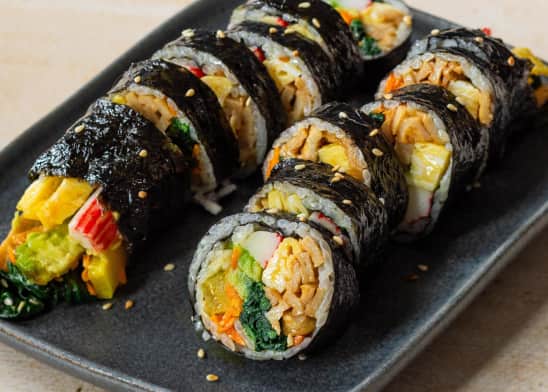
- Place 1 gim sheet shiny side down on bamboo mat, with longer side parallel to bottom edge of mat. Using lightly moistened hands, scoop one-quarter of seasoned rice, place rice on gim, and spread it out evenly all the way to edges. (Parts of gim should still be visible through rice; rice should not form solid layer.) Starting 1 inch from bottom edge of gim, use one-quarter of danmuji, one-quarter of carrot, and one-quarter of spinach to create three thin, adjacent rows. Use one-quarter of avocado slices and one-quarter of fish cakes to create two rows on top, followed by row of crab and row of omelet on top of avocado and fish cakes, overlapping ends if needed.
- Using bamboo mat as guide, lift and roll bottom edge of gim sheet up and over filling. Gently squeeze to tighten roll. Lift up top edge of mat and continue to roll remaining gim and rice into log, using mat to gently squeeze roll to seal and tighten it as you go. When fully rolled, flip bamboo mat over and roll mat away from you to release gimbap. Set gimbap aside, seam side down, and repeat shaping 3 more gimbap using remaining gim sheets, rice, and filling.
- Brush gimbap with remaining 1 teaspoon sesame oil. Using sharp knife, cut each roll into ½-inch-thick slices, dipping knife in water between cuts if slices begin to stick. Sprinkle with extra sesame seeds and serve.



Time
2¼ hours, plus 1 hour soakingYield
Serves 4 to 6Ingredients
Test Kitchen Techniques
Ingredients
Test Kitchen Techniques
Ingredients
Test Kitchen Techniques
Why This Recipe Works
Whether lovingly packed into lunches, eaten on trips and picnics, or served to visiting family and friends, gimbap is always a special treat. The seaweed-wrapped rice roll is cut into slices to reveal delightful layers of filling, which could include vegetables, egg, seafood, or meat. Nam Soon’s version, made with additions of seasoned vinegar to the rice and avocado to the roll, is superlative. So that everything is as fresh as possible, we suggest preparing the fillings while the rice cooks and setting up your “gimbap station” with all the ingredients lined up so you’ll be ready to roll when the rice is cooked.


0 Comments