Herb-Crusted Pork Roast with Mustard and Caraway
By America's Test KitchenPublished on August 22, 2007
Time
2 hours, plus 1 hour brining
Yield
Serves 4 - 6
Ingredients
Before You Begin
If only "enhanced" pork is available (the label will state that the pork was injected with a water-salt solution), do not brine the roast. Instead, simply season the stuffed and tied roast with salt before browning. Note that you should not trim the pork of its layer of fat. Do not substitute dried thyme for fresh or the herb crust will be dry and dusty tasting. The roasting time will vary widely depending on the thickness of the meat. The roast can be brined, stuffed, and tied a day ahead, but don't prepare the bread crumb topping until you are ready to cook.
Instructions
- Following illustration 1 below, lightly score fat cap on pork, making 1/4-inch crosshatch pattern. Following illustrations 2 and 3, cut pocket in roast. Dissolve 1/2 cup salt and sugar in 2 quarts water in large container; submerge roast, cover with plastic wrap, and refrigerate for 1 hour. Rinse roast under cold water and dry thoroughly with paper towels.
- Meanwhile, adjust oven rack to lower-middle position and heat oven to 325 degrees. Pulse bread in food processor until coarsely ground, about sixteen 1-second pulses (you should have 1 cup crumbs). Transfer crumbs to medium bowl (do not wash food processor workbowl) and add 2 tablespoons Parmesan, 1 tablespoon garlic, 1 tablespoon oil, 1/8 teaspoon salt, and 1/8 teaspoon pepper. Using fork, toss mixture until crumbs are evenly coated with oil.
- Add parsley or basil, thyme, mustard, caraway seeds, remaining 1 1/2 teaspoons garlic, remaining 6 tablespoons Parmesan, 2 tablespoons oil, 1/8 teaspoon salt, and 1/8 teaspoon pepper to now-empty food processor workbowl and process until smooth, about twelve 1-second pulses. Transfer herb paste to small bowl.
- Following illustrations 4 and 5, spread 1/4 cup herb paste inside roast and tie. Season roast with pepper (and salt, if using enhanced pork).
- Heat remaining 2 teaspoons oil in 12-inch skillet over medium-high heat until just smoking. Add roast, fat side down, and brown on all sides, 8 to 10 minutes, lowering heat if fat begins to smoke. Transfer roast to wire rack set in rimmed baking sheet lined with aluminum foil.
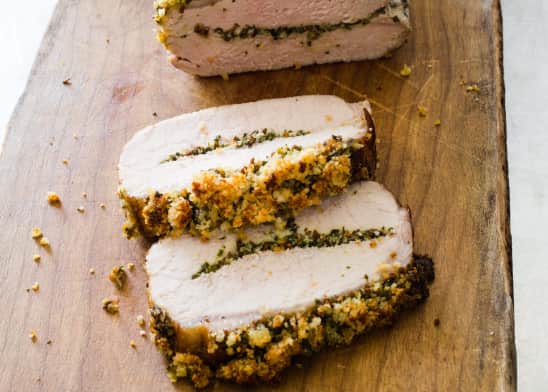
- Using scissors, snip and remove twine from roast; discard twine. Following photos below, spread remaining herb paste over roast and top with bread crumb mixture. Transfer baking sheet with roast to oven and cook until thickest part of roast registers 145 degrees on instant-read thermometer, 50 to 75 minutes. Remove roast from oven and let rest 10 minutes. Internal temperature should rise to 150 degrees. Using spatula and meat fork, transfer roast to carving board, taking care not to squeeze juices out of pocket in roast. Cut roast into 1/2-inch slices and serve immediately.


Time
2 hours, plus 1 hour briningYield
Serves 4 - 6Ingredients
Test Kitchen Techniques
Ingredients
Test Kitchen Techniques
Ingredients
Test Kitchen Techniques
Why This Recipe Works
To get our herb crust to deliver maximum herb flavor in our pork roast recipe, we cut a single horizontal pocket across the middle of the roast that could hold a good quantity of herb paste. With our internal flavor guaranteed for our pork roast recipe, we went to work on the crust, using the same herb paste we had used to fill the pocket; to keep it attached to the outside of the roast, we found we needed to score a crosshatch pattern into the fat cap, giving the paste something to grip.




10 Comments