Grain-Fed Quarter-Pound Burgers
By America's Test KitchenPublished on November 8, 2016
Yield
Makes 4 burgers

Ingredients
Before You Begin
Brush buns with softened butter and toast on wire rack set in rimmed baking sheet in 400-degree F/200-degree C oven for 4 to 6 minutes, rotating sheet halfway through toasting.
In Step 1, we give a wide time range because home freezers can vary a lot. You want the meat to be very hard so that the food processor cleanly chops it into small pieces. If the meat starts to stick together during processing, it is too warm. Return it to the freezer until properly firm.
Raw onions add texture and sharpness to a burger, but can sometimes be overpowering. In Step 2, we salt the onions to draw out moisture and season them. Then we rinse the onions to remove one of the particularly harsh-tasting compounds, propanethial-S-oxide, that forms on the cut surfaces.
We use two 12-inch skillets to cook these burgers. Place the burgers in your heavy-bottomed traditional stainless-steel or cast-iron skillet. The second skillet is used to compress the burgers (it gets wrapped in aluminum foil first) and can be of any material or finish.
It's unnecessary to temp the burgers because they will reach a food-safe temperature if cooked according to the recipe instructions. (But for more information on food safety, check out this guide.)
Instructions
- Place beef on baking sheet in single layer. Freeze beef until very firm and hard around edges but still slightly pliable, 1 to 2 hours.
- Meanwhile, stir together onion and 1 tablespoon salt; let sit for 30 minutes. Rinse onion in fine-mesh strainer; let onion drain in strainer while preparing toppings and beef. Whisk mayonnaise, ketchup, and mustard until smooth; set aside.
- Pulse half of beef in food processor until finely ground into 1/16-inch pieces, about 35 one-second pulses, stopping to redistribute beef around bowl as necessary to ensure even grinding. Transfer beef to second baking sheet. Repeat with remaining beef. Spread beef over sheet and inspect carefully, discarding any long strands of gristle or large chunks of hard meat or fat.
- Dress bun bottoms with mayonnaise mixture, drained onion, tomato, and pickle chips to taste.
- Wrap bottom of 12-inch skillet with aluminum foil; set aside. Divide beef into 4 lightly packed balls. Gently flatten into 3-inch patties. Heat 1 teaspoon oil in second (12-inch) skillet over high heat until just smoking. Transfer 2 patties to skillet. Using foil-wrapped skillet, gently press patties into 4-inch burgers. Season tops of burgers liberally with salt and pepper. Cook burgers, without moving them, until well browned, 60 to 80 seconds. Using metal spatula, flip burgers. Season second side liberally with salt and pepper. Top each burger with 1 slice cheese; cover and cook for 30 seconds. Transfer burgers to prepared buns. Wipe skillet clean with paper towels, add remaining 1 teaspoon oil, and return to high heat for 30 seconds. Repeat cooking with remaining 2 patties and remaining 2 slices cheese. Serve.


Yield
Makes 4 burgersIngredients
Ingredients
Ingredients
Why This Recipe Works
by Tim Chin
Sometimes you don’t mess with a classic. Grain-fed beef chuck is arguably nature’s perfect all-purpose burger blend (the Chuck Norris of beef cuts maybe?). At an 80:20 lean meat to fat ratio, it’s a hard cut of meat to beat for your money. For this recipe we chose a thin-profile burger that we could get crispy on the outside, while the extensive marbling of this grain-fed cut would keep the inside nice and juicy. And to all you die-hard, blowhard burger savants out there heckling us in your seats as you read this: This was to be a thin, fast-cooking, no-fuss patty, so we decided against using a burger blend—though not without some rigorous testing and heated emotional debate. We were looking for crispy edges, richness, and just a hint of tender, meaty goodness in the center—all things that chuck could accomplish beautifully with a little TLC.
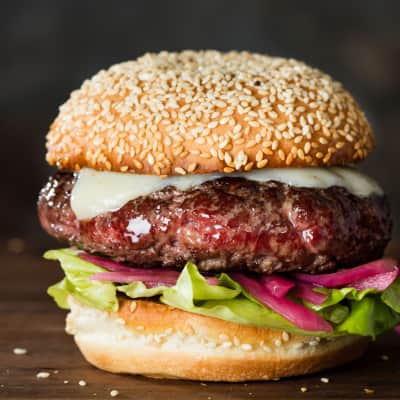
Loosely packing and pressing the patties helps create irregular crags at the edges of the burgers and ensures good surface contact with the pan, leading to crispy edges and nicely seared exteriors. Holding off on the salt until flipping contributes even more to a nice crust (salt pulls moisture out of the meat which cools the skillet and creates steam instead of browning—not what we’re going for here). Add a little cheese, a nice potato roll, and some special sauce, and you’re on your way out of burger-tory and into the beefy embrace of this diner-style classic.


5 Comments