America's Test Kitchen LogoCook's Country LogoCook's Illustrated LogoAmerica's Test Kitchen LogoCook's Country LogoCook's Illustrated Logo

White Bean Hummus with Herb and Olive Salad

By America's Test Kitchen

Published on January 6, 2017

Yield

4 cups; serves 8 to 10 as an appetizer
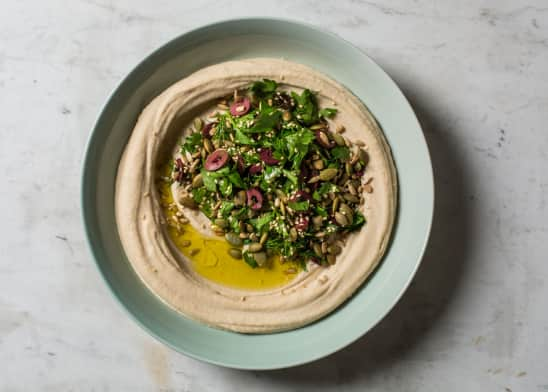
White Bean Hummus with Herb and Olive Salad

Ingredients

1 teaspoon plus 2 teaspoons kosher salt, divided¼ teaspoon baking soda 8 cups plus ⅓ cup water, divided1¼ cups white tepary beans, picked over and rinsed½ cup plus 2 teaspoons lemon juice, divided4 garlic cloves, unpeeled⅔ cup tahini ¼ teaspoon ground cumin ¾ cup fresh parsley, chopped coarse½ cup fresh dill sprigs, chopped coarse½ cup kalamata olives, pitted and sliced thin2 tablespoons plus 2 tablespoons extra-virgin olive oil, divided2 tablespoons pepitas, toasted2 tablespoons sunflower seeds, toasted2 tablespoons white sesame seeds, toasted

Before You Begin

This recipe can be cooked without the overnight soak by using a pressure cooker: In step 1 dissolve salt and baking soda in water in pressure cooker. Add beans, lock pressure cooker lid in place, and bring to high pressure over medium-high heat. As soon as pot reaches high pressure, reduce heat to medium-low and cook for 30 minutes, adjusting heat as necessary to maintain high pressure. Remove pot from heat. Quick-release pressure, then carefully remove lid, allowing steam to escape away from you (some beans will blow out, which is fine for this dish). Drain beans and set aside. Proceed with step 2 as written. You can also substitute cannellini beans 1 for 1 for the tepary beans.

Instructions

  1. Dissolve 1 teaspoon salt and baking soda in 8 cups water in large saucepan. Add beans, cover, and soak at room temperature for at least 8 hours or up to 24 hours. Bring beans (still in soaking liquid) to boil over high heat, skimming off any foam that rises to surface. Reduce heat to medium-low and simmer until beans are very tender (some beans will blow out, which is fine for this dish), 1 hour to 1¼ hours. Drain beans and set aside.
  2. Pulse ½ cup lemon juice, ⅓ cup water, garlic, and 2 teaspoons salt in food processor until coarse puree forms, about 20 pulses. Transfer to small bowl and let steep for at least 10 minutes or up to 30 minutes. Strain lemon juice mixture through fine-mesh strainer back into processor; discard garlic. Add tahini to processor with lemon juice mixture and process until smooth and well combined, 45 to 60 seconds. Scrape down sides of bowl and add cumin and beans. Process until mixture is very smooth, about 4 minutes. Season with salt to taste and adjust consistency with up to 2 tablespoons additional water.
  3. If you don’t want to serve the hummus all at once, prep and dress only the amount of herb salad you need for that serving. Leftover hummus can be refrigerated in airtight container for up to 1 week. Toss parsley, dill, olives, 2 tablespoons oil, and 2 teaspoons lemon juice together in small bowl. Season with salt to taste. Transfer hummus to large, wide serving bowl and use back of large spoon to spread hummus up sides of bowl, leaving well at center. Place herb salad in center of well. Sprinkle pepitas, sunflower seeds, and sesame seeds over top and drizzle with remaining 2 tablespoons oil. Serve with pita bread or pita chips.
White Bean Hummus with Herb and Olive Salad
Photography by Steve Klise. Styling by Lindsey Chandler.

White Bean Hummus with Herb and Olive Salad

Headshot of America's Test Kitchen
By America's Test Kitchen
Save

Yield

4 cups; serves 8 to 10 as an appetizer

Ingredients

1 teaspoon plus 2 teaspoons kosher salt, divided
¼ teaspoon baking soda
8 cups plus ⅓ cup water, divided
1¼ cups white tepary beans, picked over and rinsed
½ cup plus 2 teaspoons lemon juice, divided
4 garlic cloves, unpeeled
⅔ cup tahini
¼ teaspoon ground cumin
¾ cup fresh parsley, chopped coarse
½ cup fresh dill sprigs, chopped coarse
½ cup kalamata olives, pitted and sliced thin
2 tablespoons plus 2 tablespoons extra-virgin olive oil, divided
2 tablespoons pepitas, toasted
2 tablespoons sunflower seeds, toasted
2 tablespoons white sesame seeds, toasted

Ingredients

1 teaspoon plus 2 teaspoons kosher salt, divided
¼ teaspoon baking soda
8 cups plus ⅓ cup water, divided
1¼ cups white tepary beans, picked over and rinsed
½ cup plus 2 teaspoons lemon juice, divided
4 garlic cloves, unpeeled
⅔ cup tahini
¼ teaspoon ground cumin
¾ cup fresh parsley, chopped coarse
½ cup fresh dill sprigs, chopped coarse
½ cup kalamata olives, pitted and sliced thin
2 tablespoons plus 2 tablespoons extra-virgin olive oil, divided
2 tablespoons pepitas, toasted
2 tablespoons sunflower seeds, toasted
2 tablespoons white sesame seeds, toasted

Ingredients

1 teaspoon plus 2 teaspoons kosher salt, divided
¼ teaspoon baking soda
8 cups plus ⅓ cup water, divided
1¼ cups white tepary beans, picked over and rinsed
½ cup plus 2 teaspoons lemon juice, divided
4 garlic cloves, unpeeled
⅔ cup tahini
¼ teaspoon ground cumin
¾ cup fresh parsley, chopped coarse
½ cup fresh dill sprigs, chopped coarse
½ cup kalamata olives, pitted and sliced thin
2 tablespoons plus 2 tablespoons extra-virgin olive oil, divided
2 tablespoons pepitas, toasted
2 tablespoons sunflower seeds, toasted
2 tablespoons white sesame seeds, toasted

Why This Recipe Works

Tepary beans were first cultivated by Native Americans in the American southwest and are prized for their drought-resistant properties. The tepary bean’s tolerance of heat and water stress makes it an attractive crop for forward-thinking agriculturalists as the effects of climate change become more pronounced in the coming years. The International Center for Tropical Agriculture has begun cross-breeding tepary and common beans (think: black, red, and pinto beans) in an attempt to transfer these genetic traits to the common bean. The two main types of tepary beans are white and brown. When we cooked off a test batch of the white variety, the beans’ earthy flavor and creamy texture called out for a pureed treatment.

This recipe is inspired by Michael Solomonov’s “tehina” hummus, replacing chickpeas with tepary beans (it also works well with cannellini beans). We found that soaking the beans overnight in water with a little salt and baking soda before simmering them on the stove yielded supertender, creamy beans that are perfect for pureeing. Both salt and baking soda work to weaken cell-wall structure; the alkalinity of baking soda helps dissolve hemicelluloses, and sodium displaces magnesium, which facilitates the dissolving of cell-wall pectins. We finish the supersmooth bean hummus with a bright and briny herb and olive salad and a sprinkle of crunchy toasted seeds for a dish that can be served with some pita bread as a light lunch or dinner or as an appetizer dip for a dinner party that will win you points with vegan guests. 

Before You Begin

This recipe can be cooked without the overnight soak by using a pressure cooker: In step 1 dissolve salt and baking soda in water in pressure cooker. Add beans, lock pressure cooker lid in place, and bring to high pressure over medium-high heat. As soon as pot reaches high pressure, reduce heat to medium-low and cook for 30 minutes, adjusting heat as necessary to maintain high pressure. Remove pot from heat. Quick-release pressure, then carefully remove lid, allowing steam to escape away from you (some beans will blow out, which is fine for this dish). Drain beans and set aside. Proceed with step 2 as written. You can also substitute cannellini beans 1 for 1 for the tepary beans.

Instructions

  1. Dissolve 1 teaspoon salt and baking soda in 8 cups water in large saucepan. Add beans, cover, and soak at room temperature for at least 8 hours or up to 24 hours. Bring beans (still in soaking liquid) to boil over high heat, skimming off any foam that rises to surface. Reduce heat to medium-low and simmer until beans are very tender (some beans will blow out, which is fine for this dish), 1 hour to 1¼ hours. Drain beans and set aside.
  2. Pulse ½ cup lemon juice, ⅓ cup water, garlic, and 2 teaspoons salt in food processor until coarse puree forms, about 20 pulses. Transfer to small bowl and let steep for at least 10 minutes or up to 30 minutes. Strain lemon juice mixture through fine-mesh strainer back into processor; discard garlic. Add tahini to processor with lemon juice mixture and process until smooth and well combined, 45 to 60 seconds. Scrape down sides of bowl and add cumin and beans. Process until mixture is very smooth, about 4 minutes. Season with salt to taste and adjust consistency with up to 2 tablespoons additional water.
  3. If you don’t want to serve the hummus all at once, prep and dress only the amount of herb salad you need for that serving. Leftover hummus can be refrigerated in airtight container for up to 1 week. Toss parsley, dill, olives, 2 tablespoons oil, and 2 teaspoons lemon juice together in small bowl. Season with salt to taste. Transfer hummus to large, wide serving bowl and use back of large spoon to spread hummus up sides of bowl, leaving well at center. Place herb salad in center of well. Sprinkle pepitas, sunflower seeds, and sesame seeds over top and drizzle with remaining 2 tablespoons oil. Serve with pita bread or pita chips.


Gift This Recipe

Enjoyed this dish? Let others know by sharing it as a gift recipe.

Keep Exploring

This is a members' feature.