America's Test Kitchen LogoCook's Country LogoCook's Illustrated Logo

Reviews You Can Trust.
See Why.

The Best Baking Sprays

Tired of greasing and flouring pans before baking? Baking sprays replace that fussy process with one simple step.

Headshot of Carolyn Grillo
By Carolyn Grillo

Published on March 24, 2023

Top Pick

  • Ease of Use
  • Performance

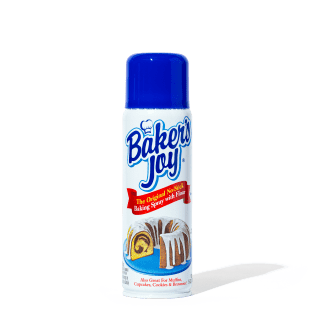
Baker’s Joy Baking Spray with Flour

This spray was easy to use—its moderately powerful nozzle sprayed in a round spray pattern and thus landed exactly where we expected. A visible layer of foam, a combination of a propellant and starch, made it easy to see that the entire pan was covered in a thin, even layer. It was effective too. When we prepared pans with this spray, baked goods always slid out easily.

Ingredients: Soybean oil, propellant (n-butane, propane), hydroxylated soy lecithin, soy lecithin, enriched flour (wheat flour, niacin, reduced iron, thiamin mononitrate, riboflavin, enzyme, folic acid), silicon dioxide

Price at Time of Testing: $3.09 for 5 oz can ($0.62 per oz)

  • Ease of Use
  • Performance

This spray was easy to use—its moderately powerful nozzle sprayed in a round spray pattern and thus landed exactly where we expected. A visible layer of foam, a combination of a propellant and starch, made it easy to see that the entire pan was covered in a thin, even layer. It was effective too. When we prepared pans with this spray, baked goods always slid out easily.

Ingredients: Soybean oil, propellant (n-butane, propane), hydroxylated soy lecithin, soy lecithin, enriched flour (wheat flour, niacin, reduced iron, thiamin mononitrate, riboflavin, enzyme, folic acid), silicon dioxide

Price at Time of Testing: $3.09 for 5 oz can ($0.62 per oz)

What You Need To Know

Using baking spray is a convenient, quick way to prepare pans, ensuring that even the stickiest baked goods slide out cleanly. Our favorite spray, Baker’s Joy Baking Spray with Flour, was especially easy to spray in a controlled manner. It was a snap to coat everything from square cake pans to muffin tins. If you regularly bake, it’s a must-have.
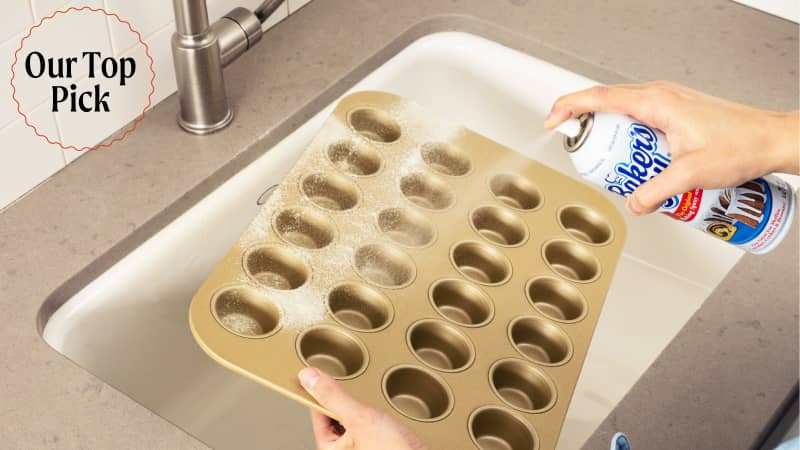
Our winner from Baker’s Joy coated our pans quickly and evenly and released muffins, cakes, and brownies with ease.

If you bake a lot, you should consider baking spray. It is a fast and easy one-step product that lets you skip the messy, tedious traditional process of greasing and flouring pans for baking. We specifically call for baking spray in recipes that are particularly sticky and when we use a Bundt pan with lots of nooks and crannies.

Cooking spray has become ubiquitous in home kitchens. Baking spray, however, is less common. For both, the main ingredient is an oil such as palm, soybean, or coconut oil. They also typically contain emulsifiers such as lecithin or mono- and diglycerides that keep the ingredients combined in the can and help the oil adhere to the surface of cookware or bakeware.

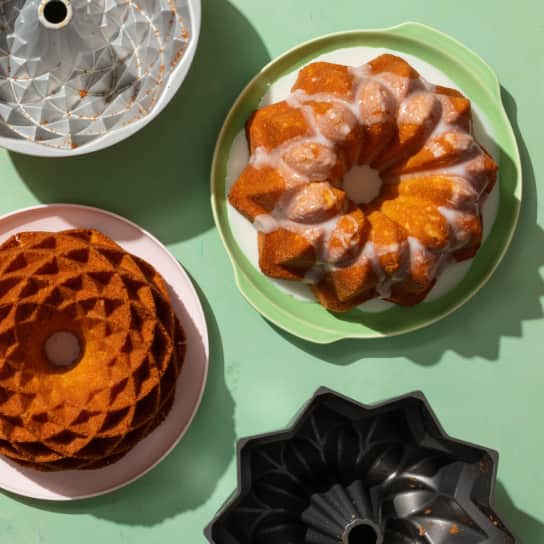
We coated an intricate Bundt pan with each spray before baking vanilla cake in it. Then we evaluated how well each cake released from the pan.

To discharge these ingredients into the air, a can needs to be pressurized. Pressure inside a can is created in two ways. One setup mixes a pressurized propellant gas (such as propane or butane) with the oil. The second setup, known as a bag-on-valve dispensing system, places the oil inside a bag, separate from the pressurized propellant gas (either compressed air or nitrogen), which fills the space between the bag and the can.

Baking spray typically—though not always—also contains flour, cornstarch, or wheat starch. These starch particles create space between the baked goods and the pan that insulates the batter or dough from the metal pan. Because of this insulation, the food cooks a bit more slowly and, more importantly, releases easily. Some baking sprays with starch also contain silicon dioxide, a fine powder that prevents clumping, which is important for even distribution of the starch.
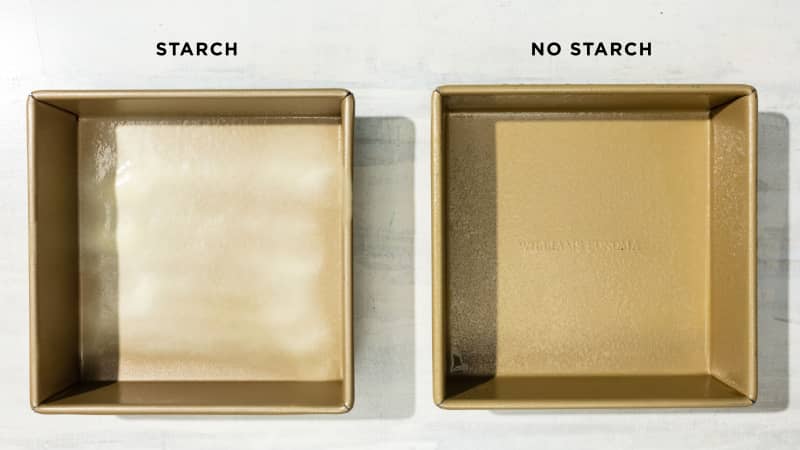
Several sprays we tested were foamy and white or cream-colored when they left the can. This is due to a combination of the propellant and the starch. Visible sprays made it easier to tell that our bakeware was covered.

One of the products we tested isn’t a spray—it’s a liquid mixture you apply to the pan and spread into a thin layer by hand. We included it because it’s marketed as a solution to the tedious task of greasing and flouring pans. We wanted to know how it stacks up against typical baking sprays. Here’s what we found.

What to Look For

  • Effective, Neutral-Flavored Sprays: The sprays in our lineup contained one or more oils, including soybean oil, canola oil, coconut oil, palm oil, and mineral oil. Every spray, no matter the oil or oils used, released muffins, cakes, and brownies, passing all our baking tests. We also liked that all of the sprays tasted neutral and didn’t alter the flavor of our baked goods.
  • Round Spray Patterns: We preferred cans that sprayed in a circular shape, the most functional shape for coverage in most baking pans. It’s also the spray pattern we’re most familiar with, so we could anticipate where the spray was going to land. We found the pattern of the spray is due to the shape of the channel the oil travels up before being dispersed, as opposed to the shape of the nozzle itself. 
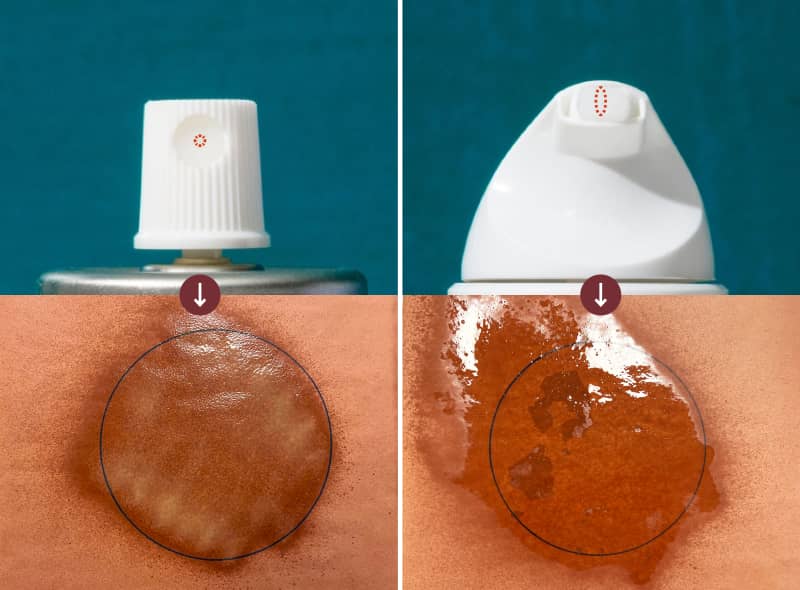
Traditional cooking sprays dispersed in a round spray pattern (left) whereas bag-on-valve cans sprayed in a vertical oval shape (right), as demonstrated on pieces of paper above. This is due to the design of the channel the oil travels up before being expelled. We preferred those that sprayed in a round spray pattern because it more efficiently covered the surface of our pans.
  • Straight Spouts: We preferred spouts that were angled straight ahead as they released spray directly in front of the can. We could anticipate where the spray was going to land, which helped us efficiently and cleanly cover our pans.
  • Moderately Powerful Spray: During testing we noticed that sprays left their canisters at different rates. Cans that dispersed mixture quickly, but not too powerfully, were best. With these baking sprays, we were able to cover the pan efficiently without excess spray splattering outside the pan.
  • Sprays with Starch: We found a few advantages to using sprays that contain a starch. The first was visibility. The combination of propellant and starch caused several sprays to become foamy and white or cream-colored as they left the can, making it easy to tell that our bakeware was evenly coated. The second advantage was easy release. This is key for ultrasticky recipes and recipes in which you’re using older bakeware or bakeware with a damaged nonstick coating. The third advantage is insulation. The starch in baking spray provides a small layer of insulation between the batter or dough and the pan. We specifically call for baking spray in our financiers recipe because that insulation helps form the ideal flat tops. Without it, the exterior of the financier sets first, while the middle continues to rise, resulting in a dome. This is especially important when baking in mini-muffin tins as the ratio of circumference to area is greater.
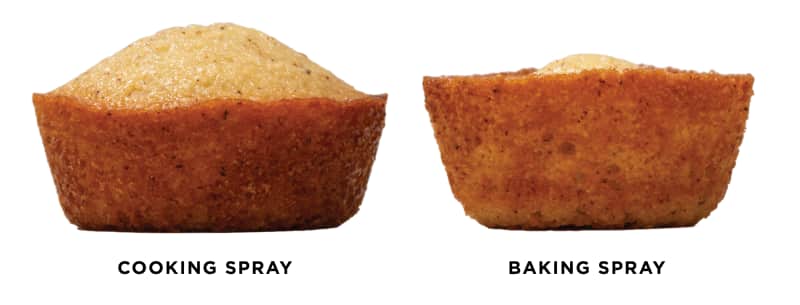
The starch in baking spray gives you extra insurance that your baked goods will release. The starch also provides insulation between the batter and the pan. That insulation helps form the ideal flat tops seen above. Without the insulation, the exterior of the baked good sets first, while the middle continues to rise, resulting in a dome.

What to Avoid

  • Elongated Oval Spray Patterns: One of the products in our lineup used a bag-on-valve system. Its spray pattern was shaped like a long oval, rather than a circle. We found it harder to control and cover the pan efficiently.
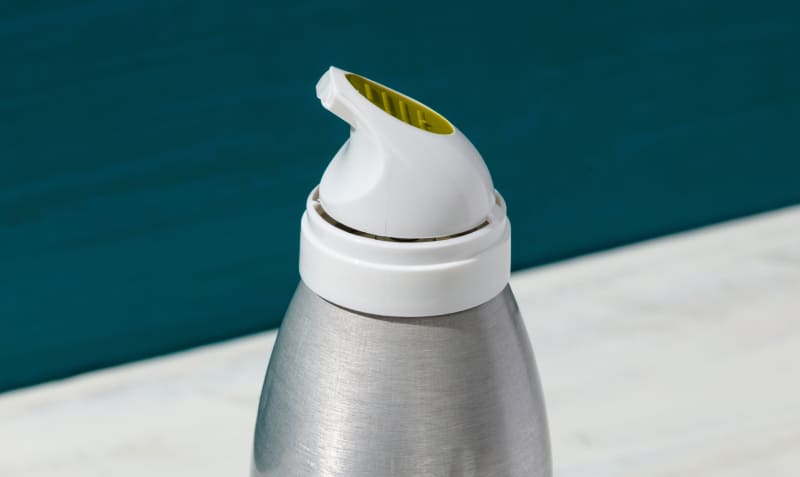
One of the sprays in our lineup had a spout that angled upward instead of straight ahead. This caused the spray to shoot out at an odd upward angle. When using this spray we often overshot the pan and sprayed the surrounding area.
  • Angled Spouts: The product we tested with the bag-on-valve dispensing system also had an angled spout that sprayed upward instead of straight ahead. This positioning made it harder to estimate where the spray would go, and we often missed the pan, covering the surrounding area instead.
  • Overly Powerful Sprays: One canister sprayed with such force that it reminded us of a fire extinguisher. Its spray radius was also larger than that of the other sprays and came out with such power that splatters flew outside of the intended area and around the kitchen.
  • Non-Aerosol Options: When testing one product, a liquid mixture that comes in a squeeze bottle, we placed a dime-size dollop in the pan and then used a paper towel to smear it over the inside of the pan. We didn’t mind spreading the solution by hand when using a simple 8-inch square baking pan, but we found the process to be tedious and time-consuming when using a more intricate Bundt pan or a muffin tin. While this product created a successful nonstick coating, we prefer the convenience of sprays.

The Tests

  • Bake Bundt cakes
  • Taste Bundt cakes to observe whether the sprays contributed any off flavors
  • Bake Cranberry-Pecan Muffins
  • Bake our favorite supermarket boxed brownies
  • Spray onto a 9-inch circle drawn on parchment paper and observe spray patterns

How We Rated

  • Ease of Use: We liked baking sprays that were easy to use and control. Products that had round spray patterns, were moderately powerful, and were visibly white or cream in color were easiest to use. 
  • Performance: Sprays that dispersed evenly to create a uniform thin layer were best. They ensured that baked goods slid out of their pans without sticking or tearing.

FAQs

It’s impossible to keep the area around where you’re spraying completely clean, but we found that spraying over a trash can or sink helps minimize the mess. That way any excess spray that misses the pan can be easily cleaned up. Avoid spraying directly over the floor as excess spray can be quite slippery.

We sometimes call for cooking spray when baking; however, we never call for baking spray when cooking. The starch in baking spray will scorch on the hot stovetop. Also, we don’t necessarily want flour in our savory food.

Everything We Tested

Highly Recommended

  • Ease of Use
  • Performance

Baker’s Joy Baking Spray with Flour

This spray was easy to use—its moderately powerful nozzle sprayed in a round spray pattern and thus landed exactly where we expected. A visible layer of foam, a combination of a propellant and starch, made it easy to see that the entire pan was covered in a thin, even layer. It was effective too. When we prepared pans with this spray, baked goods always slid out easily.

Ingredients: Soybean oil, propellant (n-butane, propane), hydroxylated soy lecithin, soy lecithin, enriched flour (wheat flour, niacin, reduced iron, thiamin mononitrate, riboflavin, enzyme, folic acid), silicon dioxide

Price at Time of Testing: $3.09 for 5 oz can ($0.62 per oz)

  • Ease of Use
  • Performance

This spray was easy to use—its moderately powerful nozzle sprayed in a round spray pattern and thus landed exactly where we expected. A visible layer of foam, a combination of a propellant and starch, made it easy to see that the entire pan was covered in a thin, even layer. It was effective too. When we prepared pans with this spray, baked goods always slid out easily.

Ingredients: Soybean oil, propellant (n-butane, propane), hydroxylated soy lecithin, soy lecithin, enriched flour (wheat flour, niacin, reduced iron, thiamin mononitrate, riboflavin, enzyme, folic acid), silicon dioxide

Price at Time of Testing: $3.09 for 5 oz can ($0.62 per oz)

  • Ease Of Use
  • Performance

Pam Baking Spray Made with Flour

We felt in control when using this can. The spray landed where we expected it to, and the visible foam made it easy to see that the pan was covered. It landed in second place because the consistency of the spray wasn’t as uniform as that of our winner’s.

Ingredients: Canola oil, palm oil, coconut oil, soy lecithin, wheat flour, silicon dioxide, natural flavor

Price at Time of Testing: $3.69 for 5 oz can ($0.74 per oz)

  • Ease Of Use
  • Performance

We felt in control when using this can. The spray landed where we expected it to, and the visible foam made it easy to see that the pan was covered. It landed in second place because the consistency of the spray wasn’t as uniform as that of our winner’s.

Ingredients: Canola oil, palm oil, coconut oil, soy lecithin, wheat flour, silicon dioxide, natural flavor

Price at Time of Testing: $3.69 for 5 oz can ($0.74 per oz)

Recommended with Reservations

  • Ease Of Use
  • Performance

Everbake Pan Spray

We loved this spray’s superfine mist that evenly coated pans. This spray was clear because it has no starch, and we had to pay closer attention to make sure that we covered every nook and cranny of each pan. While it passed all of the kitchen tests we performed using high-quality bakeware, you should be wary of using this in recipes that call for baking spray containing flour. If your nonstick pans are unreliable or you want extra insurance when making a sweet treat for a special occasion, it’s important to use a baking spray with starch.

Ingredients: Soybean oil, phosphated mono- and diglycerides, calcium carbonate, silicon dioxide, canola oil, water

Price at Time of Testing: $9.95 for 16 oz can ($0.62 per oz)

  • Ease Of Use
  • Performance

We loved this spray’s superfine mist that evenly coated pans. This spray was clear because it has no starch, and we had to pay closer attention to make sure that we covered every nook and cranny of each pan. While it passed all of the kitchen tests we performed using high-quality bakeware, you should be wary of using this in recipes that call for baking spray containing flour. If your nonstick pans are unreliable or you want extra insurance when making a sweet treat for a special occasion, it’s important to use a baking spray with starch.

Ingredients: Soybean oil, phosphated mono- and diglycerides, calcium carbonate, silicon dioxide, canola oil, water

Price at Time of Testing: $9.95 for 16 oz can ($0.62 per oz)

  • Ease Of Use
  • Performance

Bak-klene ZT All-Purpose Non-Stick Baking Spray

This spray passed all of our baking tests. The wheat starch and propellant in this spray combined make it visible, which allowed us to be sure that we covered the entire pan. Our biggest gripe was that it was hard to use. The superfoamy spray came out of the can with such intensity that it splattered outside of the intended area. It was messy and unnecessarily powerful.

Ingredients: Canola oil, mineral oil, wheat starch, sunflower lecithin, capric/caprylic triglycerides, natural flavor and propellant

Price at Time of Testing: $14.30 for 14 oz can ($1.02 per oz)

  • Ease Of Use
  • Performance

This spray passed all of our baking tests. The wheat starch and propellant in this spray combined make it visible, which allowed us to be sure that we covered the entire pan. Our biggest gripe was that it was hard to use. The superfoamy spray came out of the can with such intensity that it splattered outside of the intended area. It was messy and unnecessarily powerful.

Ingredients: Canola oil, mineral oil, wheat starch, sunflower lecithin, capric/caprylic triglycerides, natural flavor and propellant

Price at Time of Testing: $14.30 for 14 oz can ($1.02 per oz)

  • Ease of Use
  • Performance

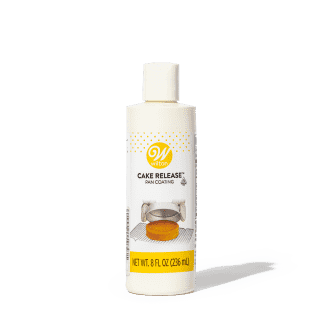
Wilton Cake Release Non-Stick Pan Coating

The only product in our lineup that wasn’t a spray, this liquid coating is a good option for bakers looking for a nonaerosol product to use when making sticky baked goods. However, we found it tedious and time consuming to spread the solution into all the intricate divots of Bundt pans and individual wells in muffin tins. We prefer the convenience of spray.

Ingredients: Soybean oil, corn starch, mono- and diglycerides, soy lecithin, mixed tocopherols (antioxidant)

Price at Time of Testing: $6.22 for 8 fl oz bottle ($0.78 per fl oz)

  • Ease of Use
  • Performance

The only product in our lineup that wasn’t a spray, this liquid coating is a good option for bakers looking for a nonaerosol product to use when making sticky baked goods. However, we found it tedious and time consuming to spread the solution into all the intricate divots of Bundt pans and individual wells in muffin tins. We prefer the convenience of spray.

Ingredients: Soybean oil, corn starch, mono- and diglycerides, soy lecithin, mixed tocopherols (antioxidant)

Price at Time of Testing: $6.22 for 8 fl oz bottle ($0.78 per fl oz)

Not Recommended

  • Ease of Use
  • Performance

La Tourangelle All-Purpose Baking Spray

While this baking spray kept baked goods from sticking, it was challenging to use. The label claimed that a light press on the spout would achieve a “drip or drizzle,” a medium press a “stream,” or a full press a “spray or mist.” While we eventually got the hang of it, achieving these results took practice. Our biggest complaint was that when we pressed fully on the spout, the spray shot upward. Lastly, the application of spray was shaped like a long oval rather than a circle, making it harder to cover the pan.

Ingredients: Canola oil, sunflower lecithin

Price at Time of Testing: $4.89 for 5 fl oz can ($0.98 per fl oz)

  • Ease of Use
  • Performance

While this baking spray kept baked goods from sticking, it was challenging to use. The label claimed that a light press on the spout would achieve a “drip or drizzle,” a medium press a “stream,” or a full press a “spray or mist.” While we eventually got the hang of it, achieving these results took practice. Our biggest complaint was that when we pressed fully on the spout, the spray shot upward. Lastly, the application of spray was shaped like a long oval rather than a circle, making it harder to cover the pan.

Ingredients: Canola oil, sunflower lecithin

Price at Time of Testing: $4.89 for 5 fl oz can ($0.98 per fl oz)

Reviews You Can Trust

The mission of America’s Test Kitchen Reviews is to find the best equipment and ingredients for the home cook through rigorous, hands-on testing. Have a question or suggestion? Send us an email at atkreviews@americastestkitchen.com. We appreciate your feedback!

The Expert

Author: Carolyn Grillo

Carolyn Grillo

Senior Editor, ATK Reviews

Carolyn is a senior editor for ATK Reviews. She's a French-trained professional baker.

Carolyn Grillo is a senior editor for ATK Reviews. She studied French patisserie at Le Cordon Bleu in Paris and worked as a baker before joining the review team. Her culinary background helps her evaluate bakeware and write about ingredients. Carolyn is also responsible for writing The Well-Equipped Cook, a weekly newsletter about kitchen equipment. Hailing from the land of Taylor ham and Italian delis (New Jersey), she has strong opinions about both and isn't afraid to share them.

*All products reviewed by America’s Test Kitchen are independently chosen, researched, and reviewed by our editors. We buy products for testing at retail locations and do not accept unsolicited samples for testing. We list suggested sources for recommended products as a convenience to our readers but do not endorse specific retailers. When you choose to purchase our editorial recommendations from the links we provide, we may earn an affiliate commission. Prices are subject to change.

Reviews You Can Trust.
See Why.

This is a members' feature.
America's Test Kitchen LogoCook's Country LogoCook's Illustrated Logo