
Since I was a kid, my family has celebrated children’s birthdays with cake mix that we bake in a Tyrannosaurus rex–shaped cake pan. When I smell those sweet, vanilla-scented cakes baking, I can practically hear people singing, “Happy Birthday.” Of course, cake mixes are ideal for more than just parties. The mixes generally require only kitchen staples—often just eggs, water, and oil or butter—and are usually easy to prepare. You can stir the ingredients together and get the cake into the oven in a matter of minutes, so you can bake cake even on a weeknight.
We’re not the only ones who always have cake mix on hand. Cake/cupcake mixes totalled more than $565 million in sales in 2024, according to data from Circana, a Chicago-based market research firm. Eighty-two percent of those sales came from three big brands: Betty Crocker, Duncan Hines, and Pillsbury. This trio was the starting point in our search for the best yellow cake mix. We rounded out our lineup with four additional brands. In our research, we discovered that yellow cake actually has two subcategories: yellow cake and “butter” or “golden” cake. We decided to test both varieties.
We prepared the cake mixes according to package directions and baked them in 13 by 9-inch pans. We then invited a panel of tasters to sample the cakes unfrosted so that everyone could focus their full attention on the cakes.
Bake Me a Cake as Fast as You Can (or Not)
Cake mixes promise simplicity, so we expected them to have straightforward instructions: Add wet ingredients to the dry and whisk to combine. To our surprise, half of the cakes had instructions that were more complicated than that. Several called for using a hand mixer at different speeds and for different amounts of time. One package instructed us to beat in the eggs one at a time, pausing to scrape the bowl each time, and then add milk in increments, alternating with the remaining cake mix.


Many package instructions called for the use of hand mixers at different speeds and amounts of time (left). We preferred when we could simply add all the ingredients to a bowl and whisk them together (right).
When it was time to bake, we carefully followed the packages’ instructions and ensured the oven temperatures were accurate and monitored with thermometers. Once we took the cakes out of the oven, we spotted more major differences. Some cakes were tall, with a uniform golden-brown appearance that reminded us of roasted marshmallows. Others were short and pale and felt sticky or tacky to the touch. As we sliced the cakes, several maintained their impressively fluffy stature; others crumbled onto the cutting boards.

Comparing the Flavor of Yellow Cake and Butter Cake
We were curious to see how the yellow cakes and butter cakes compared. For brands that sold both versions, we started by comparing the ingredient lists and nutrition information. Most were similar, but not identical. Duncan Hines and Pillsbury listed the same ingredients for their respective cakes but in slightly different orders, indicating that the ingredients are used in different quantities. Betty Crocker’s yellow cake mix was the same as its butter cake mix, except that it contained an additional “natural flavor.” As for nutrition facts, we sometimes saw a half-gram difference in fat, a few grams in sugar, or a few milligrams in sodium.


Some brands sell both yellow and butter cake mixes. Spotting differences between their ingredient lists required a keen eye.
All of the cake mixes required us to add eggs and some form of fat, as well as water or sometimes milk. There was a clear trend here. With the exception of one mix that called for both oil and butter, all the yellow cakes called for oil and all the butter cakes called for butter.
Butter adds great flavor and richness to food, but when we crunched the numbers from our tasting we realized that the top-ranked cake mixes were all yellow cakes made with oil. They had pleasant notes of vanilla, and our winner was also described as having a “creamy” flavor. Most of the butter cakes, on the other hand, had an overwhelming butter flavor, and some tasters described one cake as having an “artificial butter flavor” that reminded them of popcorn. They also had a nuttiness that reminded tasters of almond extract and coconut extract, both of which felt out of place in the cake. Manufacturers use artificial flavors and other proprietary blends of flavorings in their mixes, and it’s likely that those were the source of the unwanted flavors.
Which Cake Mixes Have the Best Texture?
In reading through our tasters’ comments, it quickly became clear that texture can make or break a cake. When we compared the textures of the cakes, they fell into two categories. The best ones had moist, pillowy textures that were easy to slice into big, tall portions. Our least favorites were much denser and drier. They crumbled like cornbread and didn’t look quite as celebratory. One cake was not even an inch tall.
All of the cake mixes contained flour, sugar, and leavening agents such as baking powder, just like cakes you would bake from scratch. Ingredients appeared on product packaging in order of volume, and we noticed that sugar appeared first on some ingredients lists while flour was the first ingredient on others. What really mattered was hidden further down in the ingredients list. The lowest-ranked samples were missing key ingredients that gave all of the other cakes a strong advantage: They didn’t have dough conditioners, which in this case were emulsifiers. Ingredients such as mono- and diglycerides, sodium stearoyl lactylate, and propylene glycol mono- and diesters are used in very small amounts to improve the texture of cake mixes by helping retain more air bubbles and produce a finer, softer, lighter crumb. Homemade cakes use techniques such as whipping eggs and creaming sugar to achieve lightness. Because of how mixes work, they don't include that sort of step, so they need other means of baking up light and delicate.

Of those high-ranked cakes with emulsifiers, we had a slight preference for cakes made with oil. As we’ve learned when developing recipes for cakes, oil-based cakes tend to be more moist when eaten because oil is liquid at room temperature while butter is solid.
Our Favorite Boxed Yellow Cake Mix: Pillsbury Moist Supreme Yellow Cake Mix
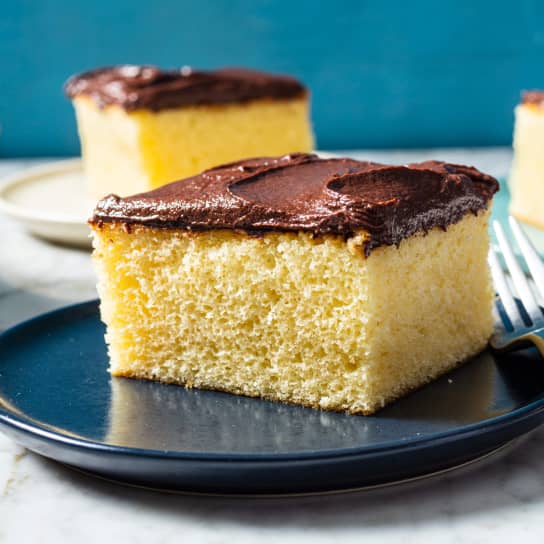
When shopping for a mix, we suggest skipping “butter cakes” and picking up a standard yellow cake instead. Pillsbury Moist Supreme Yellow Cake Mix emerged at the top of the rankings. Our tasters praised the cake’s “light” and “airy” texture. They also loved that it had a “familiar” and “classic” flavor and just the right amount of sweetness. The cake was beautifully golden brown and among the tallest of all the cakes we tested. It also had simple instructions and was easy to make, making it an excellent candidate for impromptu desserts as well as birthdays and special occasions.
- Prepare according to package instructions
- Taste plain
- Samples were randomized and assigned three-digit codes to prevent bias
- Yellow cake mix that calls for oil, not butter
- Light, airy texture
- Golden brown appearance
- Easy preparation and baking instructions