
Suffering from dinnertime fatigue? Consider chicken drumsticks. They may be unpretentious, but drumsticks outperform their poultry peers on almost every level.
Not only do legs have built-in handles to help you devour every meaty morsel but, unlike most other parts of the chicken, they’re also encased in skin that can be rendered paper-thin and golden brown, an edible wrapper to the gift of succulent, tender meat inside. Drumsticks are easy on the cook too: They don’t require trimming, and there is leeway in the cooking time since the collagen-rich, unctuous dark meat doesn’t easily dry out.
Then there’s economics: Drumsticks are easily the least expensive part of the bird.
With so much to love, I hatched a plan: Create a feast of juicy drumsticks—their skin thin, lightly crisp, and coated in potent spices—to be dipped into a spunky sauce and eaten by hand. What could be more fun and convivial?
Sign up for the Cook's Insider newsletter
The latest recipes, tips, and tricks, plus behind-the-scenes stories from the Cook's Illustrated team.
The Thriftiest Part of the Chicken

Drumsticks are a breeze to cook, rich in flavor, and fun to eat. They’re also quite a bargain. When we compared average prices for bone-in chicken breasts, thighs, drumsticks, and wings, we found that drumsticks were the most affordable—just one more reason to love them.
The First Legs
I kicked off my drumstick extravaganza with a time- and temperature-testing spree: evaluating long and slow roasting; experimenting with split methods (starting in a hot oven and finishing in a cooler one and vice versa); and considering salting and brining.
Ultimately, the easiest approach was also the best. I achieved terrific results by simply roasting the drumsticks in a 350-degree oven until they hit an internal temperature of 180 degrees (by this point, their connective tissue has dissolved into gelatin, turning the meat juicy and tender) and then flashing them under the broiler to deepen browning and ensure that as much fat as possible was rendered.
I placed the drumsticks on a wire rack set in a rimmed baking sheet for plenty of airflow, arranging them so their thick, meaty ends faced the hotter outside edge of the pan to produce the crispiest skin.
With my roasting method established, I wanted to try to conjure up a little kitchen magic: turning plain old drumsticks into a memorable meal by gussying them up with a potent spice rub.
I went for a bold, barbecue-esque blend that included salt and pepper, plenty of onion and garlic powders, brown sugar, smoked paprika, and cayenne for heat. The combination made sense on paper, but at the table, the spices came off as powdery and dry and tasted as if they hadn’t quite reached their full potential.

The Chicken Bible
Say Goodbye to Boring Chicken with 570+ Recipes for Easy Dinners, Braises, Wings, Stir-Fries, and So Much More
Shop NowSpicy and Saucy
I recalled a test kitchen recipe for broiled spice-rubbed snapper in which coriander, cayenne, and other spices were hydrated with water and then thinned with oil before being brushed onto the fish.
The water and oil helped unleash water- and fat-soluble flavor compounds in the various spices, giving them fuller, more penetrating flavors and aromas.
Sure enough, water and oil were just what the spice doctor ordered here too. Now my drumsticks hit all the notes with vivid sweetness, smokiness, and heat.
For Bolder Flavor, Hydrate Spices with Water and Oil

Before sliding our drumsticks into the oven to roast, we slather them with a slurry of heady spices that’s moistened with a couple spoonfuls each of hot water and vegetable oil.
Spice flavor compounds are largely fat-soluble; oil helps draw out those compounds so that their taste is as pronounced as possible. But some of the flavor compounds in spices are water-soluble, so it’s also crucial to add water to the slurry to ensure that all the spices’ complexities are fully realized. Water also softens the dry spices, making it easier for their flavor compounds to emerge into the oil.
Once the chicken is cooked, the water has a tertiary function of helping the spices hold on to their volatile flavor compounds.
For dipping, I mixed up a creamy white barbecue sauce (aka Alabama white sauce) by thinning mayonnaise with horseradish and cider vinegar and bumping it up with sugar, cayenne pepper, and black pepper.
The rich, lightly tangy sauce was a fitting foil for the smoky-sweet barbecue drumsticks.
A Strategic Arrangement Yields the Crispiest Skin

For well-rendered, mahogany skin, give the drumsticks plenty of air circulation by placing them on a wire rack set in a rimmed baking sheet. Arrange them so the bulbous sides face the edges of the pan, where it gets the hottest.
Inspired, I dug deeper into my spice cabinet and came up with a variation that zhuzhes up earthy store-bought curry powder with brown sugar and a few choices from the warm-spice canon: ginger, nutmeg, cardamom, and smoked paprika.
The result was toasty and savory, with a sweet finish. And because one good turn deserves another, I paired the curry drumsticks with a cooling cilantro-ginger yogurt sauce that’s tart with lime and sweet with a drizzle of honey.
Regardless of which version you try, be sure the table is outfitted with a big stack of napkins when you gather round to dig in to these succulent, boldly flavored drumsticks.

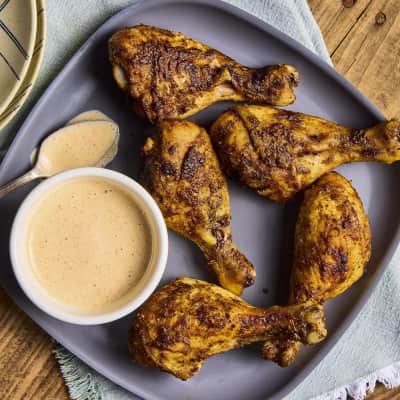
Barbecue Spice–Roasted Chicken Drumsticks with White Barbecue Sauce
Coated in gutsy spices, roasted to juicy perfection, and dunked in a creamy sauce, drumsticks make a finger-licking-good meal.
Get the Recipe
Curry-Roasted Chicken Drumsticks with Herbed Yogurt Sauce
Drumsticks coated in warm spices, roasted to juicy perfection, and dunked in a creamy yogurt sauce make a finger-licking-good meal.
Get the Recipe