


When the weather is balmy and company’s coming, South Carolina cooks haul out their stockpots.
They fill them with water or beer and generous shakes of dried spices and set them over heat until the liquid bubbles and steams. That’s the signal to add a bounty of bite-size morsels: chunks of golden corn, waxy potatoes, smoky sausage, and fresh-from-the-sea shrimp and/or crabs, which soak up the flavors of the warming, peppery spices as they cook.
Finally, the serving, which is even more effortless than the cooking—the feast is gleefully dumped atop a paper-lined table, and guests roll up their sleeves and dive into the pile with their hands, spritzing bites with lemon wedges, sprinkling on more spices, shaking out drops of hot sauce, or dunking in melted butter.
Sign up for the Cook's Insider newsletter
The latest recipes, tips, and tricks, plus behind-the-scenes stories from the Cook's Illustrated team.

It could be a gathering of a couple hundred people, or it could be just five of us catching up.
—BJ Dennis, chef and food historian
This is Lowcountry boil, the pinnacle of one-pot cooking. Cooks from the Lowcountry (the marshy coastland of South Carolina) have hosted boils for generations, transforming the region’s ample seafood into simple, delightfully tactile meals for their loved ones. The technique is as basic as can be—but the results are undeniably festive.
“It’s a celebration thing,” South Carolina chef and historian BJ Dennis said. “It could be a gathering of a couple hundred people, or it could be just five of us catching up.”
In its earliest shape, Lowcountry boil was likely little more than shrimp or crab itself, but it’s now common to see other elements in the pot too.
Corn, sausage, potatoes, and shrimp—a combination also known as Frogmore stew, as it was dubbed in the 1960s by a fisherman from the town of Frogmore—are now generally accepted as the roster of ingredients in a Lowcountry boil, though the recipe is certainly a flexible one. “Every family has their secret little tweak,” Dennis said.
Order in the Pot
For my Lowcountry boil, I wanted to preserve the simplicity that makes the dish such a boon for languid summer hosting—but at the same time, I knew making the boil wouldn’t be quite as simple as throwing it all in the pot.
To enjoy each ingredient at its best, I’d need to strategically stagger adding them to the water, starting with the longest-cooking (the potatoes) and ending with the swiftest (the shrimp).
For speed, I opted for quick-cooking baby potatoes. I tried tossing them in whole at first, and while they cooked up to my ideal creamy firmness, their flavor was lacking: The seasoned boiling liquid couldn’t permeate the potatoes’ skin before the tubers cooked through. So, I halved them to create a cut side that would allow the spiced boiling liquid to enter and flavor their interiors. As a bonus, halved potatoes would be even easier to eat and quicker to cook (cutting the corn into thirds also made it easier to eat).

For the sausage, I ended up taking the opposite strategy.
In early tests, I tried cutting chunks of my selected variety, andouille (smoked sausages are a typical choice for Lowcountry boil, and I liked the intensity this spicy, earthy type brought to the mix), but found that by the time the pieces had warmed, they had also lost their juices and fat to the pot, becoming leathery.
Tossing the links in whole worked better, as the intact casings trapped all the flavorful juices with the meat. The sausages emerged from the pot plump and ready to be sliced before serving.
Shrimp can overcook in a flash. Using shell-on jumbos would help—their larger size would provide a greater window of time before they overcooked, and the shells would insulate the delicate meat—but even a short stint in the boiling water rendered some of them too rubbery. So I killed the flame and then added the shrimp and covered the pot for a few minutes, and the residual heat trapped in the vessel cooked them through.
Spice Up the Boil (and Sauces) with This DIY Blend

A punchy spice mix is essential to Lowcountry boil, and while some cooks use store-bought spice blends, we opted to make our own for better control over the salt level of the dish. We incorporate the bright, warming blend into the dish in four ways: We not only use it to season the cooking water and garnish the finished food, as is traditional, but also to flavor our creamy, tangy rémoulade and our lemon-garlic butter for dipping.
A Bespoke Blend
Most recipes instruct the cook to make a heavily spiced boiling liquid, often using a blend such as Old Bay or Zatarain’s, and to sprinkle more of the same blend on the food at the table. These commercial blends worked well in the pot, but when I added the traditional extra sprinkle at the end, the food became too salty.
To better calibrate the salt level in the dish as a whole, I decided to whip up my own warming, piquant spice blend to use instead, which I also incorporated into a couple of simple accompaniments: creamy rémoulade and a rich lemon-garlic butter.
I spiked a stockpot full of water with my blend and tossed in a quartered lemon for brightness and a couple bay leaves for subtle earthiness. Once it was boiling, I added the potatoes, the sausage and corn, and the shrimp in turn.
By the time the shrimp were cooked through, all the other ingredients had also achieved perfect tenderness. I removed them from the water with a spider skimmer, sliced the sausages, and garnished the Lowcountry boil with that extra flourish of spices and some parsley for color.
As my tasters attacked the heap, freeing shrimp from their shells, nibbling at corncobs, and dunking chunks of potato and sausage in the sauces, they all agreed: All you need is this dish, a stack of napkins, and a cooler of beers to host this summer’s most spectacular feast.
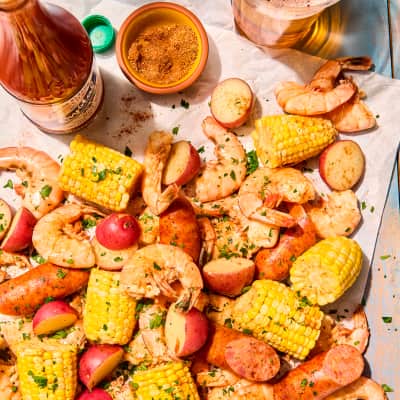
Lowcountry Boil
Nothing says summer like a heap of boiled and spiced corn, sausage, shrimp, and potatoes.
Get the Recipe