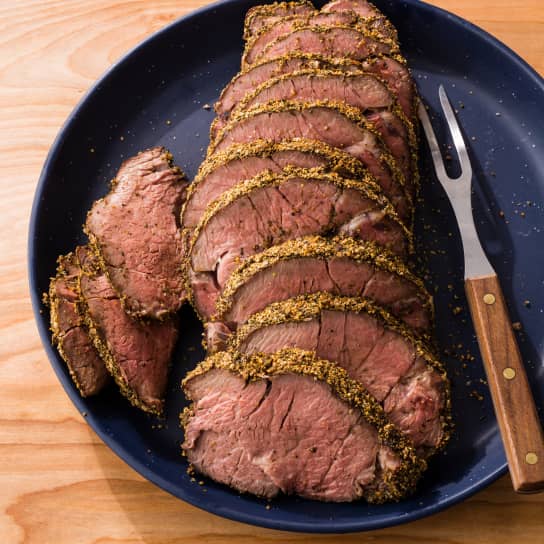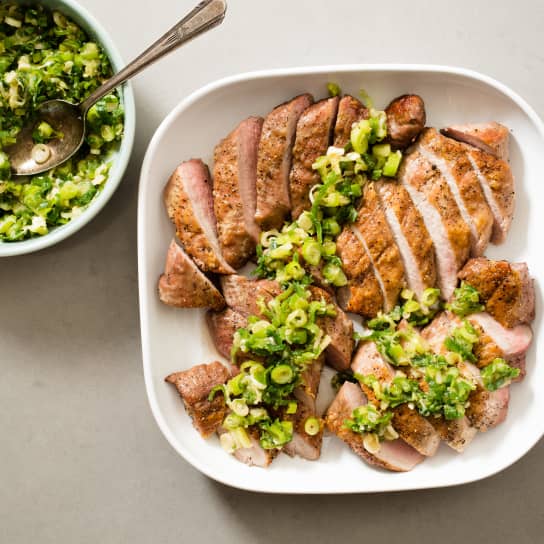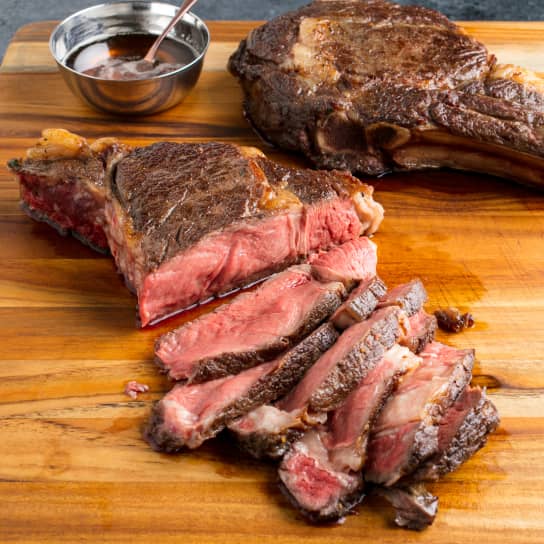
The U.S. Department of Agriculture (USDA) instructs us to cook meat to a safe internal temperature: namely, 165 degrees for poultry and 145 for beef and pork. But by the time it reaches those temperatures, meat, especially lean meat, has tightened up and lost a lot of its juiciness. Is that degree of cooking really necessary?
The temperatures provided are intended to kill off pathogenic bacteria in the meat in a hurry. But that’s not the only way to ensure safe meat.
Sign up for the Cook's Insider newsletter
The latest recipes, tips, and tricks, plus behind-the-scenes stories from the Cook's Illustrated team.
How to Ensure That Lower Temperature Meat Is Safe to Eat
Killing bacteria is always a matter of temperature and time. So, the exact same level of food safety can be achieved by cooking the meat to a lower temperature and ensuring that it stays at that temperature for a prescribed length of time. The lower the temp, the longer the time necessary to kill off any potential pathogens.
The Food Safety and Inspection Service of the USDA has published complete tables of times and temperatures for safe cooking. So, if we prefer the much juicier texture of a chicken breast that’s cooked no hotter than 150 degrees, a glance at the chart (on page 37 of that PDF) tells us that it’s necessary to hold the chicken at 150 degrees for just under 3 minutes in order to make it safe. (If we were cooking a chicken thigh, which contains more fat, we’d need to hold it for an additional minute, since fatty meat heats through more slowly than leaner meat.)
If we want to cook chicken to just 140 degrees, that’s safe too: this ultra-juicy temp, inside a crisped skin, is not uncommon in restaurant preparations! Safe, says the USDA, as long as it stays at that temp for a full 28 minutes. Sous vide is the easiest way to achieve that sort of long, low-temp preparation.
For beef, the idea is the same, but the numbers are different (see page 35). The standard USDA recommendation of 145 degrees actually assumes that the beef will stay at 145 for 4 minutes. If we want an instantaneously safe temperature, we have to go up to 158, where beef becomes dry and crumbly. A 135-degree steak is food-safe after its center has been at that temperature for 36 minutes—again, that’s optimally achieved with sous vide.

Sous Vide for Everybody
Sous vide cooking is easy, convenient, and hands-off. This cookbook demystifies sous vide cooking and gives you the tools to try exciting new dishes.
Buy NowCooking to a Lower Temperature Without Sous Vide
If you don't have a sous vide setup, it's still possible to achieve these time/temperature combinations. You just have have a probe thermometer and do some careful thermometer-watching to make sure that a safe temperature has been reached and held for a safe time. The specifics depend on what you're cooking and how. Lower-heat cooking methods such as poaching or roasting make hitting the target a lot easier than sauteing or grilling.
Often carryover cooking alone will do the job. For example, to cook a pork roast to 145°, take it out of the oven when the temperature of the coolest part of the center of the meat is 140°, and keep an eye on that temperature. As heat from the exterior of the meat travels to the center, it will climb to 145° and stay at or above that temp for a safe 4 minutes. Watch the thermometer to make sure it does, and you're good.
Safe Times and Temperatures for Cooking Chicken
via FSIS/USDA| Temperature | Time to Hold Lean Chicken Less Than 5% Fat | Time to Hold Chicken Up to 12% Fat |
|---|---|---|
145 °F | 8.9 minutes | 13 minutes |
150 °F | 2.7 minutes | 4.2 minutes |
151 °F | 2.1 minutes | 3.1 minutes |
152 °F | 1.6 minutes | 2.3 minutes |
153 °F | 1.2 minutes | 1.6 minutes |
154 °F | 1 minutes | 1.1 minutes |
155 °F | 47 seconds | 55 seconds |
160 °F | 15 seconds | 17 seconds |
165 °F | instantaneous | instantaneous |

Safe Times and Temperatures for Cooking Beef and Pork
via FSIS/USDA| Temperature | Time to Hold Red Meat |
|---|---|
130 °F | 2 hours and 1 minute |
135 °F | 37 minutes |
136 °F | 32 minutes |
137 °F | 24 minutes |
138 °F | 19 minutes |
139 °F | 15 minutes |
140 °F | 12 minutes |
141 °F | 10 minutes |
142 °F | 8 minutes |
143 °F | 6 minutes |
144 °F | 5 minutes |
145 °F | 4 minutes |

For the simplest preparations, of course, we can still cook meats to the highest USDA-approved temperatures, but knowing that safety is a function of both temperature and time opens up many more cooking options.