

Graze your way through one of the many night markets in Taipei, the alleyways bright with neon, the humid air thick with the mouthwatering aromas of o-ah jian (oyster omelet), chou doufu (stinky tofu), and sian su ji (popcorn chicken with fried basil), and you’ll spot stalls for gua bao (the name is Mandarin for “cut bun”).
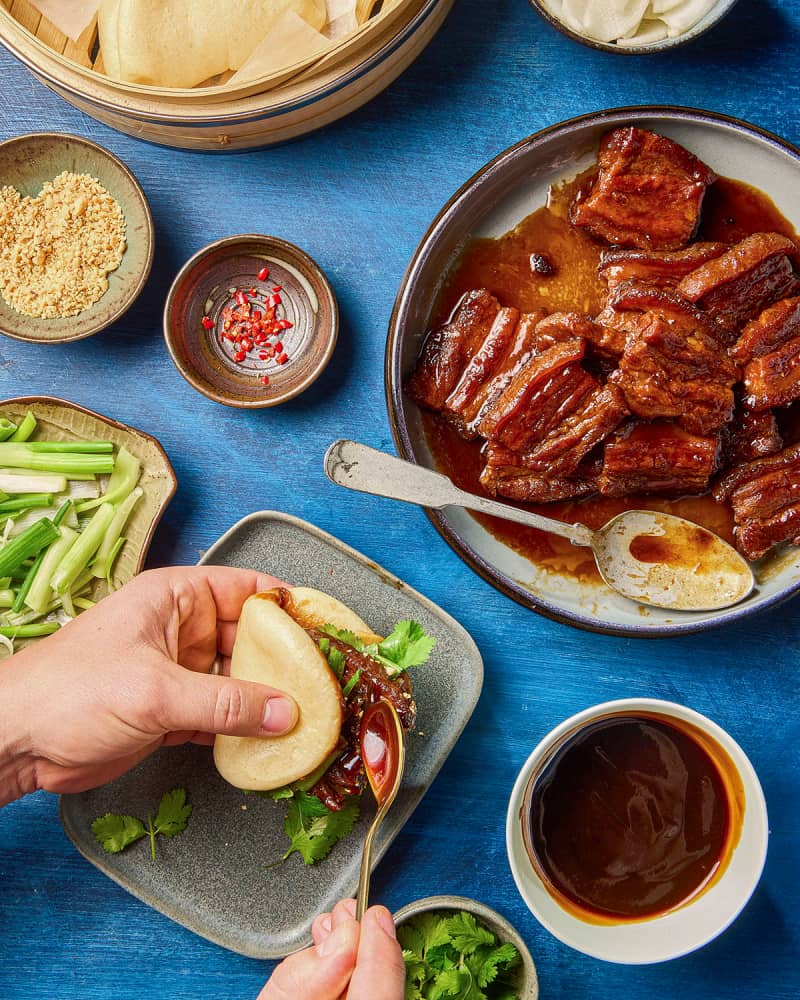
These palm-size breads are steamed in a folded shape to cradle unctuous red-cooked pork belly. Take a spot in line and watch as the merchant deftly cuts an outsize slab of the braised meat; tucks it into a downy bun; and tops the parcel with tangy fermented mustard greens, cilantro sprigs, and sugary peanut powder.

“[Gua bao] is more famous outside of Taiwan than it is inside Taiwan. It is a really special dish in that regard.”
—Clarissa Wei, author of Made in Taiwan
Clarissa Wei, author of Made in Taiwan (2023), joined me on a video call from her home in Taipei to discuss the portable snack that, in the past decade or so, has become a global phenomenon. Gua bao is such a common export, she said, that it’s actually now “more famous outside of Taiwan than it is inside Taiwan. It is a really special dish in that regard.”
American iterations of gua bao differ from what you’ll find on the subtropical island. There, the pork belly is the highlight of the sandwich, and, like a lot of Taiwanese food, Wei said, it’s very sweet—a result of the country’s long history of sugarcane farming. It’s also unapologetically fatty and garnished with a light hand. In the United States, she has noticed, ratios are different. Here, Wei said, you’ll find “dainty” amounts of leaner, savory meat generously decked out with a variety of toppings that pop with piquant, spicy, and fresh flavors.
I planned to take the less-traditional route with the filling and garnishes, but first I dove into what I consider to be the main event: soft, light-as-air steamed buns.
Sign up for the Cook's Insider newsletter
The latest recipes, tips, and tricks, plus behind-the-scenes stories from the Cook's Illustrated team.
What’s In a Name?

In Taiwan, “hu yao zhu,” or “tiger bites pig,” is a colloquial term for gua bao that refers to the way the night market staple resembles lips chewing pork. “Hu yao zhu” is also a homophone for “holding on to good fortune.” For this reason, and because the buns mimic wallets fat with money (symbolized by golden peanut powder sprinkled atop the pork), the sandwiches are also often served at business dinners.
Take a Bao
Commercially made frozen buns are widely available. Made with Hong Kong flour, a highly bleached style, they are startlingly white and as perfectly shaped as they are convenient. But I assure you that they are no match for buns made from scratch. Homemade buns—earthy with yeast, rich with milk, and lightly seasoned with sugar and salt—are a real treat. Often made with both yeast and a chemical leavener, the pocketed half-moons swell to a featherweight, lightly springy crumb. Factory buns are almost plastic-y in comparison.
If that’s not enough to convince you, then consider that homemade buns freeze and reheat flawlessly and come together easily: Just knead the ingredients in a stand mixer to develop gluten that builds elasticity and structure, and then set the dough in a warm spot to proof.
Once it’s fully risen, shape portions into small ovals, brush them with oil so the pocket doesn’t fuse together, and fold them into half-moons. Finally, leave the nascent buns to proof again for about 30 minutes. When they are puffy, transfer them to a bamboo steamer perched atop a pan of simmering water.
Hong Kong flour can be difficult to source. After a few rounds of experimenting, I chose to use all‑purpose flour for my dough, finding bread flour buns, with their higher protein content, too chewy, and cake flour buns, with less protein, too delicate. As for leavening, yeast-only buns fell short of my lofty goals. Adding baking powder noticeably improved their rise, so I included it in my recipe.
Shaping the Buns
After the kneaded dough rises for an hour, it’s time to shape the buns, which then rise for 30 minutes more before steaming. A chopstick helps maintain the half-moon shape as you move the buns onto squares of parchment. Use the paper to help transfer the buns to the steamer basket.

1. Cut, then pat into disks.

2. Pinch to form ball.

3. Round into smooth sphere.

4. Roll into oval.

5. Fold over chopstick.

6. Transfer to parchment.
I had started out using vegetable oil in the dough, per tradition, but things got interesting when I swapped in the vegetable shortening that I’d seen in a few modern recipes.
These buns were discernibly fluffier. It turns out that unlike liquid oil, solid shortening has the ability to trap microscopic air bubbles that develop in the dough during kneading. And since leavening doesn’t create bubbles—it only inflates teeny ones already in a dough—the more bubbles you start with, the more significant the rise.
Form and Function
Finally, I discovered a few tricks that made forming the buns a breeze. In early tests, the half-moons contracted into crescent moons during their second rise. That’s because folding and lifting the tender dough with my hands had stretched it out of shape.
Instead, I switched to using a chopstick, as many recipes suggest. Draped over the slender stick, the shape stayed true, and I could safely move each bun to a small square of parchment for its final proof. (The paper allows for easy transfer of the buns to the steamer and keeps the dough from sticking to its slats.)
A 5-minute rest after 10 minutes of steaming allowed the matrix of starch and protein in the skin of the buns to slowly cool and set so the buns didn’t deflate. Now I had perfectly shaped, beautifully risen breads.
The Incredible Lightness of Steamed Buns

The particularly light and airy crumb of our steamed buns can be attributed to a couple of factors. One is that the dough contains shortening rather than oil. Just as when butter and sugar are creamed together, the solid fat traps air during kneading in a way that liquid oil can’t, forming thousands of microscopic bubbles.
During proofing, abundant carbon dioxide gas produced by the dual leaveners of yeast and baking powder starts to inflate those bubbles, creating a delicately porous structure.
The fact that the buns are steamed instead of baked also contributes to their lightness. Baked goods form a hard crust when water evaporates from their surfaces in the dry air of the oven, leaving behind a rigid matrix of starch and protein. That crust has no elasticity; hence, it puts a halt to how much the crumb can expand. But cooked in a steam bath, the buns’ surfaces never harden. They stay pliable, so they expand considerably more and become plush and pillowy all the way through.
Into the Fold
On to the filling. Many braised pork belly recipes call for leisurely simmering a large slab of meat for hours and hours.
Instead, I divided a rectangular belly into slender pieces that would fit neatly into the buns. After a quick sear, I simmered the slices in the traditional “red cook” style, which consists of braising meat in soy sauce and fragrant spices. Along with the soy sauce, I stirred in oyster and hoisin sauces; Shaoxing wine; a touch of water; and a handful of aromatics, including star anise, ginger, and garlic. In a little over an hour, I had meltingly tender pork slices napped with a gleaming, savory glaze.
To celebrate, I threw a party in the test kitchen. I’d been freezing leftover fillings and buns during recipe development, so I simply reheated everything and set up a gua bao bar. Watching my colleagues tuck into buns overflowing with savory pork belly and all the fixings, I knew I’d captured the spirit of this delicious food.


Gua Bao with Braised Pork Belly, Seasoned Daikon, and Hoisin-Soy Sauce
Nestle salty-sweet pork belly inside their pillowy folds and savor the wonders of Taiwanese steamed buns.
Get the Recipe
Gua Bao with Braised Shiitake Mushrooms, Seasoned Cucumber, and Sriracha Mayonnaise
Nestle salty-sweet pork belly inside their pillowy folds and savor the wonders of Taiwanese steamed buns.
Get the Recipe