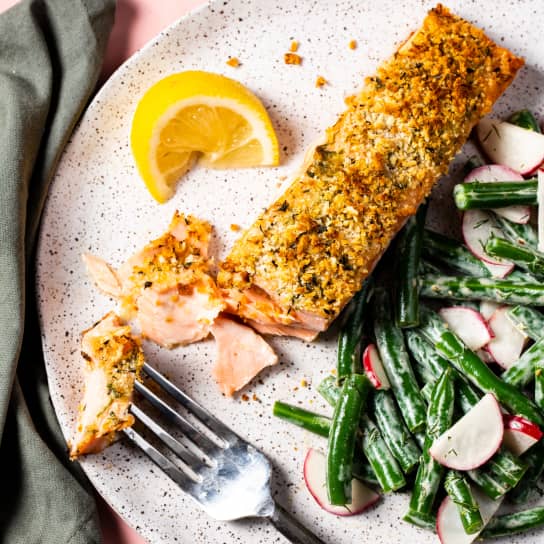

Every bite of a grilled salmon fillet is dynamic.
The char of the grill is the perfect foil for the fish’s richness, infusing the moist, flaky flesh and crackly-crisp skin with smoky complexity. Plus, grilling presents perks to the cook: The intense heat cooks the salmon speedily, and any fishy aroma stays outdoors and out of your kitchen.
There’s just one problem: It’s not easy to get salmon off the grill in one piece. The fish tends to cling tenaciously to the grate—so it’s all too easy to end up with a pile of errant pink flakes rather than a beautifully grill-marked fillet.
Sign up for the Cook's Insider newsletter
The latest recipes, tips, and tricks, plus behind-the-scenes stories from the Cook's Illustrated team.
A Sticky Situation
Food sticks to cooking grates (and pans, for that matter) when bonds form between sulfur-containing amino acids in the food’s proteins and the iron atoms in the grate.
Fortunately, though, these bonds will eventually break when exposed to high enough heat for a long enough time.
I thus knew I’d need to work with thicker fillets that could stand up to the heat long enough to allow good browning to develop.
So I chose a thick, 1½-inch skin-on center-cut piece and cut it into four fillets that I prepped simply, drying them with paper towels (moisture thwarts browning), brushing them with oil to encourage color and create a barrier between the grate and fish, and seasoning them with salt and pepper.
After carefully cleaning my grill of any leftover residue that could encourage sticking, I heated it on high and then turned it down to medium after I placed the fish on the grate. While it might seem counterintuitive to cook delicate fish so fiercely, the high-heat start is essential when grilling meat and fish for breaking their bonds with the grill.
Science: Prime Salmon for the Grill

Paint this three-ingredient sauce onto each fillet to minimize sticking and maximize browning and flavor.
MAYO contains fat that keeps the fish from sticking. Its proteins and sugars also speed and enhance browning.
HONEY adds reducing sugars so that the fish browns more quickly.
FISH SAUCE is glutamate-rich, bringing an underlying savor that enhances the fish’s flavor just enough to stand up to the char from the grill.
I opted to arrange the fillets skin side down, expecting that the skin would both hold the fillet together and make it easier to flip and also protect the flesh from the intensity of the grill.
But when I attempted my first flip, the partially cooked flesh broke apart. So I tried again, starting the fish flesh side down.
This time, when I went to flip the fish, it was firm enough that it didn’t break apart. But at the end of the cooking time, browning was still pretty moderate—and I had to gently peel the fillets from the grill. They weren’t truly no-stick just yet.

Foolproof Fish
Want to broaden your seafood scope? No matter what you buy from the fish counter, this award-winning book will teach you how to cook it.
Buy NowStick Less, Brown More
I wanted better browning, both for flavor and to help the fish release more easily, so I borrowed a surface treatment from our Grilled Whole Trout recipe, in which the fish is brushed with a mixture of mayonnaise and honey.
The reducing sugars in the honey, glucose and fructose, help speed up the Maillard reaction, which would result in deeper color and flavor. The mayonnaise helps distribute the honey on the fish’s surface—water-based honey won’t combine with oil alone, but since mayonnaise is an emulsion of oil droplets suspended in water, the honey can dissolve into the water portion, allowing it to evenly disperse—and its fat lubricates the fish, staving off sticking. Mayonnaise also contains extra protein and sugar, which speeds and enhances browning once the water in it has cooked off.
For Great Grilled Salmon, Positioning Matters Too

1. Start fillets flesh side down: his firms up the flesh, making it more resilient when flipped.
2. Place the fish diagonally across the grates: This creates the most attractive grill marks.
I brushed a thin, even coating of the thick mixture on the tops and bottoms of the fillets before seasoning them and grilling them as before. While the honey and mayonnaise didn’t contribute any perceptible flavor, their impact was obvious: The salmon was deeply browned, moist, and crisp-skinned, and it released from the grill with ease.
Feeling like I’d finally cracked the code on grilled salmon fillets, I took the opportunity to add one more ingredient to the mayonnaise mixture—a couple teaspoons of fish sauce for an underlying savoriness that enhanced the salmon’s flavor just enough to stand up to the char from the grill.


Perfect Grilled Salmon
At last, you can have it all: rosy fillets with deep char and crisp skin that actually come off the grill in one piece.
Get the Recipe
Peach and Double-Mustard Chutney
A burst of tangy-sweet flavor from a fruit chutney is an easy way to dress up any type of grilled or roasted protein.
Get the Recipe
Blueberry-Ginger Chutney
A tangy, savory-sweet chutney is an easy-to-make condiment that can elevate any type of grilled or roasted protein.
Get the Recipe
Burst Cherry Tomato and Jalapeño Chutney
This easy, robust-tasting chutney is the perfect condiment for grilled salmon or any kind of grilled or roasted protein and can be made year-round.
Get the Recipe