


For a food to be genuinely mouthwatering, it must light up all your senses.
Sichuan’s kou shui ji boldly delivers. In fact, just the sight of the dish known as mouthwatering chicken whets the appetite: Feast your eyes on the neon chili oil sauce glistening atop slices of cool chicken. Inhale the potent aromas.
You’ll get whiffs of nutty sesame oil mingling with the gentle acidity of black vinegar and the floral, citrusy pull of Sichuan peppercorns. Your tastebuds will be enthralled by the flavors: savoriness, sweetness, sourness, and surges of prickly heat, all supported by the appealing neutrality of tender poached poultry.
Sign up for the Cook's Insider newsletter
The latest recipes, tips, and tricks, plus behind-the-scenes stories from the Cook's Illustrated team.

This is one of those default dishes that you always order. Always.
—Chinese cooking authority Maggie Zhu, author of the blog Omnivore’s Cookbook
Culinary educator Maggie Zhu, author of Chinese Homestyle (2022) and the blog Omnivore’s Cookbook, zeroed in on the enormous popularity of mouthwatering chicken when we sat down to chat. “This is one of those default dishes that you always order [in a Sichuan restaurant]. Always,” she said. “Everybody loves it.”
Mouthwatering chicken falls into a category of Chinese food called “liang cai,” which directly translates to “cold dish,” though when I asked Chris Thomas of the popular YouTube series Chinese Cooking Demystified about the tradition, he clarified that these “intense” dishes are often served at room temperature. Because liang cai are typically made ahead, he said, they’re terrific for starting a meal or for interspersing with time-consuming and/or hot dishes.
What Makes It Mouthwatering?

Sichuan cuisine recognizes at least 23 distinct flavor combinations, or fuhewei, one of which is the evocative hong you (red-oil) flavor. This profile features spicy Sichuan chili oil balanced with salty, sweet, sour, umami, and fragrant tastes. Mouthwatering chicken is a favorite hong you dish; in fact, the terms “hong you” and “mouthwatering” are often used synonymously.
To make the mouthwatering dressing, the red oil is mixed with salty, umami-rich soy sauce and Sichuan peppercorns for tingly heat. Fragrance comes via nutty toasted sesame oil, and sugar and black vinegar provide undercurrents of sweet and sour.
Poaching the Poultry
Either a whole poached bird or bone-in parts can be used for kou shui ji. Hacked into pieces with a cleaver, the meat is perfectly tender and the skin has a sought-after texture that’s supple and slightly chewy. I opted for bone-in, skin-on chicken thighs: The dark meat would stay juicy, and the thighs would be a breeze to debone prior to cooking for easy eating.
To ensure succulent results, it was imperative to poach the chicken gently. Chinese chefs often use a steeping method that entails starting in cold water, bringing it to a simmer, and shutting off the heat once the water is bubbling. This way, the chicken can coast leisurely to its doneness temperature, and the skin can develop the “really nice, firm texture” that Zhu said is a hallmark of the dish.
Following suit, I deboned four skin-on thighs and arranged them in a metal steamer basket to prevent them from bobbing around in the pot. To create a tidy, plump appearance, I tucked any thinner portions of the meat under itself, pulling the skin taut.
After lowering the setup into a Dutch oven full of water, I brought everything to a simmer, covered the pot, and let the chicken finish cooking off the heat.
Once the thighs reached 175 degrees, which took about 10 minutes, I transferred them to a cutting board to cool while I prepared the dressing.
The Tradition of Liang Cai

In Chinese cooking, there is a broad class of dishes called liang cai (sometimes translated as “salads”) that are served cold or at room temperature. Typically centered around a single protein or vegetable and coated in a lively dressing, the flavor-packed, aromatic dishes are designed to “kai wei” (whet your appetite).
Because liang cai are prepared in advance and often require minimal cooking, they arrive quickly at restaurant tables and are the customary opener at banquets, where a selection may be served in an ornate lacquered box. The convenience and enticing flavors of liang cai make them a mainstay on home tables too. In addition to mouthwatering chicken, other common examples are pai huang gua (smashed cucumber salad), liangban mu’er (wood ear mushroom salad), and suanni bairou (garlic pork belly).
Devising the Dressing
The primary ingredient for the dressing is hong you, a chili oil with full-on flavor and a brilliant red color. Hong you can be purchased. but it’s so much better when you make it yourself, and it’s easy to do. To make mine, I heated 1/3 cup of vegetable oil in the microwave with a smashed garlic clove and a chunk of fresh ginger root.
Once it was bubbling, I stirred in 3 tablespoons of Sichuan chili powder, which stained the oil deep red. Typically made from a blend of chiles, the powder has a strong fragrance and fruity-hot flavor. After letting the mixture infuse for 10 minutes, I strained out the solids, leaving the luminous oil behind.
To turn the oil into the mouthwatering dressing, I rounded it out with a handful of potent pantry ingredients, starting with Chinese black vinegar, whose distinctive woodsy backbone is overlaid with moderate acidity.
Then I poured in a little soy sauce for salinity and umami depth, stirred in a couple spoonfuls of sugar for understated sweetness, and drizzled in some toasted sesame oil for deep roasty fragrance.
I finished with toasted and ground Sichuan peppercorns, which would offer their signature tingly effect.

When you’re ready to serve, slice the cool chicken crosswise 1/2 inch thick, taking care not to tear its velvety skin, and arrange it on a shallow serving platter. Spoon a sumptuous pool of the red oil sauce on top and garnish with lots of toasted sesame seeds, fresh cilantro leaves, and thinly sliced scallion greens.
Grab a slice of chicken with your chopsticks and dip it into the vibrant sauce. Your senses will delight in the culinary razzle-dazzle, and your mouth will surely water.
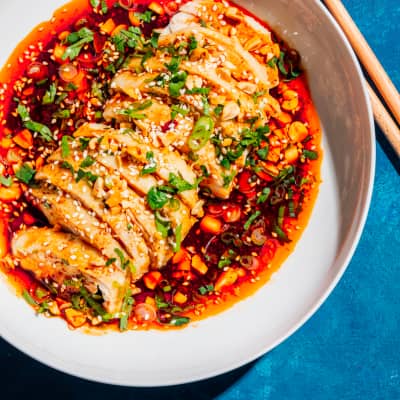
Kou Shui Ji (Mouthwatering Chicken)
The cold Sichuan dish called kou shui ji lives up to its tempting name with electric flavors, colors, and aromas.
Get the Recipe