


"You’d be hard pressed to find a single Caribbean [or Latin American] dish that isn’t complemented by tostones,” said food historian Von Diaz when we connected to discuss the iconic twice-fried green plantains.
Diaz, the author of Islas: A Celebration of Tropical Cooking (2024) was passionate about tostones’ impressive roster of assets: “They’re good, they’re cheap, they’re easy to make,” she enthused, “and everyone can put their spin on them.”
Sign up for the Cook's Insider newsletter
The latest recipes, tips, and tricks, plus behind-the-scenes stories from the Cook's Illustrated team.
There are numerous spins indeed.
On the island of Puerto Rico, where Diaz was born, tostones might be the hearty carb to round out a meal or be enjoyed as an appetizer with mayoketchup for dipping and icy cold beer on the side.
In Haiti, the tender-and-crunchy disks are called bannann peze and served alongside crispy pork and pickled vegetable relish. Travel farther south to Peru, and you’ll find them referred to as patacones and dipped in a punchy ají verde sauce. The list goes on, from one cuisine to another.

They’re good, they’re cheap, they’re easy to make, and everyone can put their spin on them.
—Von Diaz, food historian and cookbook author
Falling from Trees
The plantain, a fruit that Diaz calls “remarkable, important, and versatile,” was first introduced to the Caribbean and Latin America by Spanish colonists.
Initially, plantains gained traction as an affordable, filling ingredient for enslaved workers. Over time, as African agricultural and culinary traditions shaped plantain cultivation and preparation, the fruit became a key crop for the general population.
“When you have an abundance of this thing,” explained Diaz, pointing out that plantains “are literally falling from the trees” in many areas, “you try to find every single possible thing you can do with it.”
That bounty also led to cooking with plantains at every stage of maturity, including the unripe phase that’s used for tostones.
Like many young fruits, green plantains are sturdy (they won’t crumble or break apart when submerged in a soup or stew) and their flavor is squarely savory, with a subtle tang.

Peeling Green Plantains
Look for fruit with no yellow or black spots. Start by cutting off both ends.

1. Score the skin by making one shallow cut lengthwise (be careful not to cut the flesh underneath).
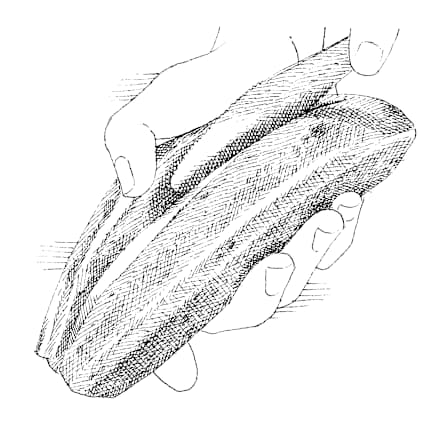
2. Using a dinner knife or thin, flat spoon, gently begin to lift the skin from the flesh, working along the scored line.
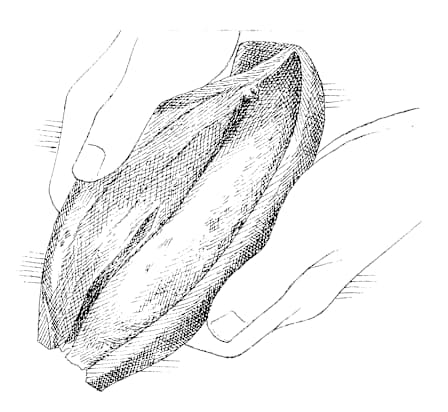
3. After about 1 inch of skin is lifted, slide your thumb under the skin; use a sweeping motion to remove the skin.
Fry and Smash
The framework for frying the plantains is similar across cuisines: First, remove the peel and cut the flesh into fat chunks. Fry the chunks, press them into thin disks, and then fry them again.
The goal of the first fry is to transform the raw, chalky texture into one that’s tender and lush.
A low-and-slow approach worked best: It took just 5 or 6 minutes in 300-degree oil to gelatinize the starch and soften the flesh without drying out the crust. Using a generous amount of oil, rather than shallow frying, was also essential for producing evenly ochre exteriors without any tough, overly browned spots.
The most effective way to press the cooked chunks into uniform disks was the traditional one: using a tostonera (plantain press). It’s a satisfying process: As the chunks are smashed, they open like flowers, with the edges splaying into petallike forms, the black seeds acting as the center of the bloom.
A Saltwater Dunk Leads to Puffed Edges and Velvety Centers

The first time we fry our tostones, evaporation drives out much of the moisture held by the plantains’ abundant starch. In order to create creamy centers and extra-crunchy, lightly inflated edges, we dunk the once-fried disks in salty water and let them rest briefly. In addition to seasoning the fruit, this step partially rehydrates the dry starch. When the plantains are returned to the hot oil, the additional water they’ve absorbed quickly turns to steam and forces its way out of the flesh, lightening the texture of the tostones and causing their edges to puff. —Paul Adams
Fry Again
The goal of the second fry is to generate crispness on the exteriors, and I found that cranking up the heat—3 minutes in 375-degree oil—did the job.
There was just one more important test to run. I had read about a traditional Puerto Rican technique that calls for briefly submerging the pressed, once-fried plantains in salt water, so I gave it a try.
It worked beautifully. The saline bath coated the broad surface area, seasoning the tostones much more thoroughly than simply sprinkling on salt at the end of the second fry. And the textural benefits were striking: During a brief rest on a wire rack, the salt water permeated and hydrated the flesh, leading to softer, silkier interiors.
Submerged in bubbling oil, the salt water–dunked tostones sizzled and puffed, developing frilly, ultracrunchy edges. I now had perfect tostones to serve as the backbone of countless meals and gatherings.
Tostonera

A simple tool comprised of two wooden (or sometimes metal) plates, a tostonera makes quick work of flattening chunks of fried plantain by providing leverage to smash the fruit. Basic versions can be purchased online for less than $10; artisanal ones run about $40. A clear drinking glass makes a good substitute since it allows you to monitor the thickness and uniformity of the tostone.

Crispy Fried Plantains (Tostones)
Fried green plantains are all about contrast: crackly, caramelized edges and soft, buttery centers.
Get the Recipe