
 Buy at ThermoWorks

 Buy at Amazon
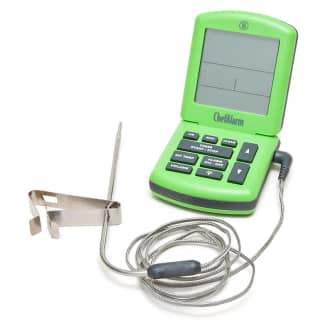
The best leave-in thermometers are accurate, easy to use, and capable of measuring high temperatures. Our co-winners are the ThermoWorks ChefAlarm and ThermoWorks Square DOT. The ChefAlarm has a single probe and is rich with special features, including a timer, both high- and low-temperature alarms, and maximum and minimum temperature recording. The Square DOT is a much simpler tool that comes with two probes, allowing you to take the temperatures of two things simultaneously—two foods, two locations on the same food, or food and air. It also has a feature that lets you take running average temperatures, which comes in handy for testing your oven’s accuracy; we’ve named it our favorite oven thermometer as a result. Neither is cheap, but both are durable, useful, well-designed tools; ultimately, the choice of which to get depends on how you intend to use your thermometers most frequently. We also recommend the ThermoPro TP16 as our Best Buy. This no-frills model is highly accurate; it’s just got a few quirks that make it a little less smooth to operate.
If you want a thermometer that takes temperatures much more quickly, check out our review of instant-read thermometers.

A good digital leave-in thermometer is a truly versatile instrument that measures temperature over time. We most commonly use these handy tools to monitor the temperature of long-cooking foods—a roast turkey or brisket, for example—without ever having to open the oven or grill. But leave-in thermometers can also be used to track the temperatures of oil when you’re deep-frying and sugar syrups when you’re making candy. They can even be used to take air temperatures—in fact, they’re our top choice for checking the accuracy of your oven.

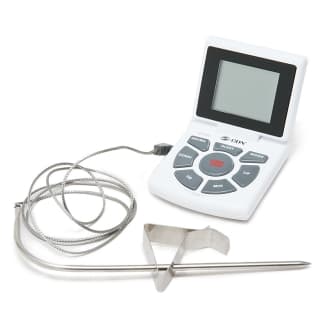
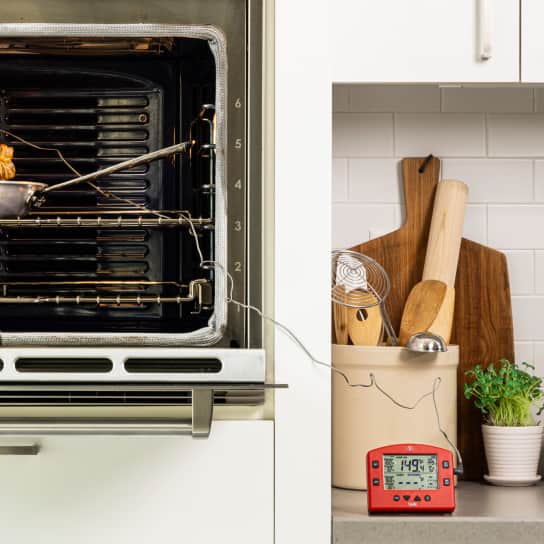
All leave-in thermometers work the same way. They have two basic parts: a display and a temperature probe attached to a heat-resistant wire. You connect the wire to an input on the display. Then, you insert the probe into your food, oil, or syrup, or stick it in the air, and, as the thermometer’s name implies, leave it there. The wire transmits data from the probe to the display, so you get a constant readout of temperatures as they change.
You’ll need a pot clip to attach the probe to your cookware while deep-frying or making candy, and you might find it handy to have a separate grate clip to test your oven temperatures, though you don’t absolutely need one. Most leave-in thermometers don’t come with both accessories, so if you plan to use your thermometer often for these tasks, see our recommendations below in the FAQ, “What should I use to stabilize my digital thermometer?”
What to Look For
- Accuracy: Accuracy is paramount, as anyone with a faulty thermometer knows. A few degrees in the wrong direction can spell scorched caramel or soggy fried chicken. Our favorite models were accurate within a degree of the correct temperature, as evaluated by a lab-grade thermometer.
- Relatively Fast Response Time: A lightning-fast response time isn’t as essential for a leave-in thermometer as it is for an instant-read thermometer. That’s because, in general, temperatures change much more slowly during most of the tasks you use a leave-in thermometer for, such as roasting a turkey or heating oil for frying—you’re not going to see big shifts over the course of 5 seconds. Still, a moderately speedy response time is better than a slow one, especially if you’re making candy. We preferred models that read out the right temperatures relatively quickly.
- Simple Interface: We liked leave-in thermometers with well-labeled buttons that made it a cinch to set temperature alarms or choose other functions.

- Large, Clear Displays: We liked thermometers with large displays that made it easy to read out temperatures.
- Higher Temperature Maximums: We liked thermometers that could take and withstand temperatures above 500 degrees. These were more versatile than thermometers that had much smaller temperature ranges, allowing us to safely monitor the temperature of hot fry oil and blazing-hot ovens. That said, if you only plan on using your thermometer in lower-heat applications—monitoring meat temperatures, for example—a smaller temperature range can be fine.
Nice to Have
- Extra Functions: Most users won’t need their thermometer to have functions beyond a high-temperature alarm, which tells you when your food or oil or sugar has risen to your target temperature. But some of our test cooks also appreciated models that had a low-temperature alarm. This comes in handy if you’re frying and don’t want your oil temperature to drop below a certain point—some food can get soggy if fried at cooler temperatures—or if you’re monitoring the air temperature inside a smoker or grill and don’t want it to get too low. We also liked models that had a built-in timer, letting us count down the cooking time or count up the amount of time that had elapsed. And one of our co-winners also has the ability to take running average temperatures instead of current ones—this comes in handy when you’re testing the accuracy of your oven’s settings, as oven temperatures can fluctuate during use but still be on target when averaged out. A few models had other features, including preset alarms for the doneness of different proteins, or the minimum and maximum temperatures achieved during a cook. Our top picks have different levels of sophistication. One of our co-winners is very feature-rich, while the other co-winner and our Best Buy are much simpler.
- Extra Probes and Inputs: Most leave-in thermometers can only use one probe at a time, and that single probe should be more than adequate for the average home cook. But it can sometimes be handy to have a thermometer that can take two or more probes. With two probes, you can monitor air temperature and food temperature simultaneously—a useful thing if you’re making barbecue and want to manage the heat on your grill or smoker, for example. You can also take the temperature of two pieces of food at once, or the temperature of two different locations of the same food—the breast and thigh of a turkey, for example. Basically, the more probes you have, the more information you’re able to gather about your food and cooking conditions. One of our co-winners has a single probe, while the other comes with two; the choice is ultimately yours.
What to Avoid
- Inaccuracy: An inaccurate thermometer is worse than no thermometer at all, giving you temperatures that will compromise your final dish.
The Tests
- Evaluate accuracy using ice bath and lab-grade thermometer
- Double-check all temperatures taken throughout with lab-grade thermometer
- Monitor oil temperature when making French fries and fried chicken
- Monitor candy temperature while making caramel sauce
- Monitor roast pork loin temperatures
- Monitor brisket and grill air temperature (where applicable)
- Monitor oven temperature
- Evaluate compatibility with a range of cooking vessels
How We Rated
- Accuracy: We rated the thermometers on how accurate they were.
- Ease of Use: We rated the thermometers on how easy they were to use in different applications.
- Functionality: We rated the thermometers on how versatile they were and how many special features they provided.