America's Test Kitchen LogoCook's Country LogoCook's Illustrated Logo

Reviews You Can Trust.
See Why.

The Best Infrared Thermometers

Infrared thermometers let you take cookware temperatures instantly. Does it matter which one you buy?

Headshot of Miye Bromberg
By Miye Bromberg

Last Updated June 25, 2025

What You Need To Know

The best infrared thermometers are accurate under controlled conditions, easy to set, and comfortable to hold. They allow you to adjust for different emissivity values, have high distance-to-spot ratios, and provide highly visible laser guides. Our favorite is the ThermoWorks Industrial IR with Circle Laser, which ticked all these boxes. We also recommend the Etekcity Infrared Thermometer Laser Grip 1022 as our Best Buy. It has a slightly undersized handle and a simpler laser guide, and it’s not quite as accurate as our favorite, but it'll still give you useful, reliable ballpark temperatures. And at a third of our winner’s price, it’s a very respectable no-frills option.
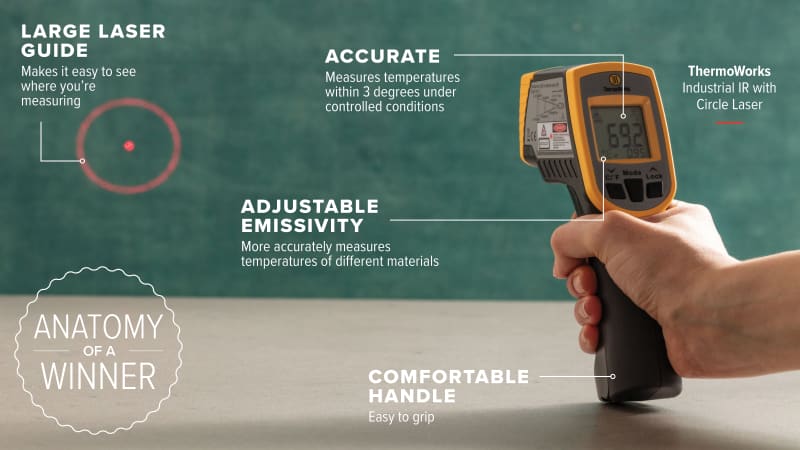
our winning infrared thermometer by Thermoworks

Infrared thermometers give you the surface temperature of any object quickly and can do so from relatively far away without making contact with the object itself. They’ve long been used in industrial scenarios to help find hot or cold spots that indicate problems in machinery, ducts, plumbing, or other building systems. In recent years, they’ve become more common in commercial kitchens as well. We were curious to find out whether they were useful for home cooks, so we bought a range of models and put them to the test.

We were intrigued by what we found. A few things to note: Because infrared thermometers measure surface temperature, not internal or air temperatures, they can’t tell you whether your steak is done (you’ll need an instant-read or meat thermometer for that) or whether your oven has preheated sufficiently (you’ll need an oven thermometer for that).
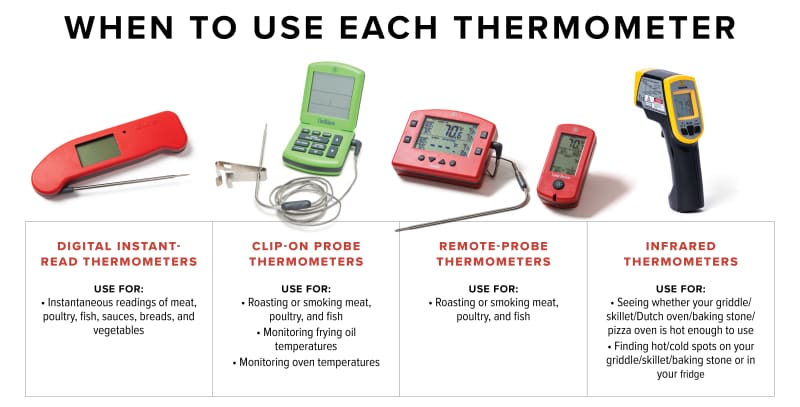
We've tested several types of thermometers over the years. Here's a rundown of each type and what they excel at.

More critically, they don’t always report temperatures as accurately as an instant-read thermometer does—in our tests, even the most accurate models sometimes gave temperature readouts that were off by as much as 100 degrees. This is not necessarily the fault of the thermometer. Under controlled conditions, many infrared thermometers are perfectly capable of being accurate. But in real life, the thermometers are sensitive to a host of factors that can interfere with their ability to measure temperatures correctly. These can include the angle at which you use the thermometer, the shininess of the object whose temperature you’re measuring, the humidity/clarity of the surrounding air, and the temperature of the thermometer itself during use.
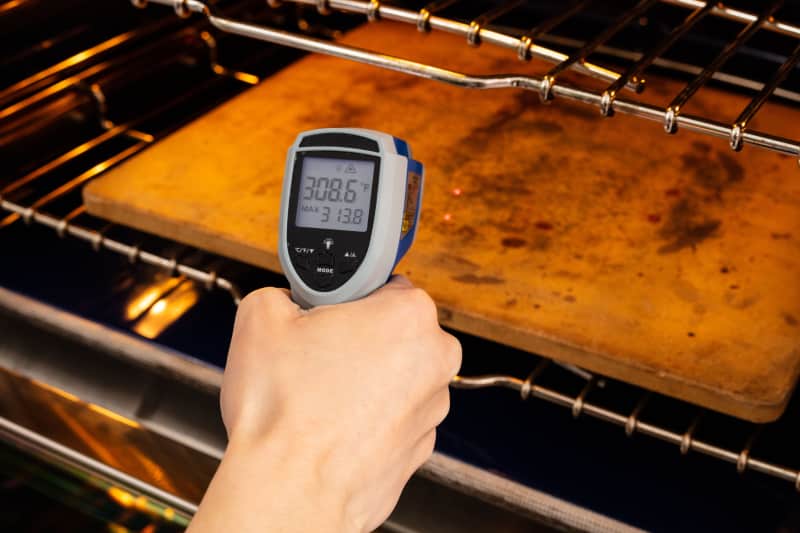
Infrared thermometers are great for measuring the temperature of surfaces such as this baking stone.

There are measures you can take to ensure more accurate results (see “What’s the best way to use my infrared thermometer?”). However, it’s best not to think of infrared thermometers as tools of absolute measurement that will give you the exact surface temperature of the object. Instead, consider them tools that give you ballpark temperatures. These ballpark temperatures can still be incredibly useful, especially in situations where you can’t get that information any other way—we’ve found them particularly helpful for getting the temperature of outdoor pizza ovens, for example. They’re also great for scenarios where specific temperatures don’t necessarily matter but temperature differences do, allowing you to quickly scan your refrigerator or freezer for warm spots or to check several areas of your griddle or flat-top grill to see if it’s preheated evenly. More generally, they’re good for learning the surface temperature of anything you might cook or bake on: They can tell you the temperature at which your skillet sears steak best, your griddle makes the perfect pancakes, or your bread oven or baking stone gives your bread the most well-blistered crust. These temperatures will be specific to your cookware, and they may not be exactly accurate—your thermometer may report 408 degrees when your skillet is actually 425. But the best infrared thermometers will report the same temperatures every time you cook, giving you a solid benchmark to shoot for and helping you get consistent results.

What to Look For

  • Accuracy: While we expect some error from infrared thermometers due to the imperfect conditions in which they’re used, we still want a model that’s as accurate as possible. The best infrared thermometers were accurate within 3.1 degrees of the true temperature under controlled conditions
We liked models that allowed us to adjust for the emissivity values of different materials, as this gave us more accurate readouts.
  • Adjustable Emissivity: Infrared thermometers work by measuring the energy radiating from an object’s surface, which they then convert into a temperature reading. The amount of energy radiated by any object is governed by something called emissivity, which is measured on a scale from 0 to 1. Many infrared thermometers let you adjust their settings to account for the specific emissivity of the object whose temperature you’re taking. We found that this led to much more accurate readouts than those we got from models with fixed emissivity, which assume that every object has an emissivity of 0.95. (You can find the emissivity values of common cookware materials online.)
  • A Big Distance-to-Spot Ratio: The distance-to-spot (DTS) ratio tells you how big the “spot”—the area you’re measuring—is relative to your distance from the object. A thermometer with an 8:1 DTS ratio, for example, lets you measure temperatures within a 1-inch-diameter circle from a 8-inch distance. Larger ratios are better, as they let you pinpoint the temperatures of specific areas more accurately from longer distances—an advantage when you don’t want to get too close to your blazing-hot pizza oven. In our price range, DTS ratios of 10 to 1 or 12 to 1 are most common; we preferred those with 12:1 ratios, as they gave us a little more distance from our target. (Thermometers with higher ratios exist but cost significantly more.) 
Models that had bull's-eye laser guides made it easier for us to see where we were measuring than models with simple laser pointers.
  • A Large, Highly Visible Laser Guide: The laser (or lasers) included with most infrared thermometers isn’t actually responsible for taking temperatures. Rather, it’s there to show you where you’re aiming. Most infrared thermometers have either one or two lasers. These were fine, but our favorite model had a laser bull’s-eye—a circle with a dot inside—that made it especially easy to see where we were pointing the thermometer, even in bright daylight.
  • An Easy-to-Use Interface: We preferred models with large, easy-to-push buttons and interfaces that made it simple to change settings (e.g., to toggle between Celsius and Fahrenheit or to adjust the emissivity value).
  • A Comfortable, Medium-Length Handle: The best models had handles that were neither too short nor too long and neither too thick nor too narrow, so they could be comfortably held by hands of different sizes.

How To Use Your Infrared Thermometer

Want the most accurate results from your infrared thermometer? Here are some tips.

read more

What to Avoid

  • Inaccuracy: One model wasn’t very accurate even under controlled conditions, and it got worse as testing progressed.
  • Fixed Emissivity: Thermometers with fixed emissivity assume that every object has an emissivity value of 0.95. Their readouts were much less accurate as a result when measuring the temperatures of items with lower values.

The Tests

  • Evaluate each thermometer’s accuracy at different temperatures (0 degrees, 68 degrees, and 300 degrees Fahrenheit)
  • Use each thermometer to take the temperatures of cast-iron and stainless-steel cookware at different heat levels (68 degrees, 310 degrees, 450 degrees, and 1050 degrees Fahrenheit), adjusting the emissivity value and evaluating the accuracy using a type K thermocouple
  • Have testers of different hand sizes evaluate ease of use

How We Rated

  • Accuracy: We rated the models on how accurate they were under controlled conditions (materials of known emissivity evaluated at a 90-degree angle). 
  • Ease of Use: We evaluated how easily we could change settings, turn on backlights and lasers, and view the laser guide itself. 
  • Comfort: We rated the models on how comfortable they were for hands of different sizes to hold.

FAQs

Check out our guide to proper infrared thermometer use.

Digital Instant-Read Thermometer: for instantaneous internal food temperatures 

This is our go-to thermometer—the one we use most often in the kitchen. It takes internal temperatures within seconds, so we use it to check the doneness of meat, poultry, fish, sauces, custards, and even bread and vegetables such as potatoes. In a pinch, you can also use it to see if your frying oil is at the right temperature.

Clip-On Probe Thermometer: leave-in thermometer for internal food and ambient temperatures 

This is best for tracking the internal temperature of food or oil over longer periods of time. We use it when roasting or smoking meat and to monitor oil temperatures when deep-frying. Our favorite, the ThermoWorks ChefAlarm, can also be used as an oven thermometer if you buy a separate air probe!

Remote-Probe Thermometer: leave-in thermometer for internal food and ambient temperatures 

This is essentially the same as a clip-on probe thermometer, but it allows you to walk away from the food, either giving you a portable alert system or pushing alerts to your phone when your food has reached your target temperature. This means it’s useful for long, slow cooks where you can’t (or don’t want to) be close to the food the whole time—for example, when you’re roasting a pork shoulder or smoking a brisket outside.

Infrared Thermometer: for instantaneous cookware/bakeware temperatures

This tells you how hot your cookware or bakeware is, letting you know when it’s ready to sear/brown/bake. It’s also useful for scanning large surfaces quickly to find hot or cold spots in your fridge or freezer or on griddles, skillets, and other cookware.

Refrigerator/Freezer Thermometer: This lets you keep an eye on your fridge and freezer temperatures so that you can find out whether they’re running cold or warm. 

Oven Thermometer: This tells you whether your oven runs hot or cool so that you can either recalibrate the oven or adjust your baking times.

No. Infrared thermometers measure only surface temperatures, so you can’t use them to evaluate the doneness or internal temperature of any food.

No. We recommend using only thermometers specifically designed for this purpose. Conventional infrared thermometers will give you inaccurate results, and the lasers they use can potentially damage your vision.

Yes and no. You can’t use the thermometer to gauge the grates’ temperature in isolation, as the thermometer will take into account other surfaces below the grates in addition to the grates themselves. Instead, if you want to get the temperature of the grill, stick a small skillet on the grill—any kind is fine—as the grill is heating up. Once you’re nearly ready to grill, add a thin layer of oil to the pan and measure the temperature of that instead, using an emissivity value of 0.95.

An infrared thermometer can help you cook more consistently. Check out our guide to target temperatures to see what heat levels to look for, and for which tasks.

Everything We Tested

Good 3 Stars out of 3.
Fair 2 Stars out of 3.
Poor 1 Star out of 3.

Highly Recommended

  • Accuracy:
  • Ease of Use
  • Comfort

WinnerThermoWorks Industrial IR with Circle Laser

Our favorite infrared thermometer was the most accurate we tested. Its handle was comfortable for hands of all sizes to grip. And we loved its large, highly visible bull’s-eye laser guide, which made it especially easy to see where we were aiming, even in bright daylight. We just wish that its buttons were a little easier to press—they’re a bit small and stiff—and that it were simpler to change certain settings, though a handy primer is printed on one side of the thermometer.

Model Number: IRK-2

DTS Ratio: 12:1

Temperature Range: : -58° to 1022°F

Emissivity: Adjustable

Average Accuracy Under Controlled Conditions: Within 1.7°F

Extra Features: Backlight, port for K-type thermocouple, Max/Min, C/F, Avg, High/Low Alarms

Price at Time of Testing: $89.00

  • Accuracy:
  • Ease of Use
  • Comfort

Our favorite infrared thermometer was the most accurate we tested. Its handle was comfortable for hands of all sizes to grip. And we loved its large, highly visible bull’s-eye laser guide, which made it especially easy to see where we were aiming, even in bright daylight. We just wish that its buttons were a little easier to press—they’re a bit small and stiff—and that it were simpler to change certain settings, though a handy primer is printed on one side of the thermometer.

Model Number: IRK-2

DTS Ratio: 12:1

Temperature Range: : -58° to 1022°F

Emissivity: Adjustable

Average Accuracy Under Controlled Conditions: Within 1.7°F

Extra Features: Backlight, port for K-type thermocouple, Max/Min, C/F, Avg, High/Low Alarms

Price at Time of Testing: $89.00

  • Accuracy:
  • Ease of Use
  • Comfort

Fluke 62 Max Plus Infrared Thermometer

This industrial infrared thermometer was very accurate under controlled conditions and had an interface that made it simple to change settings or emissivity values. Its buttons were easy to press, too. And we liked that it used two lasers to show us the outer limits of the area being measured. It’s quite expensive, though, and its handle is thick, so smaller-handed users struggled to grip it and press the trigger comfortably.

Model Number: n/a

DTS Ratio: 12:1

Temperature Range: : -22° to 1202°F

Emissivity: Adjustable

Average Accuracy Under Controlled Conditions: Within 3.1°F

Extra Features: Backlight, Max/Min, C/F, Avg, Diff, High/Low Alarms

Price at Time of Testing: $161.95

  • Accuracy:
  • Ease of Use
  • Comfort

This industrial infrared thermometer was very accurate under controlled conditions and had an interface that made it simple to change settings or emissivity values. Its buttons were easy to press, too. And we liked that it used two lasers to show us the outer limits of the area being measured. It’s quite expensive, though, and its handle is thick, so smaller-handed users struggled to grip it and press the trigger comfortably.

Model Number: n/a

DTS Ratio: 12:1

Temperature Range: : -22° to 1202°F

Emissivity: Adjustable

Average Accuracy Under Controlled Conditions: Within 3.1°F

Extra Features: Backlight, Max/Min, C/F, Avg, Diff, High/Low Alarms

Price at Time of Testing: $161.95

  • Accuracy:
  • Ease of Use
  • Comfort

ThermoWorks Industrial IR Gun

A slightly simpler version of our winner, this infrared thermometer had a single laser beam and an interface that was actually a bit easier to navigate. It was almost as accurate as our favorite, too, and its handle was comfortable for hands of different sizes to grip. Our one gripe? It had tiny, stiff buttons that were hard to press repeatedly, as you might need to when adjusting the emissivity value.

Model Number: IR-GUN-S

DTS Ratio: 12:1

Temperature Range: : -76° to 1022°F

Emissivity: Adjustable

Average Accuracy Under Controlled Conditions: Within 2.8°F

Extra Features: Backlight, Max/Min, C/F, Avg, High/Low Alarms

Price at Time of Testing: $69.00

  • Accuracy:
  • Ease of Use
  • Comfort

A slightly simpler version of our winner, this infrared thermometer had a single laser beam and an interface that was actually a bit easier to navigate. It was almost as accurate as our favorite, too, and its handle was comfortable for hands of different sizes to grip. Our one gripe? It had tiny, stiff buttons that were hard to press repeatedly, as you might need to when adjusting the emissivity value.

Model Number: IR-GUN-S

DTS Ratio: 12:1

Temperature Range: : -76° to 1022°F

Emissivity: Adjustable

Average Accuracy Under Controlled Conditions: Within 2.8°F

Extra Features: Backlight, Max/Min, C/F, Avg, High/Low Alarms

Price at Time of Testing: $69.00

Recommended

  • Accuracy:
  • Ease of Use
  • Comfort

Best BuyEtekcity Infrared Thermometer Laser Grip 1022

This infrared thermometer had a simple, easy-to-navigate interface. It was a touch less accurate than we’d like under controlled conditions but was still within a reasonable margin of error for temping pizza ovens and the like. Its two lasers did a good job of showing us the outer limits of the area where temperatures were being measured. The handle is pretty short, though, so it was a little harder for even small hands to get a comfortable grip on it. However, it’s a solid option for the price.

Model Number: 1022D

DTS Ratio: 12:1

Temperature Range: : -58° to 1022°F

Emissivity: Adjustable

Average Accuracy Under Controlled Conditions: Within 7.6°F

Extra Features: Backlight, Max, C/F

Price at Time of Testing: $32.99

  • Accuracy:
  • Ease of Use
  • Comfort

This infrared thermometer had a simple, easy-to-navigate interface. It was a touch less accurate than we’d like under controlled conditions but was still within a reasonable margin of error for temping pizza ovens and the like. Its two lasers did a good job of showing us the outer limits of the area where temperatures were being measured. The handle is pretty short, though, so it was a little harder for even small hands to get a comfortable grip on it. However, it’s a solid option for the price.

Model Number: 1022D

DTS Ratio: 12:1

Temperature Range: : -58° to 1022°F

Emissivity: Adjustable

Average Accuracy Under Controlled Conditions: Within 7.6°F

Extra Features: Backlight, Max, C/F

Price at Time of Testing: $32.99

Recommended with Reservations

  • Accuracy:
  • Ease of Use
  • Comfort

Mastercool 52224-A Infrared Thermometer with Laser

We loved how easy to use this simple, no-frills infrared thermometer was. It had a great bull’s-eye laser guide, and a single button allows you to change from Celsius to Fahrenheit; otherwise, there were no settings we could have adjusted even if we’d wanted to. Unfortunately, there was a bit of a downside to that. Under controlled conditions, the thermometer was decently accurate. But because it reads all objects at a fixed emissivity value of 0.95, it was significantly less accurate than adjustable-emissivity thermometers when we used it to measure the temperatures of shinier cookware—off by as much as 175 degrees in one test. It also has a big, thick handle that was hard for smaller hands to grip comfortably.

Model Number: 52224-A

DTS Ratio: 12:1

Temperature Range: : -58° to 1022°F

Emissivity: Fixed

Average Accuracy Under Controlled Conditions: Within 6.5°F

Extra Features: Backlight, Max, C/F

Price at Time of Testing: $64.80

  • Accuracy:
  • Ease of Use
  • Comfort

We loved how easy to use this simple, no-frills infrared thermometer was. It had a great bull’s-eye laser guide, and a single button allows you to change from Celsius to Fahrenheit; otherwise, there were no settings we could have adjusted even if we’d wanted to. Unfortunately, there was a bit of a downside to that. Under controlled conditions, the thermometer was decently accurate. But because it reads all objects at a fixed emissivity value of 0.95, it was significantly less accurate than adjustable-emissivity thermometers when we used it to measure the temperatures of shinier cookware—off by as much as 175 degrees in one test. It also has a big, thick handle that was hard for smaller hands to grip comfortably.

Model Number: 52224-A

DTS Ratio: 12:1

Temperature Range: : -58° to 1022°F

Emissivity: Fixed

Average Accuracy Under Controlled Conditions: Within 6.5°F

Extra Features: Backlight, Max, C/F

Price at Time of Testing: $64.80

Not Recommended

  • Accuracy:
  • Ease of Use
  • Comfort

ThermoPro TP30 Digital Infrared Thermometer Gun

This thermometer was comfortable to hold and relatively easy to operate, though it required a slightly less intuitive maneuver to adjust emissivity values. Unfortunately, it struggled to measure higher temperatures accurately, even under controlled conditions. And after we used it to measure the temperature of a hot skillet on the grill, exposing it to higher heat, it temporarily stopped working properly, with temperature readings fluctuating wildly as we pressed the trigger.

Model Number: TP-30

DTS Ratio: 12:1

Temperature Range: : -58° to 1022°F

Emissivity: Adjustable

Average Accuracy Under Controlled Conditions: Within 122.3°F

Extra Features: Backlight, Max/Min, C/F, Avg

Price at Time of Testing: $23.99

  • Accuracy:
  • Ease of Use
  • Comfort

This thermometer was comfortable to hold and relatively easy to operate, though it required a slightly less intuitive maneuver to adjust emissivity values. Unfortunately, it struggled to measure higher temperatures accurately, even under controlled conditions. And after we used it to measure the temperature of a hot skillet on the grill, exposing it to higher heat, it temporarily stopped working properly, with temperature readings fluctuating wildly as we pressed the trigger.

Model Number: TP-30

DTS Ratio: 12:1

Temperature Range: : -58° to 1022°F

Emissivity: Adjustable

Average Accuracy Under Controlled Conditions: Within 122.3°F

Extra Features: Backlight, Max/Min, C/F, Avg

Price at Time of Testing: $23.99

  • Accuracy:
  • Ease of Use
  • Comfort

Maverick LT-04 Infrared Laser Thermometer

With limited extra features, this infrared thermometer was very easy to use. It was also fairly comfortable to hold, though it was a bit harder to get a grip on its slick plastic handle than it was with other models. Under controlled conditions, the thermometer was reasonably accurate. Unfortunately, because we couldn’t adjust emissivity values to match the materials whose temperatures we were measuring, readouts were much less accurate on shinier cookware—off by as much as 182 degrees in one case.

Model Number: LT-04

DTS Ratio: 10:1

Temperature Range: : -44° to 1022°F

Emissivity: Fixed

Average Accuracy Under Controlled Conditions: Within 7.0°F

Extra Features: Backlight, Max/Min, C/F

Price at Time of Testing: $52.99

  • Accuracy:
  • Ease of Use
  • Comfort

With limited extra features, this infrared thermometer was very easy to use. It was also fairly comfortable to hold, though it was a bit harder to get a grip on its slick plastic handle than it was with other models. Under controlled conditions, the thermometer was reasonably accurate. Unfortunately, because we couldn’t adjust emissivity values to match the materials whose temperatures we were measuring, readouts were much less accurate on shinier cookware—off by as much as 182 degrees in one case.

Model Number: LT-04

DTS Ratio: 10:1

Temperature Range: : -44° to 1022°F

Emissivity: Fixed

Average Accuracy Under Controlled Conditions: Within 7.0°F

Extra Features: Backlight, Max/Min, C/F

Price at Time of Testing: $52.99

America's Test Kitchen Accolades Badge

Reviews You Can Trust

The mission of America’s Test Kitchen Reviews is to find the best equipment and ingredients for the home cook through rigorous, hands-on testing. We stand behind our winners so much that we even put our seal of approval on them. Have a question or suggestion? Send us an email at atkreviews@americastestkitchen.com. We appreciate your feedback!

The Expert

Author: Miye Bromberg

Miye Bromberg

Deputy Editor, ATK Reviews

Miye is the deputy editor for ATK Reviews. She covers bread, booze, and blades.

Miye Bromberg is the deputy editor for ATK Reviews. Areas of specialization include bread, booze, and blades. A native of New York, she now lives in Kentucky, where she spends her free time thinking about film, tending her garden, and traveling long distances to eat dosas.

Appears In

This item is featured in the following. Click the links to dig in!

*All products reviewed by America’s Test Kitchen are independently chosen, researched, and reviewed by our editors. We buy products for testing at retail locations and do not accept unsolicited samples for testing. We list suggested sources for recommended products as a convenience to our readers but do not endorse specific retailers. When you choose to purchase our editorial recommendations from the links we provide, we may earn an affiliate commission. Prices are subject to change.

Reviews You Can Trust.
See Why.

This is a members' feature.
America's Test Kitchen LogoCook's Country LogoCook's Illustrated Logo