 Buy at Amazon
 Buy at Pyrex
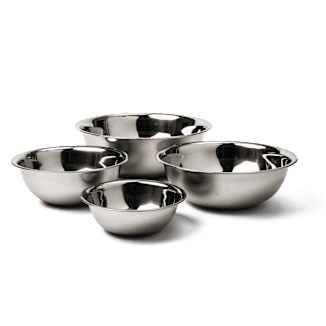
A great set of mixing bowls is essential in any kitchen. They should be comfortable to hold and make it more efficient to transfer food to other containers. Stainless-steel sets are affordable, lightweight, and durable. Our winner is the Vollrath Economy line. We compiled our own set of the 1.5-quart, 3-quart, and 5-quart sizes; they come in countless additional sizes. Some cooks like to have a glass set in addition to or instead of stainless steel because they’re microwave-safe. Our winning glass set is the Pyrex 8-Piece Mixing Bowl Set with Assorted Lids. They’re sturdy and have a wide rim.

We reach for a mixing bowl, if not several, every single time we make a meal. They’re the best vessel for tasks big and small, everything from whisking one serving of vinaigrette to making a big batch of cookie dough or meatballs or tossing a salad. Because they’re such kitchen workhorses, they need to be easy to use and move around the kitchen and shouldn’t be a hassle to clean. A bowl is a bowl—their basic designs don’t vary a lot—but having a collection of bowls at the ready that are the right shape and size can make preparing food more efficient and enjoyable.


A good collection of mixing bowls is indispensable in a well-stocked kitchen. We reach for one when making nearly any meal.
We only tested sets that included a large bowl with a capacity of 4 quarts or more; a large mixing bowl is invaluable in the kitchen and anything smaller just isn’t large enough for many tasks. A few models we tried also had intriguing features such as handles or rubber bases intended to minimize slipping. We used the sets to make vinaigrette, whipped cream, and brownies in an effort to find mixing bowls that earn a spot among the kitchen tools you’ll reach for every single day.
What Material Mixing Bowls Should You Buy?
Mixing bowls come in a variety of materials, including plastic, ceramic, stainless steel, and glass. We chose not to test plastic bowls because plastic items shouldn’t be used in the microwave or with hot foods as that can cause them to release microplastics into food. They can also retain oils and stains, which can also negatively impact the quality of the food you make in them. We also skipped ceramic sets because they tend to be available only in limited sizes and they’re heavy and expensive.
We love stainless-steel bowls and reach for them often because they’re virtually indestructible and the best ones are lightweight. Even a large 8-quart bowl often weighs less than a pound. They also usually come in a wide range of sizes; manufacturers can make larger versions without making them too heavy or fragile. The main downside to stainless-steel bowls is that they can’t go in the microwave.

We also like using glass mixing bowls because they can go in the microwave, which is convenient for melting butter or steaming vegetables, for example. Their transparent walls are an added bonus for tasks such as monitoring how much your bread dough is rising. But glass mixing bowls are heavier and more fragile than stainless steel and are available in more limited sizes; we couldn’t find any glass bowls larger than 4.5 quarts.
Whether you stock your kitchen with stainless steel or glass comes down to personal preference and how you typically use your mixing bowls. We think every cook should have a great set of stainless-steel bowls. If you have the kitchen space, glass bowls offer unique benefits and a set would round out your collection nicely.
What to Look for
- Range of Sizes: We liked sets that offered distinctly small, medium, and large bowls. Most of the bowls we tested came in predetermined sets, typically in the realm of 1.5, 3, and 5 quarts. Our favorite stainless-steel bowls, which are sold separately instead of in a set, come as big as 8, 10, or even 20 quarts. Extra-large bowls always come in handy, even for a small household. They’re great for proofing bread dough and marinating meat. Big bowls give you the space to toss salads without having to worry about anything going overboard. For delicate tasks, such as mixing voluminous egg whites into cake batter, they provide plenty of room to fold gently.

- Wide Rim: We preferred bowls with broad rims. They offer a helpful surface to hold while vigorously mixing, ensuring the bowls don’t slip out of your hands. They also make it easy to lift a bowl in the air and scrape out its contents, such as when pouring brownie batter into a pan. Only one glass set, from Pyrex, had rims that were wide enough to hold onto.
Nice to Have
- Lids: Whether we’re storing leftovers in the fridge or bringing food to a party, we often need to cover our mixing bowls. Some sets came with lids, which we thought was a nice bonus. We liked that it eliminated the need to use plastic wrap.
What to Avoid
- No Rim: Bowls that lacked any sort of rim were more difficult to lift or hold onto during mixing. They were also more difficult to rinse in the sink, especially when it came to slippery, heavy glass models.

- Plastic Parts: One set of bowls in our lineup was categorized as stainless steel but had a plastic coating. We don’t recommend heating plastic, so this gave us pause about putting them through the dishwasher. Unlike other stainless-steel bowls, their plastic coating also means they can’t be placed over a pan of simmering water, as we might do for a makeshift double boiler.
- Bowls That Must Be Hand-Washed: Mixing bowls are some of the most frequently used items in the kitchen, so it’s just a hassle to have to hand-wash them every time you use them. While most of the stainless-steel sets in our lineup are dishwasher-safe, the manufacturers of the All-Clad set recommended hand-washing.
Other Considerations
- Bowl Shape: Mixing bowls typically come in two shapes: deep, tall bowls and shorter, shallower bowls. Either shape can make great food, but both have pros and cons. When you’re vigorously whisking a dressing or using a hand mixer to whip cream, deep bowls with tall, steep sides are beneficial. Their high walls contain splatters, minimizing messes. But deeper bowls also made it more difficult to scrape out food neatly into a baking dish or storage container. We had to turn them nearly upside down to get out every last drop. We had a slight preference for bowls with shorter, more gradually sloped walls. They felt more natural to hold aloft and transfer food into containers. Their wide shape also made it easier to gently fold ingredients and to see the food in the bowl, but they were more likely to let the occasional splatter escape.

The Tests
- In small bowls, whisk Foolproof Vinaigrette, then transfer to storage containers
- In medium bowls, use hand mixer to make whipped cream and then a spatula to fold in lemon curd; transfer to storage containers
- In large bowls, prepare brownies using a whisk and spatula, then transfer batter to baking pan
- Clean bowls in the dishwasher 10 times
How We Rated
- Performance: We evaluated the range of sizes available from each manufacturer and the quality of the foods we made in each mixing bowl.
- Ease of Use: We assessed how easy it was to mix various foods using different utensils and tools, as well as how easy it was to transfer food from the bowls into baking pans or storage containers.
- Durability: We evaluated how the bowls held up throughout testing and when run through the dishwasher.