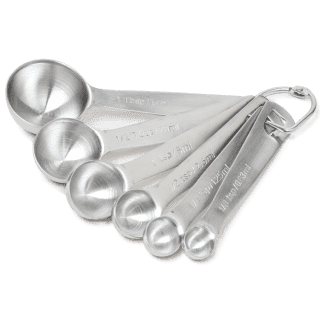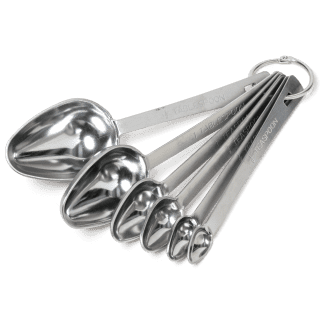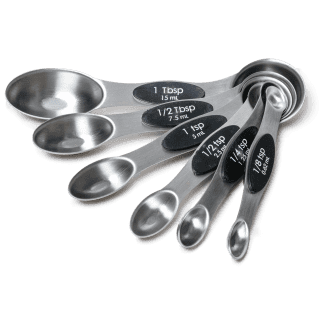


- Measure water to assess accuracy
- Measure unbleached all-purpose flour to assess accuracy (scooping from large 6-quart container)
- Measure table salt to gauge ease of use (scooping from salt box)
- Measure dried basil, ground turmeric, and dried red pepper flakes (scooping from spice jars)
- Measure peanut butter (scooping from jar)
- Detach and reattach all spoons 5 times
- Scoop brown sugar from box
- Coat with canola oil, then wash by hand
- Wash 19 times in dishwasher
- Have additional testers measure flour
We stock approximately 200 measuring spoons in the test kitchen, as our cooks use them to measure everything from baking soda to olive oil. And while these tiny tools appear to be straightforward, a seemingly innocuous detail—numbers that are printed on the handle and fade over time or a connector ring that requires too much effort to pry open—can make some sets a pain to use.
We’ve stuck by our tried-and-true winning measuring spoons from Cuisipro for years, but with so many new designs on the market, we decided to retest. We chose seven sets, priced from $4.99 to $16.68, all containing at least the five measures we frequently use in our recipes: 1 tablespoon, 1 teaspoon, ½ teaspoon, ¼ teaspoon, and ⅛ teaspoon. (We consider other sizes to be nonessential, so we excluded those individual spoons from testing where applicable.) The sets varied in design: Some were traditional, with a round bowl connected to a handle, and some were double-sided spoons that resembled barbells—a straight handle with a bowl on each end. One set also had bowls with sliders, which allowed us to adjust the measurement sizes.
We tested spoons for accuracy, repeatedly removed each spoon from the set and reattached it, measured ingredients of various textures (table salt, dried basil, ground turmeric, red pepper flakes, peanut butter, and brown sugar), and washed each set 20 times. We also asked users—some with large hands, others with small hands—to test each set. At the end of testing, we rated the spoons on accuracy, ease of use, and durability to form our rankings.

Narrower spoons with rectangular or oval-shaped heads were easier to fit into smaller containers, such as spice jars.
A Note On Accuracy
Accuracy is essential in cooking, especially when baking, so we tested accuracy with both water and unbleached all-purpose flour. We used our recommended dip-and-sweep method and weighed each spoon’s contents on a high-precision scale to the hundredth of a gram.
Most measuring spoons were within an acceptable range, and any inaccuracies in the smaller spoons—the ½-, ¼-, and ⅛-teaspoon measures—were mere fractions of a gram. Of the larger spoons, though, three were problematic. When we measured water, one of the 1‑teaspoon measures held, on average, 35 percent less than it should have. And when we measured flour, two 1‑tablespoon measures ran too big—one model held roughly 32 percent more flour than it should have, and the other held a hefty 41 percent more.
Our test cooks design recipes to work even if you aren’t using perfectly calibrated measuring tools, and we found the smaller spoons’ inaccuracies perfectly acceptable given that they were off by only tenths of a gram. But we downgraded 1-teaspoon and 1‑tablespoon measures that were inaccurate by 30 percent or more, as this translated to roughly 2 to 3 grams of either excess or missing ingredients, which could potentially affect a recipe’s outcome.


Assistant Editor Emily Phares uses a KitchenArt adjustable measuring spoon to measure flour (left) and an OXO measuring spoon to measure peanut butter (right).
Ease Of Use: Material, Spoon Width, And Leveling
Our lineup included five metal sets and two plastic ones. When we scooped ingredients using the plastic models, we noticed that the ingredients often clung to the surface even after release, leaving behind a light dusting of turmeric or flour or a few pieces of dried basil or red pepper flakes. We much preferred metal measuring spoons because of their cleaner release, which gave us better accuracy and less mess. Our science research editor explained that the difference came down to how the two materials conduct static electricity. Plastic spoons are nonconductive and hold static electricity—which attracts powdery particles—whereas metal spoons allow the charge to flow, so ingredients don’t cling.
We measured a lot of different ingredients, in containers ranging from a large 6-quart vessel to a small spice jar with a 1½-inch opening.
It was easy to dip all the spoons into larger containers, but small spice jars were problematic. Only three of the 1‑tablespoon measures fit through the 1½-inch openings of typical basil and turmeric jars. These spoons had narrower bowls, either oval or rectangular in shape, that ranged in width from 1 to 1¼ inches; spoons that were even just ⅛ inch wider didn’t fit.
But the bigger issue was whether spoons were easy to “dip and sweep,” a method that entails dipping a measuring spoon into a container, scooping ingredients up in a heaping mound, and then running a straightedge along the bowl to remove excess. Two sets had design issues that led to trapped food and slightly inaccurate measurements. One had ridged handles into which ingredients settled, so we had to run a knife down each individual ridge to remove the excess. Another set of spoons had a bowl on each end—one round, the other oval-shaped, like a measuring-spoon barbell—and a raised grip on the handle, which accumulated excess ingredients that had to be swept off.
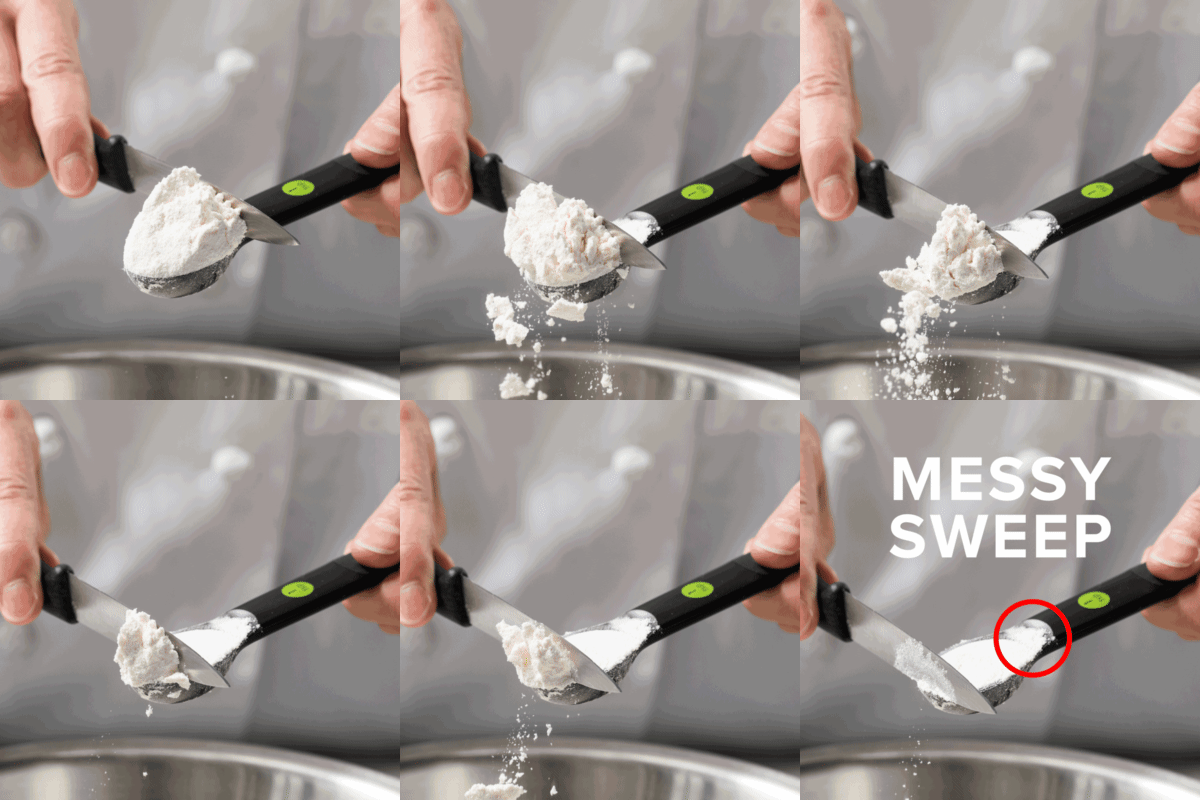
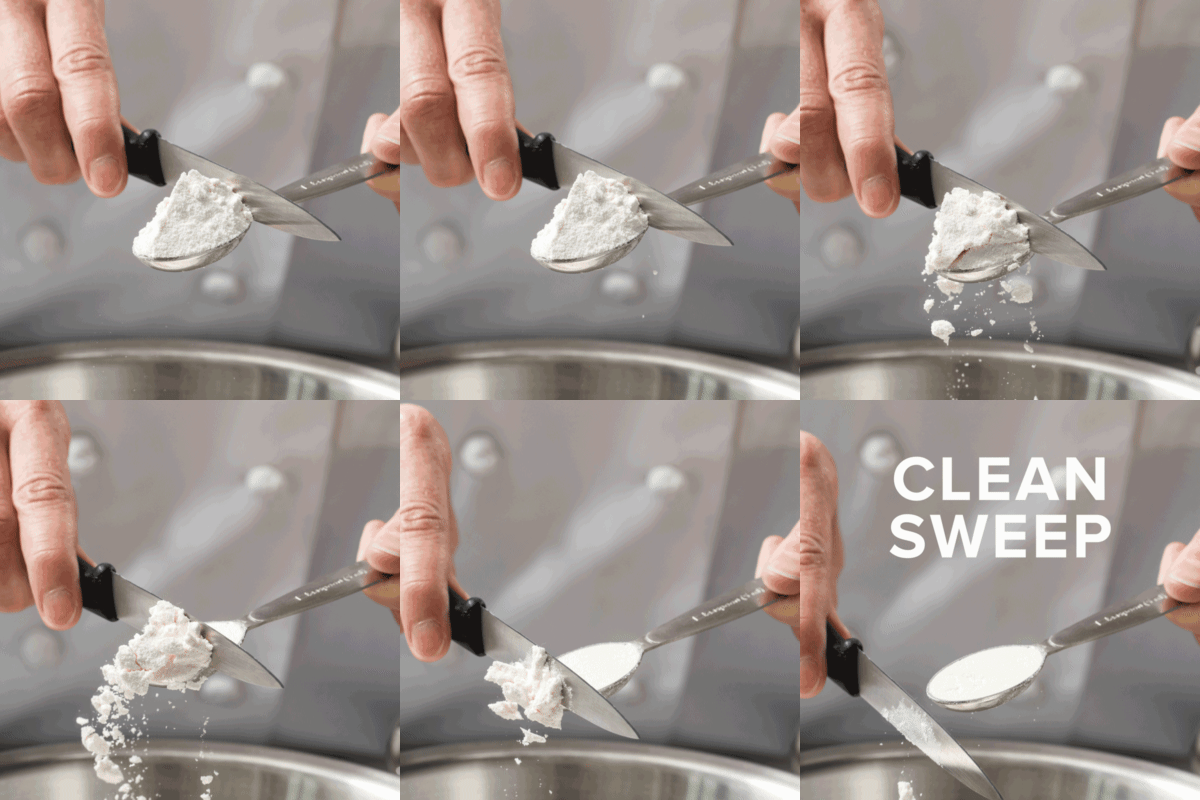
Two models had other issues that impeded the sweep. One set had a small step between handle and bowl rather than sitting flush, so we had to stop midway to reposition our knife and continue to level. Another set had a small, curved ramp between the spoon handle and bowl, which became an ingredient hideaway because the knife wasn’t flush with that part of the spoon during leveling.
The highly ranked models allowed us to easily scoop ingredients into the bowl only—without excess collecting on the handle—and they were easy to level off, thanks to a smooth, straight runway from handle to bowl that allowed for an unimpeded sweep.

One set's metal ring has rust after washing.
Attachment Mechanism Matters
Measuring spoons can easily go astray in kitchen drawers, so most manufacturers provide some means of keeping them together. Though it’s often quicker to use a spoon without removing it from the set, it can be easier to use the spoons individually, so we wanted a set that was easy to separate and not too cumbersome to use with all the spoons attached. Our lineup included a wide variety of connecting mechanisms, and the issues were plentiful. A snap-together set required significant force to press the spoons back together, which sometimes hurt our hands. Another set, with a D‑shaped, hinged closure, required even more effort to pry open. A magnetic set also scored poorly because the magnets weren’t strong and the spoons separated easily. Our favorite set was held together with a ball chain (similar to what military dog tags hang on), which was very easy to open and close.

The adjustable spoon didn't form a tight seal, so liquid leaked back inside the chamber.
Durability: Can Measuring Spoons Handle Brown Sugar?
We measured brown sugar using each set’s 1-tablespoon, 1-teaspoon, and ⅛‑teaspoon measure to see if they would bend. (We used a fresh box of brown sugar that had not previously been opened, and even then the sugar was quite firm.) Most sets had one or more spoons that bent—some into a slight arc, others into a full-on frown shape. However, three sets remained unbowed by the brown sugar. Two were plastic, and the third was a solidly constructed set of metal spoons that users found especially “sturdy” and “substantial.”
- Measures accurately
- Handle that extends straight from the bowl, with a smooth, flat surface that allows for a clean sweep to level ingredients
- Made from stainless steel for easy removal of ingredients with no cling
- Simple and comfortable attachment mechanism that made it easy to remove and reattach spoons
- Sturdy construction that did not bend when scooping brown sugar
We also washed each set of spoons 20 times (once by hand and the remainder in the dishwasher), and while most came out looking like new, a set of two adjustable spoons (with a sliding wall that changes the bowl size) was more difficult to clean. Ingredients, both wet and dry, sometimes worked their way under the wall and into an empty chamber in the spoon, and we had to snap off the cover pieces (or sliders) to thoroughly clean them. Then, after we replaced the cover piece on the larger of the two spoons, we noticed that the slider didn’t create as tight a seal anymore, so liquid ingredients seeped into the empty chamber more easily.
Our Winning Measuring Spoons: Cuisipro Stainless Steel 5 Piece Measuring Spoons
Our former winner, the Cuisipro Stainless Steel 5-Piece Measuring Spoons ($12.33), again outscored the competition with an “uncomplicated” design, including a handle that was level with the bowl, which made scooping and leveling easy, and a ball-chain connector that allowed us to quickly and comfortably remove and reattach spoons if desired. Its “sturdy,” “substantial” metal construction prevented ingredients from clinging and was durable enough to withstand firmly packed brown sugar.