


 Buy at Amazon
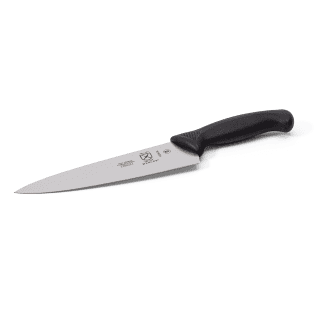
Our favorite chef’s knife is the Victorinox Swiss Army Fibrox Pro 8" Chef’s Knife. We’ve routinely tested and recommended this knife for nearly three decades, and for good reason: It cuts foods of all kinds effortlessly, is comfortable for hands of all sizes to grip, and arrives and stays quite sharp. It’s also reliably durable, easy to sharpen, and well-made. We think it’s the best option for most people—and it has stayed at an affordable price for all these years. If you are on a particularly tight budget, we think that the Mercer Culinary Millennia 8-Inch Chef’s Knife offers great value. It costs less than our top choice and performs just as well; it is our Best Buy. Our only quibble is that its handle is made from a highly textured plastic that some users found less pleasant to hold. If you would like a knife that looks and feels much more luxurious—and are willing to pay more for the privilege—we highly recommend an Upgrade Pick, the Shun Classic 8" Western Cook’s Knife. It’s got a beautiful, razor-sharp blade and a long wood composite handle that most users found comfortable to hold. It made quick work of every task we set before it.

A good chef’s knife is a cook’s best friend. It’s arguably the most important tool in the kitchen, an essential all-purpose blade that can do everything from small, precise tasks (mincing garlic) to minor butchery (breaking down a chicken, filleting a fish) and a whole lot in between. If you buy just one knife, many say, let it be a chef’s knife.
For this review, we focused on knives with blades measuring about 8 inches, as we’ve found this length to be the most useful and versatile for most cooks. We also limited the scope to Western-style chef’s knives, which generally have a heavier weight, a larger blade, and a more curved blade edge than the gyuto many home cooks use instead. With a price cap of about $250, all the knives in our current lineup are what most knife shops consider “mass-produced.” In this price range, almost all the Western-style chef’s knives available are made from stainless (stain-resistant) steel. If you are interested in using a knife with a carbon-steel blade, we recommend checking out our reviews of gyuto or nakiri.


We use our chef’s knives for pretty much everything; it’s great for chopping vegetables (as shown here) but also for breaking down chickens, slicing sandwiches, and a whole lot more.
How Much Should You Spend on a Knife?
It really depends on your budget and needs. We don’t think you have to spend a lot to get a solid knife. We’ve recommended the Victorinox Swiss Army Fibrox Pro 8" Chef’s Knife as our top choice for decades, and it generally costs between $45 and $70 online. A mainstay of commercial kitchens, it’s an amazing no-frills performer, with a comfortable, easy-to-grip plastic handle and a sharp, moderately thin blade. It won’t win any beauty contests, but it offers incredible value for its price. We’ve found acceptable knives that cost even less too; the Mercer Culinary Millennia 8-Inch Chef’s Knife can usually be purchased for under $30. With a rubbery plastic handle, it looks and feels quite utilitarian, but it’s a surprisingly decent performer considering its bargain-basement cost.
If you are just starting to cook, have a limited budget, or just want a good knife that you don’t need to be too precious about maintaining or caring for, any one of these knives will stand you in good stead. (Cooks in the Test Kitchen use dozens of the Victorinox chef’s knife on a daily basis, both at work and at home.)
That said, you can spend a lot more than $75 on a chef’s knife, and many of us find it worthwhile to do so. After all, a knife is a tool that most of us use every day, and a good one should last a lifetime. If you have the means, it can be worth your while to make a bigger investment.
What Do You Get When You Spend More on a Knife?
We get this question a lot, and with good reason: We all want to know what you get if you upgrade from a fairly basic knife to something, well, a little more expensive. To find out, we interviewed almost a dozen knife manufacturers and knife shop owners about the differences between their least and most expensive knives. As we learned, there are some significant benefits:
- Harder Blades: The more you pay, the more likely it is that your knife will come with a blade made from a harder steel alloy. Harder steel alloys are more expensive to produce. According to senior science editor Paul Adams, harder alloys can require more costly metal elements (such as vanadium and tungsten) to produce. And as Mike Tarkanian, senior lecturer in the Department of Materials Science and Engineering at the Massachusetts Institute of Technology, explained, “The harder the steel, the more difficult it is to work with.” A harder alloy might require more labor to shape, and knives made with it might have a higher “scrap rate”—that is, a greater percentage of the knives produced with it might turn out imperfectly or otherwise prove to be unsellable. In many cases, rather than using an entirely different alloy, manufacturers of higher-end knives harden their steel with costly multi-day cycles of heating and cooling to strengthen the blade. The benefits? Harder steel can be made into thinner, more rigid knives that can feel more agile and precise, and blades made with it have better edge retention, meaning that they keep their sharp edges longer. There are a few downsides, too, though: That hard steel is prone to chipping, so as with Japanese knives, you’ll want to avoid using these blades to cut through bone or frozen and other especially hard or dense foods. And while you’ll have to sharpen a knife with a hard steel blade less frequently, it can be more difficult to do so when the time rolls around, taking more passes, force, or time on a whetstone, electric sharpener, or manual sharpener.
- Premium Handles: More expensive knives can have handles made from more expensive materials—often wood. Or they might come in colors other than a conventional matte black. This gives them a nicer look and feel.

- Better Finishing and Quality Control: As Josh Donald from Bernal Cutlery in San Francisco told us, more expensive knives often see better finishing and a more rigorous quality control process than cheaper ones. Knives may be sharpened to a finer degree, and handles may be shaped, polished, and smoothed to have more pleasant contours. And all these tasks may be performed by hand, requiring expert labor and adding time to production. In addition, the finished knives may be scrutinized more intensively in order to ensure that the knives have no blemishes or defects in their construction. Time, expertise, and extensive quality control cost manufacturers money, driving prices up on higher-quality knives.

Basically, paying more will usually get you a better-looking, better-feeling knife—one that provides a more luxurious cutting experience than your basic blade.
As Kirsten Dressler Wilson, vice president of knife company Messermeister told us, “Pasta sauce out of a jar can taste just fine, but if you’ve ever been to Italy in late summer, when the tomatoes are ripe, you know that there’s an entirely different level of flavor. It can be very hard to go back to the old jar once you’ve tasted the difference. . . . When we make an entry-priced knife, we strive to contain some of the basic elements of our premium knives, but out of necessity, we make some sacrifices in materials, design, and/or finishing in order to deliver a product at a more accessible price. For us, the key is to deliver fair and solid value while accentuating at least one key performance element, like sharpness, comfort, or ease of maintenance. The consumer can choose what is important to them, but they can’t have it all. The materials, processes and shapes that are used in our premium knives are all selected for performance. It is not always obvious to the eye, but these materials deliver much greater sharpness, durability, and function than common materials.”

“The materials, processes, and shapes that are used in our premium knives are all selected for performance. It is not always obvious to the eye, but these materials deliver much greater sharpness, durability, and function than common materials.”
—Kirsten Dressler Wilson, VP of Messermeister
There’s one other consideration to keep in mind. If you’re willing to pay more for your primary knife to begin with, you might want to invest in a gyuto or santoku instead of a Western-style chef’s knife. While we recommend the majority of the more expensive knives we’ve tested as part of this review, many of our testers preferred the feel and cutting action of these Japanese knives, which cost about the same. The big blades, longer handles, thicker spines, and heavier builds found on Western-style chef’s knives aren’t for everyone. If you have small hands or prefer a lighter-weight, more nimble blade, one of these other knives might be the way to go.
What to Look For
- A Sharp Blade: A sharp knife is a pleasure to use, making quick work of any task. We think a chef’s knife should be keen and ready to use right out of the box, since not all cooks have the equipment or skills to sharpen their knives at home. Two main factors determine sharpness. One is edge angle—the angle of the blade on either side of its cutting edge. The narrower the angle, the thinner the cutting edge and the sharper the knife can feel in action. Most of the knives we tested had narrow edge angles of 13 to 16 degrees, which would—in theory—be enough of an angle to make a knife feel sharp. In practice, the sharpness of many of the blades came down to a second factor: how well they had been sharpened and honed at the factory. The best knives had smooth, even-looking edges with no chips. Our top two knives had edge angles on the upper half of the range but had been nicely sharpened so that they glided through onions and tomatoes as smoothly as knives with narrower edge angles.

- A Gently Curved Edge: Western-style chef’s knives have blades that are curved to enable cuts where you rock the blade forward from tip to heel. We preferred blades where the curve was fairly gentle, allowing a natural cutting motion. Blades with more exaggerated, rounded bellies occasionally put our arms and wrists at slightly more awkward angles as we cut.

We preferred knives with gently curved blades (top), as these allowed us to make different types of cuts easily. Knives with more dramatically curved blades (bottom) sometimes put our arms and wrists at awkward angles as we cut.
- Clearance Under the Handle: In general, the taller the blade is at the heel, the higher the handle sits above the cutting board, providing more space underneath it for our fingers to curl. Our favorite blades were about 2 inches tall at the heel. Blades that were shorter sometimes didn’t leave enough room for our fingers, pushing them into the cutting board as we rocked through cuts.


Blades that were tall at the heel (left) left plenty of room for our fingers to curl around the handle; blades that were shorter (right) didn’t provide enough clearance, cramping our fingers.
- A Rounded Spine: We liked blades with rounded spines, as they were more comfortable to choke up on than those with sharper, squared-off spines, which dug into our hands.


Blades with rounded spines (right) were easier to choke up on and grip than those with sharper, squared-off spines (left).
- A Grippy Handle with Rounded Edges: We preferred knives with handles made from rubbery, textured materials, as these were cushier and easier to grip, especially when our hands were wet or greasy. We didn’t have clear preferences on the shape of the handle. We liked uniformly cylindrical Japanese-style handles and curvier handles with ergonomic bumps; both gave us plenty of grip options. Regardless of style, the best handles had soft, rounded contours, nestling into our hands instead of biting into them.

The best knives were able to chop tough butternut squash with authority; lesser knives faltered, wobbled, or got stuck.
What to Avoid
- A Dull or Poorly Sharpened Blade: A dull blade will mangle your food, bruising your parsley and crushing your onion into eye-watering pulp instead of dicing it neatly. It’s also dangerous; it’ll slip on chicken skin or require extra force to push through a potato, putting your fingers at risk. To our chagrin, several of the knives we tested came out of the box with dull, coarse, toothy, or inconsistently sharpened edges (e.g., sharp at the tip yet dull at the heel).
- An Ultrathin Blade: Thin blades are great for relatively light use and precision tasks, such as mincing garlic or dicing onions, but they’re not necessarily ideal in an all-purpose knife. Measuring just 1.3 millimeters thick, the thinnest blade struggled on tasks that required more power, wobbling and bending alarmingly when we bore down on it while cutting through chicken breasts.
Other Considerations
- Spine Thickness: The thickness of a blade’s spine helps determine how powerful or agile a blade feels. In general, the thicker the spine from one end to another, the heavier, and more rigid the blade will usually be overall, providing extra power for cleaving through dense butternut squash or bone. With a thick-spined blade of 2.5 mm or more, gravity is on your side. The downside is that blades with thicker spines can also function similarly to axes, wedging into food and getting stuck if their edges aren’t sufficiently sharp. On the flip side, as mentioned above, blades that have especially thin spines can be less rigid and more flexible. They’re nimble and can glide through food effortlessly, but they lack power for tougher jobs and can sometimes make less precise cuts if their blades bend too much during use. Western-style chef’s knife blades typically have thicker spines than those seen in Japanese gyuto, their rough equivalent. While we wouldn’t necessarily dismiss a knife out of hand because it had a particularly thick or thin spine, our top choices had spines whose thickness fell in the middle of the range, measuring about 2 to 2.3 mm at the center of the spine.

Blades with thin spines (top) are more nimble and glide through food more effortlessly. Blades with thick spines (bottom) have more power; while they sometimes wedge into food and get stuck, they are good at getting through dense butternut squash and bone.
- Weight: Some testers liked heavier knives, saying they felt especially solid and well-made in their hands. Others preferred fairly lightweight knives, finding them easier to use for long periods without tiring. Ultimately, the choice is personal; we highly recommend both heavier and lighter options.
The Tests:
- Evaluate each knife’s sharpness using an industrial sharpness-testing machine at the beginning and end of testing
- Slice tomatoes
- Dice onions
- Mince garlic
- Mince parsley
- Break down a whole chicken into parts
- Break down butternut squash and dice it
How We Rated:
- Blade: We evaluated how spine shape, blade height and curvature, and other factors contributed to each knife’s performance.
- Handle: We rated each knife on how comfortable its handle was to grip.
- Sharpness: We rated the knives on how sharp they were before, during, and at the end of testing.




 Buy at Material