
 Buy at Amazon
Our longtime favorite wood cutting board is the Teakhaus Edge-Grain Cutting Board (XL). This large, reversible board provides plenty of room to work on. It’s heavy enough to sit securely on the counter but not so heavy that it’s hard to lift or maneuver. And it’s extremely easy to maintain, requiring less oil less frequently than others to keep it waterproof and durable. If you’d like a slightly smaller board, we also recommend the Teakhaus Edge-Grain Cutting Board (L).
If a big wood or bamboo cutting board isn’t quite what you’re looking for, check out our review of large plastic cutting boards, our review of small cutting boards, or our review of bar boards.

A good knife is nothing without an equally good cutting board on which to use it. While some cooks like lighter-weight boards made from plastic or other materials, for others, the ultimate cutting board is a thick, solid, unbudgeable model made of wood or bamboo. This kind of board is an investment; compared to a lighter board, you’ll have to spend more money, perform regular maintenance, and use more muscle to lift and maneuver it for cleaning. But for that money and effort, you get a board that can potentially last a lifetime—and is a much greater pleasure to cut on, as well.
What Size Cutting Board Should I Get?
It depends. In general, we recommend getting the biggest cutting board that will fit on your counter and in your sink—and that you’re able to comfortably lift. Bigger boards give you more room to work when trimming big roasts or slicing long bunches of leafy greens, though they’re also good for smaller tasks as well. Many of our test cooks also like using a bigger board because they can prep multiple ingredients on it and keep them on the board as they work, simplifying their mise en place. We think a cutting board measuring at least 15 by 20 inches is the best size for most home cooks, and our favorite wood board is actually a bit larger, measuring 18 by 24 inches.
That said, big, heavy wooden cutting boards aren’t for everyone. If portability and ease of use are priorities, you might want to consider a lighter-weight large plastic cutting board offering the same surface area. Or you might prefer a smaller cutting board altogether—though they don’t provide as much work space, small boards are generally easier than large ones to maneuver and wash, though they’re more prone to warping and other damage. And if you just want a tiny board for little tasks, we recommend investing in a wood or plastic bar board.
Are Expensive Cutting Boards Worth the Money?
They can be. Large wood cutting boards are often expensive to begin with due to the material costs of producing them—wood itself isn’t cheap. Boards that are made by hand by artisans and smaller boutique shops cost even more, since you’re paying for a higher level of personal attention and skilled craftsmanship than what you’ll see in a mass-produced, factory-made cutting board. Handmade boards can be worthy investments indeed; all of the cutting boards we’ve tested that came from smaller workshops were beautiful and proved exceptionally durable and well-made. Most were also seasoned with oil especially well before shipping, reducing the risk of damage during initial use. That said, you don’t have to spend a small fortune to get a good-quality wood cutting board. Well-made, durable mass-produced cutting boards exist, too—our longtime favorite is one such option.
What to Look For
- Moderate Weight: The heavier the board, the more securely it will sit on the counter, providing insurance against accidental slips or wobbles when you cut on it. While all of the boards in the lineup were reasonably stable, a few of the lighter models, weighing 11 or 12 pounds, occasionally moved around during more vigorous chopping sessions. That said, heavier boards can be difficult to pick up, which you’ll need to do if you want to clean them in the sink. Users who tested the heaviest cutting boards (weighing between 19 and a whopping 33 pounds), confessed that they were unwilling to wrestle these boards into the sink on a regular basis, opting to clean them on the countertop instead. If rock-solid stability is your primary concern, a heavier board might be perfect for you. Still, most users preferred somewhat lighter boards that they could clean in the sink, even if that lighter weight meant that the board occasionally wiggled when used without a grip mat or wet paper towel underneath to anchor it. The sweet spot was 15 pounds: heavy enough to be stable but not so ponderous that it was difficult to lift.

The sweet spot was 15 pounds: heavy enough to be stable but not so ponderous that it was difficult to lift.
- Moderate Thickness: Boards that were thicker than 2 inches—or boards with feet that elevated them as much as 3 inches off the countertop—raised the knives of taller cooks to a position that felt natural for chopping. But these tall boards were tough on shorter testers, who had to hunch their shoulders to get enough leverage to slice through food. For most testers, boards that were 1.5 to 2 inches tall were just about right.
- Solid Construction: Boards that were well made—with tight, securely glued joints—resisted warping and cracking better than those that had been less carefully constructed.
Other Considerations
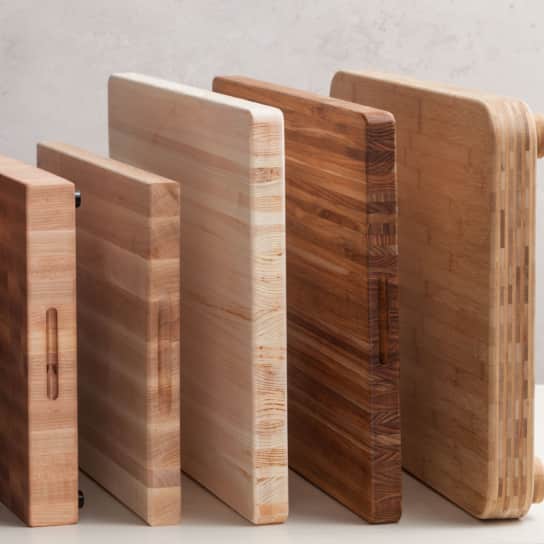
- Boards with Feet versus Reversible Boards: Boards with feet have a few advantages. As explained above, they’re great for taller cooks because the feet raise the cutting surface higher for easier chopping. Often tipped with grippy plastic or rubber, feet can help the boards stick to the counter, ensuring stable, secure chopping even if the boards aren’t that heavy. Some testers also liked how easy these raised boards were to grab—they could just stick their hands in the space underneath them and lift. Others pointed out that this space promoted air flow that facilitated drying on the countertop. By contrast, boards without feet must be stood on end to be dried evenly and completely. But many testers preferred these boards because they’re reversible, capable of being used on either side. And while they’re not quite as easy to pick up as boards with feet, several of the reversible boards came with finger grips—slight indentations on their short sides—that facilitated lifting. Ultimately, one type isn’t necessarily better than the other; it really depends on your personal preference.
What Makes Some Cutting Boards More Durable than Others?
Historically, our cutting board rankings have rested on two characteristics: durability and ease of maintenance. If a cutting board warps, cracks, or falls apart quickly, it doesn’t matter how beautiful or perfect it is for your personal use. Over the course of several months, we subjected all the boards to a wide variety of use, mincing parsley, chopping onions, slicing loaves of bread, pounding chicken cutlets, and using a cleaver to hack apart pounds of bone-in chicken parts. We also washed each board by hand more than 100 times over six months, maintaining them as needed between washings with mineral oil applications. At the end of testing, we examined each board for damage.
Ultimately, three factors determine how durable any cutting board is: the type of wood, the grain style, and the way you use and care for it.
Which Type of Wood Is Best for Cutting Boards?
In part, a board’s durability has to do with the type of wood used to make it. Every type of wood has a different hardness, which can be measured by the Janka hardness test. A wood’s Janka hardness value is expressed in pounds-force (lbf). The higher the Janka hardness value, the harder the wood. And the harder the wood, the more likely it is to resist damage: by the end of testing, the board made from soft hinoki (Janka hardness value of 348 to 627 lbf) was scarred much more deeply than boards made from harder woods such as maple (1,439 lbf) and yellow birch (1,259 lbf) or bamboo (1,480 lbf [estimated]).


Boards made from bamboo or harder woods such as maple (left) were noticeably less damaged after 5,000 cuts than boards made from softer woods such as hinoki (right).
On the flipside, we were curious whether these harder, more durable wood and bamboo boards would dull our knives faster than softer ones. To find out, we teamed up with the Autodesk Technology Center in Boston, using one of their robots to make 5,000 cuts on every board with a brand-new, factory-sharpened knife and pausing every 200 cuts to test the sharpness of the blade. To expedite the testing, the cuts were made at a fairly large force load, averaging 7 pounds, or about the amount of force you’d use to break down a chicken.
The results were reassuring. All the knives could still slice through paper (our basic sharpness test) after 5,000 cuts—enough to get you through many, many meal prep sessions— though some did so with more difficulty than others. (See the FAQ below: “Do different types of wood dull your knife faster?”) Adam Senalik, research general engineer at the U.S. Department of Agriculture (USDA) Forest Service Forest Products Laboratory in Madison, Wisconsin, told us that even though there is some variation in the hardnesses of the different woods and bamboo, all are still very soft compared to, say, glass, which can dull your knife in just a few strokes.
In the end, any board you choose will be fine for your knife. While harder boards do resist damage a bit better than soft ones, many of our testers preferred softer boards, finding them a bit more plush and pleasant to cut on overall. Ultimately, there are small tradeoffs to choosing a wood for your cutting board, so the choice of material is up to you. Our favorite board hits a happy medium. Made of teak (Janka hardness of 989 lbf), it’s soft enough to provide a luxurious cutting experience but hard enough to be relatively durable.


Edge-Grain versus End-Grain Construction: Which Is Better?
The way a board is constructed, or its grain style, can also play a role in determining how well it resists damage over time. There are two types of grain style: end-grain and edge-grain. End-grain boards are made from blocks of wood with their grain exposed on the cutting surface and extending vertically. Edge-grain boards are made from planks of wood with their grain running parallel to the cutting surface.
End-grain boards have a few characteristics that make them more susceptible to cracking and splitting. For one thing, they absorb more moisture than edge-grain boards; those vertical grains act like straws, sucking in any liquid that they encounter. This can have serious consequences for durability. Matt Huffman, furniture maker at Fort Point Cabinetmakers in Boston, explained: As each block or plank absorbs moisture (for example, while the board is being washed), it swells, pushing against the surrounding blocks or planks. And as it dries out, it shrinks, pulling away. This process of expansion and contraction changes the precise dimensions of the wood and stresses the glue joints that connect the pieces of wood, making it more likely that the pieces, both block and plank, will separate. The more water the wood absorbs, the greater the expansion and contraction. We saw this in action with the one end-grain board that cracked; it drank up water so quickly that we could barely blot it dry, and it ended up separating along many of its glue lines.
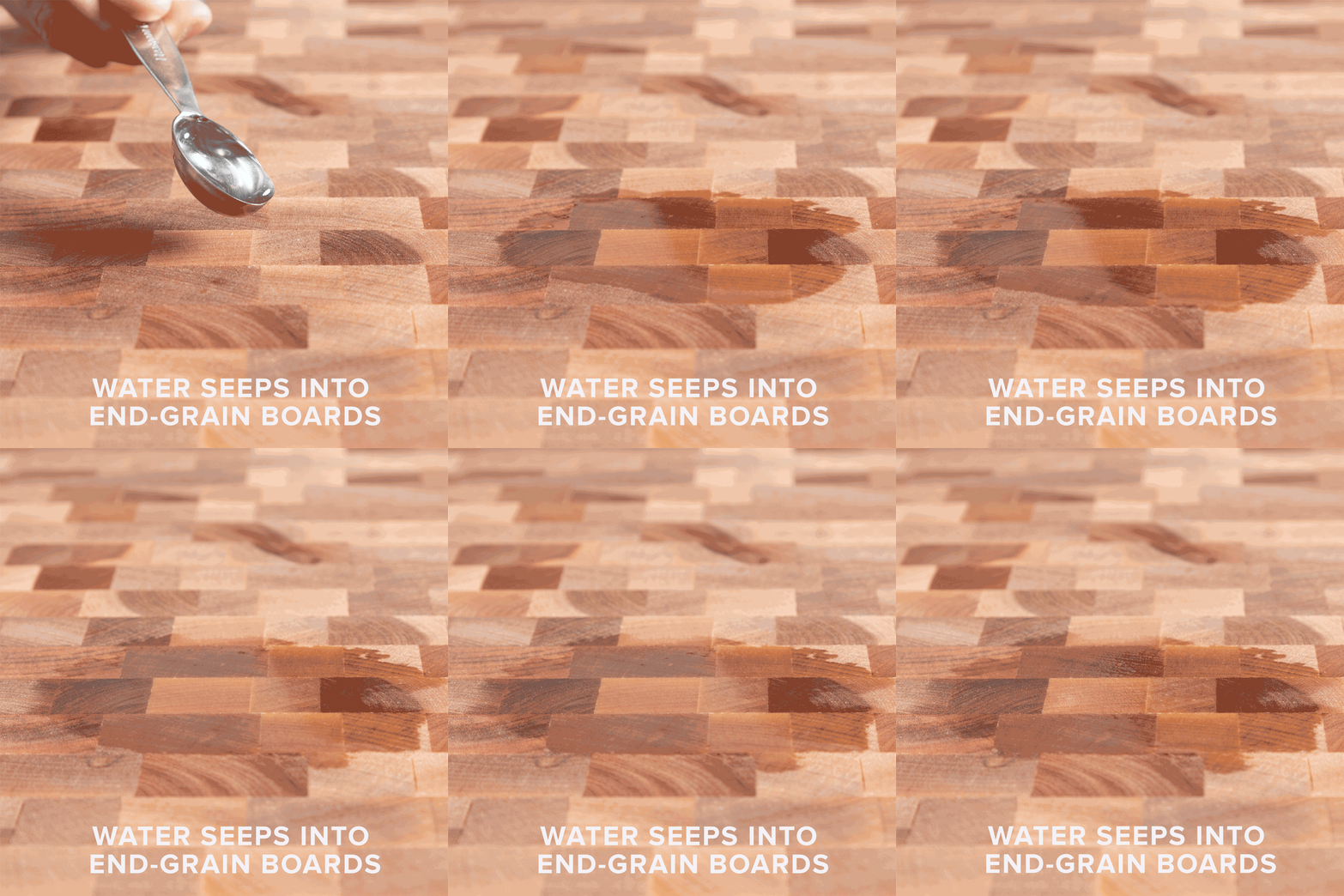
As Huffman explained, there’s another basic issue with end-grain boards. Because they’re made from so many different wood blocks, they have a lot more moving parts than most edge-grain boards—literally—and thus many more glue joints that can fail over time. Good woodworkers can account for the movement of each block and compensate accordingly. But these adjustments don’t always happen with mass-produced boards, so keep that in mind when choosing a model.
There is one last durability consideration with end-grain boards. When using an edge-grain board, your knife slices against the grain. When using an end-grain board, your knife slices with the blocks’ exposed grain. (Some folks think this makes end-grain boards gentler on the knife, but in our robot testing, there was no clear difference in sharpness between knives used on end-grain boards and knives used on edge-grain boards.)
Ordinarily, you’re cutting with such low force when performing ordinary kitchen cutting tasks that no real damage is done to the board. But if you make a forceful cut on an end-grain board—as you would when using a cleaver, for example—you are at a greater risk of splitting down the grain line than you would be if you were using an edge-grain board. Adam Senalik, research general engineer at the U.S. Department of Agriculture (USDA) Forest Service Forest Products Laboratory in Madison, Wisconsin, compares the process to chopping firewood: The easiest way to split a log is by chopping it on its end, with the grain, not on its side, against the grain. Indeed, when we hacked up chicken parts with a cleaver on each of the boards, the only board that cracked was an end-grain model. Cracks are worrisome not only because they forecast a shorter lifespan for the board but also because they can harbor bacteria.
This is not to say that you should avoid end-grain boards entirely. Far from it! When well-made and carefully treated, a good end-grain board can last a very long time. Indeed, all of the end-grain boards we sourced from small workshops survived testing in near-perfect condition, having been constructed with a lot of attention and expertise. Conversely, a few of the edge-grain boards we tested cracked and split too. While end-grain boards do have some intrinsic vulnerabilities, the grain style itself isn’t the sole determinant of how durable a board will be long-term. A lot depends on how well the boards themselves are constructed—and how well you, the user, handle it.

Associate Editor Miye Bromberg washed each cutting board by hand 100 times during testing.
Durability, Use, and Maintenance
Any cutting board can warp or crack if it isn’t maintained properly: After washing one model just six times, the planks in it started to separate slightly along the glue lines. This is because the most important factor in determining a board’s longevity isn’t the type of wood or the construction style—it’s the care the user takes in maintaining it. If a board hasn’t been properly conditioned before you receive it, you’ll need to apply several coats of oil or board butter prior to use to prevent it from absorbing water and cracking or warping. Throughout use, you’ll also need to oil it to maintain that waterproof coating (see this article on caring for your wood cutting board).
We measured the amount of oil that we needed to keep all the boards well seasoned during use. End-grain boards needed a lot more care than the edge-grain boards, absorbing oil greedily: On average, they took in 26.5 grams of oil during every maintenance session, though one model took in a whopping 47.3 grams of oil per session and could probably have absorbed more. By comparison, edge-grain boards only needed an average of 6.6 grams of oil per maintenance session. Our favorite required the least amount of oil—a mere 3.3 grams was enough to ensure that it stayed waterproof. That’s because it’s made from teak, a material that exudes oily resins called tectoquinones, which help keep the wood conditioned, repelling water.

End-grain boards require more oil to maintain than do edge-grain boards. Our winning cutting board requires the least oil of all.
Better still, we didn’t need to oil the teak board quite as often as other boards; it remained shiny well past the days when other boards needed a new coat. All that oil helped the board resist stains; after we left chopped chipotle chile in adobo on it for a few hours, there was virtually no evidence that the dark red chile had ever even been near it. Boards with comparatively less well-developed oil coatings were left with faint stains, though these generally disappeared after a few extra washes.
The Tests
- Mince parsley
- Chop onions
- Slice 1 loaf of bread
- Pound 4 chicken cutlets
- Cleave 9 pounds of chicken wings
- Chop chipotle chile in adobo sauce, leave for 2 hours, wash, examine for stains and odors
- Have 4 users of different heights test
- Hand-wash 100 times
- Maintain as needed, measuring amount of oil required
- Send separate copy home with user for 1 month; switch to another model for additional month
How We Rated
- Durability: We evaluated how resistant the boards were to scarring, cracking, separating, warping, and staining.
- Stability: We evaluated how securely the boards sat on the countertop.
- Ease of Use: We rated the boards on how easy they were to lift and how pleasant they were to cut on.
- Maintenance: We rated the boards on how much maintenance they needed; boards requiring less oil applied after washing or less frequent maintenance generally received more points.


 Buy at Jones Cutting Boards