

 Buy at Amazon
- Test a range of electric pasta machines
- Make spaghetti, fettuccine, penne, and lasagna sheets following the instructions provided in each of the machines’ instruction manuals
- Make spaghetti, fettuccine, penne, and lasagna sheets with our Egg Pasta Dough for Electric Pasta Machines
- Make spaghetti, fettuccine, penne, and lasagna sheets with our Semolina Dough for Electric Pasta Machines
- After each use, clean the machine and its parts according to the manufacturer’s instructions
Our favorite manual pasta maker, the Marcato Atlas 150 Wellness Pasta Machine, flawlessly rolls and cuts dough for perfect homemade fettuccine, sheets of lasagna, and angel hair pasta. But the Marcato and manual makers like it can’t produce extruded pasta such as spaghetti or tubular shapes such as macaroni and penne. Enter electric pasta makers, which promise not only to make these extruded pasta shapes but also to mix and knead the dough for you. Some even have built-in scales to weigh ingredients as you add them, so you don’t have to use a separate kitchen scale. But how well do these machines actually make pasta—and how easy are they to use and clean?
To find out, we tested a range of machines, using them to make different types of pasta. For these tests, we followed the recipes provided in each of the machines’ instruction manuals. We also made pasta using our Egg Pasta Dough for Electric Pasta Machine and our Semolina Pasta Dough for Electric Pasta Machine with each of the models.

Unlike manual models, electric pasta makers are able to make extruded pasta shapes such as penne and spaghetti. They also promise to mix and knead the dough for you.
How Easy Were The Machines To Use?
The machines in our lineup were similarly designed. Each featured a mixing paddle centered inside a chamber topped with a transparent plastic perforated lid. Shaping disks were positioned in a holder at the front of each machine. To make pasta, we added the flour to the mixing chamber, closed the lid, turned on the machine, and slowly added the liquid ingredients (egg and water) through the perforated lid. Once the dough was mixed, the paddle reversed direction and slowly pushed the dough through the shaping disk. We then cut the pasta strands as the machine extruded the dough.
We liked machines with simple control panels and limited options: start/stop, mix, and extrude. The control panels of the some machines were less intuitive and more jumbled, with lots of buttons and settings.

You can use a paring knife to cut the pasta as it extrudes, but our favorite machines came with dedicated tools for that purpose. (One of them was cleverly attached to the machine.) We also liked machines with shaping disks that were positioned vertically, so the extruding pasta was easy to see and cut. The disks of a few machines faced downward toward the counter, either directly toward the counter or at odd angles, making it hard to see the pasta as it came out.

Can You Use Any Pasta Dough Recipe In These Machines?
When we tried to make spaghetti using our Master Recipe for Pasta Dough and our recipe for gluten-free fresh pasta dough, all the machines struggled. Because these recipes weren’t designed with an electric pasta machine in mind, they were far too wet. We’ve since developed recipes that use less liquid; these worked well with every model. And we’ve found that incorporating a short rest between mixing and extruding these drier pasta doughs helps ensure success, too. (While most machines automatically progress from mixing to extruding, you can pause in between stages as needed; one machine also lets you choose each stage manually.) In a pinch, you can also use the recipes included in the machines’ manuals. However, some models produced less-than-ideal pasta at times, even with their own recipes. The edges of their fettuccine were ragged, their sheets of lasagna were narrow and torn in parts, and some made curved penne that looked more like macaroni or fusilli that was gently wavy instead of tightly curled.
Our takeaway? Use recipes that have been formulated specifically for electric pasta machines, including our new Egg Pasta Dough for Electric Pasta Machine, our Semolina Pasta Dough for Electric Pasta Machine, our Whole-Wheat Pasta Dough for Electric Pasta Machine, and our Gluten-Free Pasta Dough for Electric Pasta Machine. Pasta recipes developed for hand rolling or for manual pasta machines will not work.

We found that it was best to use the recipes that came with the machines. When we did so, our favorite model produced gorgeous spaghetti.
- Simple, easy-to-understand control panel
- Comes with a flat-edged tool for cutting the extruded pasta
- Extrudes the pasta frontward, giving us a clear visual of the pasta and making it easier to cut
- Produces great spaghetti, fettuccine, penne, and sheets of lasagna
How Easy Were The Machines To Clean?
To put it bluntly, none of the machines was easy to clean. This is because you have to disassemble the machine and wash each part separately. Our favorite electric pasta maker, for example, requires you to remove the front panel, then the shaping disk, then the disk holder, then the mixing paddle, then the mixing chamber. All the models also came with cleaning tools that had needle-like pointed ends to help you remove dough from the nooks and crannies of the shaping disks. And, of course, you must reassemble everything afterward.
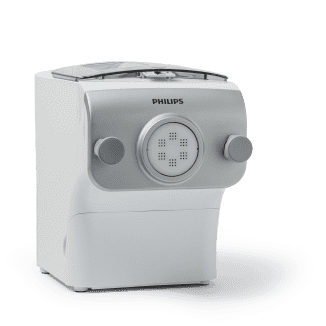
The Best Electric Pasta Machine: Philips Pasta Maker
Our favorite electric pasta maker was the priciest of the bunch. It effortlessly made spaghetti, fettuccine, and sheets of lasagna. It produced good penne, too. At times, the penne had a slight curl to its ends, but it still had defined ridges, which we liked. We liked its simple control panel and the flat-edged tool for cutting the extruded pasta. Like all the pasta machines, it took a bit of time to clean. And while it came with just four shaping disks (for spaghetti, fettuccine, penne, and lasagna sheets), you can buy extra attachments for shells, paccheri, rigatoni, macaroni, angel hair, pappardelle, and tagliatelle.