America's Test Kitchen LogoCook's Country LogoCook's Illustrated LogoAmerica's Test Kitchen LogoCook's Country LogoCook's Illustrated Logo

Pollo al Mattone (Chicken Under a Brick)

By Steve Dunn

Published on February 15, 2026

Time

1¼ hours plus 20 minutes resting

Yield

Serves 4

Pollo al Mattone (Chicken Under a Brick)

Ingredients

1 (4- to 4 ½-pound) whole chicken, giblets discarded4 teaspoons kosher salt 2 tablespoons vegetable oil 1½ teaspoons grated lemon zest plus 2 tablespoons juice, plus extra juice for serving 1 tablespoon minced fresh parsley 1½ teaspoons minced fresh rosemary 1½ teaspoons Dijon mustard 1 garlic clove, minced¼ teaspoon red pepper flakes ¼ teaspoon pepper Lemon wedges

Before You Begin

You will need 2 standard-sized bricks; alternatively, use a weight that’s at least 8 pounds (12-inch cast iron skillet or Dutch oven), but one as light as 4 pounds will work. We used Diamond Crystal kosher salt; if using Morton kosher salt, use only ½ teaspoon on each breast and leg. It’s important to remove the chicken from the oven at an internal temperature that is lower than usual and rest it the full 20 minutes before serving; the chicken will continue to cook as it rests (a probe thermometer is ideal here). Use an oven mitt or dish towel to safely grip and maneuver the hot bricks in step 4. If the skillet setup is too heavy to safely maneuver in steps 3 and 4, remove the weight just before transferring the skillet to the oven and replace before roasting; then remove it again before taking the skillet out.

Instructions

  1. Adjust oven rack to lower-middle position and heat oven to 400 degrees. Wrap 2 bricks tightly in aluminum foil and set aside. Place 1 whole chicken, giblets discarded, breast side down on cutting board. Using kitchen shears, cut through bones on either side of backbone. Trim off any excess fat and discard backbone. Flip chicken over and press on breastbone to flatten. Pat chicken dry with paper towels.
  2. Using your fingers, carefully loosen skin covering breast and legs. Rub ¾ teaspoon kosher salt under skin of each breast, ¾ teaspoon salt under skin of each leg, and 1 teaspoon salt onto bird's cavity. Tuck wings behind back and turn legs so drumsticks face inward toward breasts. (Chicken can be refrigerated, uncovered, for up to 24 hours. Pat dry with paper towels before cooking).
  3. Heat 2 tablespoons vegetable oil in 12-inch ovenproof skillet over medium-high heat until just smoking. Swirl skillet to coat evenly with oil. Place chicken in skillet skin-side down. Place weight on top of chicken, making sure it is in even contact with breasts and legs, and press chicken firmly into skillet. Cook for 5 minutes, rotating pan halfway through cooking. Transfer skillet, with weight still on chicken, to oven and roast for 20 minutes.
  4. Remove skillet from oven and remove weight. Using tongs and thin metal spatula, flip bird so it is skin-side up (if necessary, run spatula under chicken to loosen from bottom of skillet). Return skillet to oven and continue to roast chicken (unweighted) until thickest part of breast registers 150 degrees, 15 to 20 minutes longer.
  5. Meanwhile, combine 1½ teaspoons grated lemon zest plus 2 tablespoons juice, 1 tablespoon minced parsley, 1½ teaspoons minced rosemary, 1½ teaspoons Dijon mustard, 1 minced garlic clove, ¼ teaspoon pepper flakes, and ¼ teaspoon pepper in bowl.
  6. Transfer chicken to carving board and let rest, uncovered, for 20 minutes. Add any fat and pan juices to lemon mixture. Carve chicken and whisk any accumulated juices into vinaigrette. Season vinaigrette with salt, pepper, and lemon juice to taste. Serve chicken, passing vinaigrette and lemon wedges separately.

Pollo al Mattone (Chicken Under a Brick)
Photography by Steve Klise. Styling by Joy Howard.

Pollo al Mattone (Chicken Under a Brick)

Headshot of Steve Dunn
By Steve Dunn

Published on February 15, 2026

Save

Time

1¼ hours plus 20 minutes resting

Yield

Serves 4

Ingredients

1 (4- to 4 ½-pound) whole chicken, giblets discarded
4 teaspoons kosher salt
2 tablespoons vegetable oil
1½ teaspoons grated lemon zest plus 2 tablespoons juice, plus extra juice for serving
1 tablespoon minced fresh parsley
1½ teaspoons minced fresh rosemary
1½ teaspoons Dijon mustard
1 garlic clove, minced
¼ teaspoon red pepper flakes
¼ teaspoon pepper
Lemon wedges

Test Kitchen Techniques

Ingredients

1 (4- to 4 ½-pound) whole chicken, giblets discarded
4 teaspoons kosher salt
2 tablespoons vegetable oil
1½ teaspoons grated lemon zest plus 2 tablespoons juice, plus extra juice for serving
1 tablespoon minced fresh parsley
1½ teaspoons minced fresh rosemary
1½ teaspoons Dijon mustard
1 garlic clove, minced
¼ teaspoon red pepper flakes
¼ teaspoon pepper
Lemon wedges

Test Kitchen Techniques

Ingredients

1 (4- to 4 ½-pound) whole chicken, giblets discarded
4 teaspoons kosher salt
2 tablespoons vegetable oil
1½ teaspoons grated lemon zest plus 2 tablespoons juice, plus extra juice for serving
1 tablespoon minced fresh parsley
1½ teaspoons minced fresh rosemary
1½ teaspoons Dijon mustard
1 garlic clove, minced
¼ teaspoon red pepper flakes
¼ teaspoon pepper
Lemon wedges

Test Kitchen Techniques

Why This Recipe Works

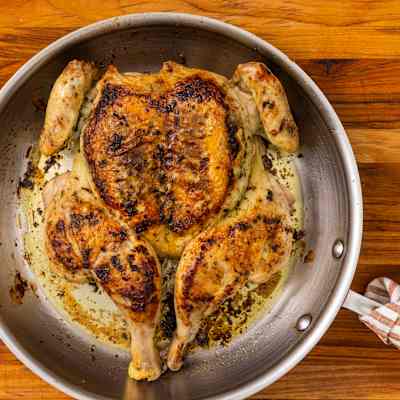
Pollo al mattone, or brick chicken, takes spatchcocked roast chicken to the next level by pressing the flattened bird under a weight as it cooks. After spatchcocking (or butterflying) the bird, we applied salt directly to the meat rather than to the skin; that way, the salt seasoned the meat directly, and the skin held the salt in place so it didn’t fall off during cooking. Pressing the chicken with bricks (or any heavy weight) speeded cooking even more by forcing it to maintain contact with the hot pan. It also kept the bird flat so that every bit of the skin browned deeply. Removing the chicken from the oven before it was done took advantage of carryover cooking. As it rested, its temperature rose to the 160-degree target without overshooting it, so the meat was tender and juicy. Then, rather than seasoning the meat with Tuscan flavors such as rosemary, garlic, and lemon, we mixed them into the chicken’s pan drippings to create a punchy, rich-tasting vinaigrette that we spooned over the carved meat.

Want more? Read the whole story

Before You Begin

You will need 2 standard-sized bricks; alternatively, use a weight that’s at least 8 pounds (12-inch cast iron skillet or Dutch oven), but one as light as 4 pounds will work. We used Diamond Crystal kosher salt; if using Morton kosher salt, use only ½ teaspoon on each breast and leg. It’s important to remove the chicken from the oven at an internal temperature that is lower than usual and rest it the full 20 minutes before serving; the chicken will continue to cook as it rests (a probe thermometer is ideal here). Use an oven mitt or dish towel to safely grip and maneuver the hot bricks in step 4. If the skillet setup is too heavy to safely maneuver in steps 3 and 4, remove the weight just before transferring the skillet to the oven and replace before roasting; then remove it again before taking the skillet out.

Instructions

  1. Adjust oven rack to lower-middle position and heat oven to 400 degrees. Wrap 2 bricks tightly in aluminum foil and set aside. Place 1 whole chicken, giblets discarded, breast side down on cutting board. Using kitchen shears, cut through bones on either side of backbone. Trim off any excess fat and discard backbone. Flip chicken over and press on breastbone to flatten. Pat chicken dry with paper towels.
  2. Using your fingers, carefully loosen skin covering breast and legs. Rub ¾ teaspoon kosher salt under skin of each breast, ¾ teaspoon salt under skin of each leg, and 1 teaspoon salt onto bird's cavity. Tuck wings behind back and turn legs so drumsticks face inward toward breasts. (Chicken can be refrigerated, uncovered, for up to 24 hours. Pat dry with paper towels before cooking).
  3. Heat 2 tablespoons vegetable oil in 12-inch ovenproof skillet over medium-high heat until just smoking. Swirl skillet to coat evenly with oil. Place chicken in skillet skin-side down. Place weight on top of chicken, making sure it is in even contact with breasts and legs, and press chicken firmly into skillet. Cook for 5 minutes, rotating pan halfway through cooking. Transfer skillet, with weight still on chicken, to oven and roast for 20 minutes.
  4. Remove skillet from oven and remove weight. Using tongs and thin metal spatula, flip bird so it is skin-side up (if necessary, run spatula under chicken to loosen from bottom of skillet). Return skillet to oven and continue to roast chicken (unweighted) until thickest part of breast registers 150 degrees, 15 to 20 minutes longer.
  5. Meanwhile, combine 1½ teaspoons grated lemon zest plus 2 tablespoons juice, 1 tablespoon minced parsley, 1½ teaspoons minced rosemary, 1½ teaspoons Dijon mustard, 1 minced garlic clove, ¼ teaspoon pepper flakes, and ¼ teaspoon pepper in bowl.
  6. Transfer chicken to carving board and let rest, uncovered, for 20 minutes. Add any fat and pan juices to lemon mixture. Carve chicken and whisk any accumulated juices into vinaigrette. Season vinaigrette with salt, pepper, and lemon juice to taste. Serve chicken, passing vinaigrette and lemon wedges separately.

Gift This Recipe

Enjoyed this dish? Let others know by sharing it as a gift recipe.

This is a members' feature.