
America's Test Kitchen LogoCook's Country LogoCook's Illustrated Logo

Reviews You Can Trust.
See Why.

The Best Chef’s Knives

A good knife is a cook’s best friend. How do you choose the one that’s right for you?

Headshot of Miye Bromberg
By Miye Bromberg

Last Updated October 22, 2025

Editor&aposs Note:Update, October 2025

We tested seven knives priced between $75 and $200. While we still think that the Victorinox Swiss Army Fibrox Pro 8" Chef's Knife is the best knife you can buy for less than $75, we’ve added an additional winner for cooks who’d like to spend a bit more: the Shun Classic 8" Western Cook’s Knife.

What You Need To Know

Our favorite inexpensive chef’s knife is the Victorinox Swiss Army Fibrox Pro 8" Chefs Knife. We’ve routinely tested and recommended this knife for nearly three decades, and for good reason: It cuts foods of all kinds effortlessly, is comfortable for hands of all sizes to grip, and arrives and stays quite sharp. It’s also reliably durable, easy to sharpen, and well-made. We think it’s the best affordable option for most people. If you are on a particularly tight budget, we think that the Mercer Culinary Millennia 8-Inch Chef’s Knife offers great value. It costs half as much as our top choice and performs just as well. Our only quibble is that its handle is made from a highly textured plastic that some users found less pleasant to hold. If you would like a knife that looks and feels much more luxurious—and are willing to pay more for the privilege—we highly recommend the Shun Classic 8" Western Cooks Knife. It’s got a beautiful, razor-sharp blade and a long wood composite handle that most users found comfortable to hold. It made quick work of every task we set before it.

three knives are shown with callouts explaining that these are the best knives under and over $75

A good chef’s knife is a cook’s best friend. It’s arguably the most important tool in the kitchen, an essential all-purpose blade that can do everything from small, precise tasks (mincing garlic) to minor butchery (breaking down a chicken, filleting a fish) and a whole lot in between. If you buy just one knife, many say, let it be a chef’s knife.

For this review, we focused on knives with blades measuring about 8 inches, as we’ve found this length to be the most useful and versatile for most cooks. We also limited the scope to Western-style chef’s knives, which generally have a heavier weight, a larger blade, and a more curved blade edge than the gyuto many home cooks use instead. For now, we’ve set a price cap of about $250, though we hope to review knives at higher price points in the future; all the knives in our current lineup are what most knife shops consider “mass-produced.” In this price range, almost all the Western-style chef’s knives available are made from stainless (stain-resistant) steel. If you are interested in using a knife with a carbon-steel blade, we recommend checking out our reviews of gyuto or nakiri.

a knife minces a white oniona man with grey hair cuts Swiss charda knife cuts red bell pepper into strips

We use our chef’s knives for pretty much everything—not only for chopping vegetables (as shown here) but also for breaking down chickens, slicing sandwiches, and a whole lot more.

How Much Should You Spend on a Knife?

It really depends on your budget and needs. We don’t think you have to spend a lot to get a solid knife. We’ve recommended the Victorinox Swiss Army Fibrox Pro 8" Chef’s Knife as our top inexpensive choice for decades, and it generally costs between $45 and $70 online. A mainstay of commercial kitchens, it’s an amazing no-frills performer, with a comfortable, easy-to-grip plastic handle and a sharp, moderately thin blade. It won’t win any beauty contests, but it offers incredible value for its price. We’ve found acceptable knives that cost even less too; the Mercer Culinary Millennia 8-Inch Chef’s Knife can usually be purchased for under $30. With a rubbery plastic handle, it looks and feels quite utilitarian, but it’s a surprisingly decent performer considering its bargain-basement cost.

If you are just starting to cook, have a limited budget, or just want a good knife that you don’t need to be too precious about maintaining or caring for, any one of these knives will stand you in good stead. (Cooks in the Test Kitchen use dozens of the Victorinox chef’s knife on a daily basis, both at work and at home.)

That said, you can spend a lot more than $75 on a chef’s knife, and many of us find it worthwhile to do so. After all, a knife is a tool that most of us use every day, and a good one should last a lifetime. If you have the means, it can be worth your while to make a bigger investment.

What Do You Get When You Spend More on a Knife?

We get this question a lot, and with good reason: We all want to know what you get if you upgrade from a fairly basic knife to something, well, a little more expensive. To find out, we interviewed almost a dozen knife manufacturers and knife shop owners about the differences between their least and most expensive knives. As we learned, there are some significant benefits:

  • Harder Steel Alloys: The more you pay, the more likely it is that your knife will come with a blade made from a harder steel alloy. Harder steel alloys are more expensive to produce. According to senior science editor Paul Adams, harder alloys can require more costly metal elements (such as vanadium and tungsten) to produce. And as Mike Tarkanian, senior lecturer in the Department of Materials Science and Engineering at the Massachusetts Institute of Technology, explained, “The harder the steel, the more difficult it is to work with.” A harder alloy might require more labor to shape, and knives made with it might have a higher “scrap rate”—that is, a greater percentage of the knives produced with it might turn out imperfectly or otherwise prove to be unsellable. That hard steel alloy might also require more sophisticated (and expensive) equipment and techniques to shape and grind, or it could require costly processing and manufacturing techniques (such as sintering or multiple cycles of heat treatment). The benefits? Harder steel can be made into thinner, more rigid knives that can feel more agile and precise, and blades made with it have better edge retention, meaning that they keep their sharp edges longer. There are a few downsides, too, though: that hard steel is prone to chipping, so as with Japanese knives, you’ll want to avoid using these blades to cut through bone or frozen and other especially hard or dense foods. And while you’ll have to sharpen a knife with a hard steel blade less frequently, it can be more difficult to do so when the time rolls around, taking more passes, force, or time on a whetstone, electric sharpener, or manual sharpener.
  • Premium Handles: More expensive knives can have handles made from more expensive materials—often wood. Or they might come in colors other than a conventional matte black. This gives them a nicer look and feel.
we see three handles: one scuffed black plastic handle, one red swirly handle, and one maroon composite handle
More expensive knives, such as the middle and bottom models, often have nicer handles made with premium materials or sporting special colors. Less expensive knives usually have more utilitarian black plastic handles, as we see at top.
  • Better Finishing and Quality Control: As Josh Donald from Bernal Cutlery in San Francisco told us, more expensive knives often see better finishing and a more rigorous quality control process than cheaper ones. Knives may be sharpened to a finer degree, and handles may be shaped, polished, and smoothed to have more pleasant contours. And all these tasks may be performed by hand, requiring expert labor and adding time to production. In addition, the finished knives may be scrutinized more intensively in order to ensure that the knives have no blemishes or defects in their construction. Time, expertise, and extensive quality control cost manufacturers money, driving prices up on higher-quality knives.
two blades are shown. One is simple and unadorned; the other has a fancy, rippled, hammered finish.
Less expensive knives (top) have simpler, softer blades. Spending more money can get you a sharper blade made from harder steel and often one that has been given special treatments or processing, as seen with the hammered finish on the blade at bottom.

Basically, paying more will usually get you a better-looking, better-feeling knife—one that provides a more luxurious cutting experience than your basic blade.

As Kirsten Dressler Wilson, vice president of knife company Messermeister told us, “Pasta sauce out of a jar can taste just fine, but if you’ve ever been to Italy in late summer, when the tomatoes are ripe, you know that there’s an entirely different level of flavor. It can be very hard to go back to the old jar once you’ve tasted the difference. . . . When we make an entry-priced knife, we strive to contain some of the basic elements of our premium knives, but out of necessity, we make some sacrifices in materials, design, and/or finishing in order to deliver a product at a more accessible price. For us, the key is to deliver fair and solid value while accentuating at least one key performance element, like sharpness, comfort, or ease of maintenance. The consumer can choose what is important to them, but they can’t have it all. The materials, processes and shapes that are used in our premium knives are all selected for performance. It is not always obvious to the eye, but these materials deliver much greater sharpness, durability, and function than common materials.”

“The materials, processes, and shapes that are used in our premium knives are all selected for performance. It is not always obvious to the eye, but these materials deliver much greater sharpness, durability, and function than common materials.”

—- Kirsten Dressler Wilson, VP of Messermeister

There’s one other consideration to keep in mind. If you’re willing to pay more for your primary knife to begin with, you might want to invest in a gyuto or santoku instead of a Western-style chef’s knife. While we recommend the majority of the more expensive knives we’ve tested as part of this review, many of our testers preferred the feel and cutting action of these Japanese knives, which cost about the same. The big blades, longer handles, thicker spines, and heavier builds found on Western-style chef’s knives aren’t for everyone. If you have small hands or prefer a lighter-weight, more nimble blade, one of these other knives might be the way to go.

What to Look For

  • A Sharp Blade: A sharp knife is a pleasure to use, making quick work of any task. We think a chef’s knife should be keen and ready to use right out of the box, since not all cooks have the equipment or skills to sharpen their knives at home. Two main factors determine sharpness. One is edge angle—the angle of the blade on either side of its cutting edge. The narrower the angle, the thinner the cutting edge and the sharper the knife can feel in action. Most of the knives we tested had narrow edge angles of 13 to 16 degrees, which would—in theory—be enough of an angle to make a knife feel sharp. In practice, the sharpness of many of the blades came down to a second factor: how well they had been sharpened and honed at the factory. The best knives had smooth, even-looking edges with no chips. Our top two knives had edge angles on the upper half of the range but had been nicely sharpened so that they glided through onions and tomatoes as smoothly as knives with narrower edge angles.
A large knife slices through a tomato.
A sharp blade should cut cleanly through a delicate tomato, keeping each slice intact, with no torn skin or pulped insides.
  • A Gently Curved Edge: Western-style chef’s knives have blades that are curved to enable cuts where you rock the blade forward from tip to heel. We preferred blades where the curve was fairly gentle, allowing a natural cutting motion. Blades with more exaggerated, rounded bellies occasionally put our arms and wrists at slightly more awkward angles as we cut.

We preferred knives with gently curved blades (top), as these allowed us to make different types of cuts easily. Knives with more dramatically curved blades (bottom) sometimes put our arms and wrists at awkward angles as we cut.

  • Clearance Under the Handle: In general, the taller the blade is at the heel, the higher the handle sits above the cutting board, providing more space underneath it for our fingers to curl. Our favorite blades were about 2 inches tall at the heel. Blades that were shorter sometimes didn’t leave enough room for our fingers, pushing them into the cutting board as we rocked through cuts.
A hand holds the handle of a blade, with plenty of room between the knuckles and the counter.A hand holds the handle of a blade, knuckles grazing the counter.

Blades that were tall at the heel (left) left plenty of room for our fingers to curl around the handle; blades that were shorter (right) didn’t provide enough clearance, cramping our fingers.

  • A Rounded Spine: We liked blades with rounded spines, as they were more comfortable to choke up on than those with sharper, squared-off spines, which dug into our hands.
the top of a knife blade with sharp, squared off edgesthe top of a knife blade with rounded edges

Blades with rounded spines (right) were easier to choke up on and grip than those with sharper, squared-off spines (left).

  • A Grippy Handle with Rounded Edges: We preferred knives with handles made from rubbery, textured materials, as these were cushier and easier to grip, especially when our hands were wet or greasy. We didn’t have clear preferences on the shape of the handle. We liked uniformly cylindrical Japanese-style handles and curvier handles with ergonomic bumps; both gave us plenty of grip options. Regardless of style, the best handles had soft, rounded contours, nestling into our hands instead of biting into them.
A knife sits on a white plastic cutting board with pieces of a butternut squash cut up around it.

The best knives were able to chop tough butternut squash with authority; lesser knives faltered, wobbled, or got stuck.

What to Avoid

  • A Dull or Poorly Sharpened Blade: A dull blade will mangle your food, bruising your parsley and crushing your onion into eye-watering pulp instead of dicing it neatly. It’s also dangerous; it’ll slip on chicken skin or require extra force to push through a potato, putting your fingers at risk. To our chagrin, several of the knives we tested came out of the box with dull, coarse, toothy, or inconsistently sharpened edges (e.g., sharp at the tip yet dull at the heel).
  • An Ultrathin Blade: Thin blades are great for relatively light use and precision tasks, such as mincing garlic or dicing onions, but they're not necessarily ideal in an all-purpose knife. Measuring just 1.3 millimeters thick, the thinnest blade struggled on tasks that required more power, wobbling and bending alarmingly when we bore down on it while cutting through chicken breasts.

Other Considerations

  • Spine Thickness: The thickness of a blade’s spine helps determine how powerful or agile a blade feels. In general, the thicker the spine from one end to another, the heavier, and more rigid the blade will usually be overall, providing extra power for cleaving through dense butternut squash or bone. With a thick-spined blade of 2.5 mm or more, gravity is on your side. The downside is that blades with thicker spines can also function similarly to axes, wedging into food and getting stuck if their edges aren’t sufficiently sharp. On the flip side, as mentioned above, blades that have especially thin spines can be less rigid and more flexible. They’re nimble and can glide through food effortlessly, but they lack power for tougher jobs and can sometimes make less precise cuts if their blades bend too much during use. Western-style chef’s knife blades typically have thicker spines than those seen in Japanese gyuto, their rough equivalent. While we wouldn’t necessarily dismiss a knife out of hand because it had a particularly thick or thin spine, our top choices had spines whose thickness fell in the middle of the range, measuring about 2 to 2.3 mm at the center of the spine.
We see the tops of two knife blades: on top, a thin spine, and on bottom, a thicker one.

Blades with thin spines (top) are more nimble and glide through food more effortlessly. Blades with thick spines (bottom) have more power; while they sometimes wedge into food and get stuck, they are good at getting through dense butternut squash and bone.

  • Weight: Some testers liked heavier knives, saying they felt especially solid and well-made in their hands. Others preferred fairly lightweight knives, finding them easier to use for long periods without tiring. Ultimately, the choice is personal; we highly recommend both heavier and lighter options.

The Tests:

  • Evaluate each knife’s sharpness using an industrial sharpness-testing machine at the beginning and end of testing
  • Slice tomatoes
  • Dice onions
  • Mince garlic
  • Mince parsley
  • Break down a whole chicken into parts
  • Break down butternut squash and dice it

How We Rated:

  • Blade: We evaluated how spine shape, blade height and curvature, and other factors contributed to each knife’s performance.
  • Handle: We rated each knife on how comfortable its handle was to grip.
  • Sharpness: We rated the knives on how sharp they were before, during, and at the end of testing.

FAQs

Not sure if your knife is sharp? Use this simple test to find out.

Keep your knife sharp with these simple techniques.

In between sharpening sessions, touch up the edge of your blade with a honing steel.

If you’re on the go, consider getting a blade guard to protect your knife.

Please don’t. To learn why, check out our article on this topic.

This article explains the differences between these two major knife types.

Everything We Tested

Good 3 Stars out of 3.
Fair 2 Stars out of 3.
Poor 1 Star out of 3.

Highly Recommended - Over $75

  • Blade
  • Handle
  • Sharpness

Best Knife over $75Shun Classic 8" Western Cook’s Knife

This knife wowed users with its ultrakeen blade, which sliced even dense butternut squash as if it were butter. A relatively thick spine and heavier weight also contributed to the ease with which we were able to wield this knife, conferring extra power as we sliced and diced. The blade has a moderately curved edge, which makes it ideal for folks who like to rock through their cuts. We have just one small complaint The smooth, straight wood composite handle is a bit slippery and quite long, with a usable length of more than 5 inches, making it a little trickier for smaller hands to grip securely.

Model Number: DM0766

Handle Material: Pakkawood

Weight: 8.1 oz

Edge Angle: 22°

Heel Height: 2.1 in

Price at Time of Testing: $184.95

  • Blade
  • Handle
  • Sharpness

This knife wowed users with its ultrakeen blade, which sliced even dense butternut squash as if it were butter. A relatively thick spine and heavier weight also contributed to the ease with which we were able to wield this knife, conferring extra power as we sliced and diced. The blade has a moderately curved edge, which makes it ideal for folks who like to rock through their cuts. We have just one small complaint The smooth, straight wood composite handle is a bit slippery and quite long, with a usable length of more than 5 inches, making it a little trickier for smaller hands to grip securely.

Model Number: DM0766

Handle Material: Pakkawood

Weight: 8.1 oz

Edge Angle: 22°

Heel Height: 2.1 in

Price at Time of Testing: $184.95

  • Blade
  • Handle
  • Sharpness

Miyabi Artisan 8-inch, Chef’s Knife

We debated whether to include this knife here or in our gyuto review. While the knife has a Japanese name, it’s actually made by a German company, Zwilling, and its design reflects its mixed pedigree. While the shape of the blade is fairly similar to that of a gyuto—forming a narrower triangle than most of the chef’s knives we’ve tested here—it’s got the heftier weight, larger handle, and more curved blade edge of a Western-style knife, making it a better fit for this review. Exact classification aside, this knife was one of the top choices of everyone who tried it. Its ultrasharp blade cut through every type of food effortlessly. And the blade has a rippled, dimpled tsuchime finish that is supposed to help prevent food from sticking as you cut. While we didn’t notice this benefit, the finish certainly makes for an especially good-looking knife. One minor quibble The wood handle is fairly smooth, long (over 5 inches), and full-bellied, making it a little harder for smaller hands to grip securely.

Model Number: 34073-203/1019789

Handle Materials: Cocobolo wood, Rosewood, Pakkawood

Weight: 7.3 oz

Edge Angle: 9–12°

Heel Height: 1.9 in

Price at Time of Testing: $199.95

  • Blade
  • Handle
  • Sharpness

We debated whether to include this knife here or in our gyuto review. While the knife has a Japanese name, it’s actually made by a German company, Zwilling, and its design reflects its mixed pedigree. While the shape of the blade is fairly similar to that of a gyuto—forming a narrower triangle than most of the chef’s knives we’ve tested here—it’s got the heftier weight, larger handle, and more curved blade edge of a Western-style knife, making it a better fit for this review. Exact classification aside, this knife was one of the top choices of everyone who tried it. Its ultrasharp blade cut through every type of food effortlessly. And the blade has a rippled, dimpled tsuchime finish that is supposed to help prevent food from sticking as you cut. While we didn’t notice this benefit, the finish certainly makes for an especially good-looking knife. One minor quibble The wood handle is fairly smooth, long (over 5 inches), and full-bellied, making it a little harder for smaller hands to grip securely.

Model Number: 34073-203/1019789

Handle Materials: Cocobolo wood, Rosewood, Pakkawood

Weight: 7.3 oz

Edge Angle: 9–12°

Heel Height: 1.9 in

Price at Time of Testing: $199.95

Highly Recommended - Under $75

  • Blade
  • Handle
  • Sharpness

Best Knife Under $75Victorinox Swiss Army Fibrox Pro 8" Chef’s Knife

Our longtime inexpensive favorite remains a pleasure to use. With a sharp, gently curved blade, it effortlessly dispatched every task we set before it, mincing garlic precisely and breaking down chicken and dense butternut squash with authority. Its light weight and rounded spine made it easy to wield for long periods, and its textured plastic handle was comfortable to grip for hands of all sizes. Its basic looks won’t win any beauty contests, but over the decades, it’s proved itself to be a steady, stalwart companion for many cooks.

Model Number: 5.2063.20-X4

Handle Material: Thermoplastic elastomer

Weight: 5⅞ oz

Edge Angle: 15°

Heel Height: 2 in

Price at Time of Testing: $55.00

  • Blade
  • Handle
  • Sharpness

Our longtime inexpensive favorite remains a pleasure to use. With a sharp, gently curved blade, it effortlessly dispatched every task we set before it, mincing garlic precisely and breaking down chicken and dense butternut squash with authority. Its light weight and rounded spine made it easy to wield for long periods, and its textured plastic handle was comfortable to grip for hands of all sizes. Its basic looks won’t win any beauty contests, but over the decades, it’s proved itself to be a steady, stalwart companion for many cooks.

Model Number: 5.2063.20-X4

Handle Material: Thermoplastic elastomer

Weight: 5⅞ oz

Edge Angle: 15°

Heel Height: 2 in

Price at Time of Testing: $55.00

  • Blade
  • Handle
  • Sharpness

Mercer Culinary Renaissance 8-Inch Forged Chef’s Knife

This knife ran a very close race with our winner. It had a very sharp, gently curved blade that tackled every task well, and its rounded spine was easy to choke up on when we used a pinch grip. It’s a little heavier than our winner, but some testers actually preferred that extra weight, finding it “solid” and “authoritative” in their hands. And it’s just as inexpensive. One small quibble? The handle is made from a somewhat slick plastic that sometimes felt slippery when wet or greasy.

Model Number: M23510

Handle Material: Delrin polyoxymethylene

Weight: 8⅛ oz

Edge Angle: 16°

Heel Height: 1.9 in

Price at Time of Testing: $56.00

  • Blade
  • Handle
  • Sharpness

This knife ran a very close race with our winner. It had a very sharp, gently curved blade that tackled every task well, and its rounded spine was easy to choke up on when we used a pinch grip. It’s a little heavier than our winner, but some testers actually preferred that extra weight, finding it “solid” and “authoritative” in their hands. And it’s just as inexpensive. One small quibble? The handle is made from a somewhat slick plastic that sometimes felt slippery when wet or greasy.

Model Number: M23510

Handle Material: Delrin polyoxymethylene

Weight: 8⅛ oz

Edge Angle: 16°

Heel Height: 1.9 in

Price at Time of Testing: $56.00

  • Blade
  • Handle
  • Sharpness

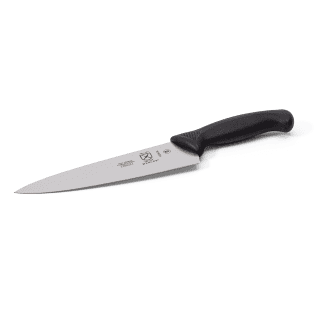
Best Buy Under $75Mercer Culinary Millennia 8-Inch Chef’s Knife

Costing about half the price of our winner, this knife is a great value. It resembles our top choice in many ways, with a blade that’s nearly identical sharp and capable of dispatching all tasks effortlessly. And it’s lightweight and easy to wield. We generally liked its handle, which was large (but not too large) and mostly comfortable to hold. Our one small quibble is with its material, a bumpy rubber that’s so grippy that it sometimes impedes movement, making it a touch harder to shift hand positions easily.

Model Number: M22608

Handle Material: Santoprene and polypropylene

Weight: 5⅞ oz

Edge Angle: 16°

Heel Height: 2 in

Price at Time of Testing: $23.99

  • Blade
  • Handle
  • Sharpness

Costing about half the price of our winner, this knife is a great value. It resembles our top choice in many ways, with a blade that’s nearly identical sharp and capable of dispatching all tasks effortlessly. And it’s lightweight and easy to wield. We generally liked its handle, which was large (but not too large) and mostly comfortable to hold. Our one small quibble is with its material, a bumpy rubber that’s so grippy that it sometimes impedes movement, making it a touch harder to shift hand positions easily.

Model Number: M22608

Handle Material: Santoprene and polypropylene

Weight: 5⅞ oz

Edge Angle: 16°

Heel Height: 2 in

Price at Time of Testing: $23.99

  • Blade
  • Handle
  • Sharpness

Victorinox Swiss Classic 8" Chef’s Knife

This knife is nearly identical to our favorite. It has the same sharp, relatively thin, gently curved blade, so it excelled at every task we gave it, mincing garlic and powering through butternut squash equally well. And it’s even lighter in weight, so we could use it effortlessly for long periods. Testers just didn’t like its handle quite as much as our favorite’s—it’s longer, it’s slightly slicker, and it has an indentation in its belly, all of which made it less comfortable to grip.

Model Number: 6.8063.20-X2

Handle Material: Thermoplastic elastomer

Weight: 5⅝ oz

Edge Angle: 15°

Heel Height: 2 in

Price at Time of Testing: $54.00

  • Blade
  • Handle
  • Sharpness

This knife is nearly identical to our favorite. It has the same sharp, relatively thin, gently curved blade, so it excelled at every task we gave it, mincing garlic and powering through butternut squash equally well. And it’s even lighter in weight, so we could use it effortlessly for long periods. Testers just didn’t like its handle quite as much as our favorite’s—it’s longer, it’s slightly slicker, and it has an indentation in its belly, all of which made it less comfortable to grip.

Model Number: 6.8063.20-X2

Handle Material: Thermoplastic elastomer

Weight: 5⅝ oz

Edge Angle: 15°

Heel Height: 2 in

Price at Time of Testing: $54.00

Recommended - Over $75

  • Blade
  • Handle
  • Sharpness

Wüsthof Classic 8" Chef’s Knife

The blade on this chef’s knife has a relatively narrow triangular shape, so at first glance, you might think it was a gyuto. But the knife’s heavy weight, thick spine, and big bolster left no doubt that this was a German-made knife, providing more power than many of the other knives we’ve tested. The blade itself was quite sharp, but because its spine was so thick and the knife overall was hefty, it sometimes felt a little less nimble than testers liked. Testers approved of its handle, though, which is made from a grippy synthetic material that’s meant to mimic the feel of wood. The handle also comes in different colorways, allowing a little more customization and character than your average black-handled blade.

Model Number: 1040100120

Handle Material: Plastic

Weight: 9 oz

Edge Angle: 14°

Heel Height: 1.8 in

Price at Time of Testing: $170.00

  • Blade
  • Handle
  • Sharpness

The blade on this chef’s knife has a relatively narrow triangular shape, so at first glance, you might think it was a gyuto. But the knife’s heavy weight, thick spine, and big bolster left no doubt that this was a German-made knife, providing more power than many of the other knives we’ve tested. The blade itself was quite sharp, but because its spine was so thick and the knife overall was hefty, it sometimes felt a little less nimble than testers liked. Testers approved of its handle, though, which is made from a grippy synthetic material that’s meant to mimic the feel of wood. The handle also comes in different colorways, allowing a little more customization and character than your average black-handled blade.

Model Number: 1040100120

Handle Material: Plastic

Weight: 9 oz

Edge Angle: 14°

Heel Height: 1.8 in

Price at Time of Testing: $170.00

  • Blade
  • Handle
  • Sharpness

ZWILLING Pro 8-Inch Chef’s Knife

This knife evoked strong reactions from testers. Out of the box, it was incredibly sharp, but not everyone liked the pronounced curve of its edge, which required us to position our arms at an awkward angle and rock the blade from tip to heel in a much more dramatic fashion when slicing and chopping. It’s also one of the heaviest knives we tested, with a thick, blocky plastic handle with squared-off edges that wasn’t comfortable for all of our users to hold. It didn’t lack for power, but it sometimes felt a little clunky and oversized for some.

Model Number: 38401-203

Handle Material: Polymer (plastic)

Weight: 9.2 oz

Edge Angle: 15°

Heel Height: 1.8 in

Price at Time of Testing: $100.99

  • Blade
  • Handle
  • Sharpness

This knife evoked strong reactions from testers. Out of the box, it was incredibly sharp, but not everyone liked the pronounced curve of its edge, which required us to position our arms at an awkward angle and rock the blade from tip to heel in a much more dramatic fashion when slicing and chopping. It’s also one of the heaviest knives we tested, with a thick, blocky plastic handle with squared-off edges that wasn’t comfortable for all of our users to hold. It didn’t lack for power, but it sometimes felt a little clunky and oversized for some.

Model Number: 38401-203

Handle Material: Polymer (plastic)

Weight: 9.2 oz

Edge Angle: 15°

Heel Height: 1.8 in

Price at Time of Testing: $100.99

  • Blade
  • Handle
  • Sharpness

Messermeister Oliva Elite 8" Chef’s Knife

One of the handsomest knives we tested, this well-made model came with a long, lightly textured olive wood handle that was easy for all but the smallest hands to hold comfortably. (You’ll need to condition the handle with oil occasionally to keep it from drying out and cracking.) Its blade was reasonably sharp, allowing us to capably chop, dice, slice, and mince most foods easily, though its relatively thick spine meant that it sometimes wedged into butternut squash instead of slicing through cleanly.

Model Number: E/6686-8S

Handle Material: Mediterranean olive wood

Weight: 7.8 oz

Edge Angle: 15°

Heel Height: 2 in

Price at Time of Testing: $189.95

  • Blade
  • Handle
  • Sharpness

One of the handsomest knives we tested, this well-made model came with a long, lightly textured olive wood handle that was easy for all but the smallest hands to hold comfortably. (You’ll need to condition the handle with oil occasionally to keep it from drying out and cracking.) Its blade was reasonably sharp, allowing us to capably chop, dice, slice, and mince most foods easily, though its relatively thick spine meant that it sometimes wedged into butternut squash instead of slicing through cleanly.

Model Number: E/6686-8S

Handle Material: Mediterranean olive wood

Weight: 7.8 oz

Edge Angle: 15°

Heel Height: 2 in

Price at Time of Testing: $189.95

Recommended - Under $75

  • Blade
  • Handle
  • Sharpness

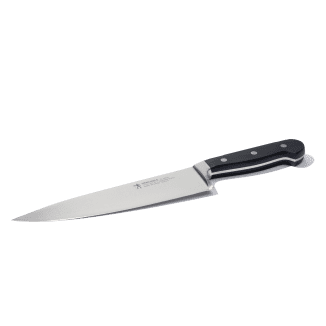
HENCKELS Classic 8 Inch Chef’s Knife

Heavy and solid-feeling, this German-style chef’s knife did an excellent job with most tasks, faltering only when we used it to cut butternut squash, its blade wedging into the dense vegetable. While the blade itself is sharp, its edge has a more dramatic curve than our top choices do, forcing our arms into slightly more awkward angles when working at the tip as a result. Most of us found the handle comfortable, though small-handed testers found it a little thicker and harder to grab toward the bolster.

Model Number: 31161-201

Handle Material: Plastic

Weight: 8⅛ oz

Edge Angle: 14°

Heel Height: 1.8 in

Price at Time of Testing: $69.95

  • Blade
  • Handle
  • Sharpness

Heavy and solid-feeling, this German-style chef’s knife did an excellent job with most tasks, faltering only when we used it to cut butternut squash, its blade wedging into the dense vegetable. While the blade itself is sharp, its edge has a more dramatic curve than our top choices do, forcing our arms into slightly more awkward angles when working at the tip as a result. Most of us found the handle comfortable, though small-handed testers found it a little thicker and harder to grab toward the bolster.

Model Number: 31161-201

Handle Material: Plastic

Weight: 8⅛ oz

Edge Angle: 14°

Heel Height: 1.8 in

Price at Time of Testing: $69.95

  • Blade
  • Handle
  • Sharpness

Zwilling Gourmet 8-Inch Chef’s Knife

With a razor-sharp, gently curved blade, this knife made quick work of most tasks, mincing and dicing with precision and maneuvering nimbly between joints when we broke down chicken. A few small flaws kept it from rating more highly. There’s a little less clearance under the handle than we’d like, so our fingers sometimes hit the cutting board when we sliced or diced. And the spine and butt of the blade had square edges that occasionally dug into our fingers when we used a pinch grip. Like several of the other knives, it had a slick plastic handle that was a little slippery when wet. But in general, we thought this was a respectable option.

Model Number: 36111-203

Handle Material: Polyoxymethylene

Weight: 6¾ oz

Edge Angle: 15°

Heel Height: 1.75 in

Price at Time of Testing: $59.95

  • Blade
  • Handle
  • Sharpness

With a razor-sharp, gently curved blade, this knife made quick work of most tasks, mincing and dicing with precision and maneuvering nimbly between joints when we broke down chicken. A few small flaws kept it from rating more highly. There’s a little less clearance under the handle than we’d like, so our fingers sometimes hit the cutting board when we sliced or diced. And the spine and butt of the blade had square edges that occasionally dug into our fingers when we used a pinch grip. Like several of the other knives, it had a slick plastic handle that was a little slippery when wet. But in general, we thought this was a respectable option.

Model Number: 36111-203

Handle Material: Polyoxymethylene

Weight: 6¾ oz

Edge Angle: 15°

Heel Height: 1.75 in

Price at Time of Testing: $59.95

  • Blade
  • Handle
  • Sharpness

Material 8" Knife

This knife had an especially narrow edge angle on its well-sharpened blade, rendering it extremely keen and capable of dispatching all tasks admirably. We just wish that the blade itself had a slightly less pronounced curve, as we found that we had to raise our arms and wrists awkwardly when rocking the blade from tip to heel. The spine and butt of the blade were also squared off, so they occasionally dug into our hands. And like those of several other knives, the handle was made of plastic that got slippery when wet, though it was otherwise comfortable to grip in different positions.

Model Number: n/a

Handle Material: Stain-resistant polyamide composite

Weight: 7⅝ oz

Edge Angle: 13°

Heel Height: 1.9 in

Price at Time of Testing: $75.00

  • Blade
  • Handle
  • Sharpness

This knife had an especially narrow edge angle on its well-sharpened blade, rendering it extremely keen and capable of dispatching all tasks admirably. We just wish that the blade itself had a slightly less pronounced curve, as we found that we had to raise our arms and wrists awkwardly when rocking the blade from tip to heel. The spine and butt of the blade were also squared off, so they occasionally dug into our hands. And like those of several other knives, the handle was made of plastic that got slippery when wet, though it was otherwise comfortable to grip in different positions.

Model Number: n/a

Handle Material: Stain-resistant polyamide composite

Weight: 7⅝ oz

Edge Angle: 13°

Heel Height: 1.9 in

Price at Time of Testing: $75.00

Recommended with Reservations - Over $75

  • Blade
  • Handle
  • Sharpness

Made In Chef Knife

This knife has a handsome, nicely shaped handle that comes in a fun range of colors; it was comfortable for all hands to grip, if a tiny bit slippery due to the smooth plastic with which it was made. The blade wasn’t quite as sharp as we’d have liked; that dullness, combined with the blade’s relatively thick spine, meant that the knife sometimes wedged into butternut squash and got stuck while we were cutting. Overall, we found this heavy knife to be serviceable and solidly built but not inspiring; we’d take a cheaper, sharper, more agile knife over it.

Model Number: n/a

Handle Material: Polyoxymethylene (plastic)

Weight: 8.5 oz

Edge Angle: 12.5°

Heel Height: 2 in

Price at Time of Testing: $119.00

  • Blade
  • Handle
  • Sharpness

This knife has a handsome, nicely shaped handle that comes in a fun range of colors; it was comfortable for all hands to grip, if a tiny bit slippery due to the smooth plastic with which it was made. The blade wasn’t quite as sharp as we’d have liked; that dullness, combined with the blade’s relatively thick spine, meant that the knife sometimes wedged into butternut squash and got stuck while we were cutting. Overall, we found this heavy knife to be serviceable and solidly built but not inspiring; we’d take a cheaper, sharper, more agile knife over it.

Model Number: n/a

Handle Material: Polyoxymethylene (plastic)

Weight: 8.5 oz

Edge Angle: 12.5°

Heel Height: 2 in

Price at Time of Testing: $119.00

  • Blade
  • Handle
  • Sharpness

Lamson 8" Premier Forged Chef Knife

We liked the looks of this knife, which featured a fiery red, swirl-laden acrylic handle. But we were less impressed by the knife’s performance. Out of the box, its blade was not nearly as sharp as we’d have liked, given the price; it performed tasks relatively capably, but not particularly precisely. Weighing nearly 10 ounces, it’s the heaviest knife we’ve tested, and our hands tired when we had to wield it for longer prep sessions. That weight, combined with an exceptionally thick spine, made it feel like a bit of a blunt instrument, offering more power than finesse. While most testers found the handsome handle to be easy to grip, the metal spine of the blade poked up through the acrylic sides of the handle and felt rough against the palms of our hands. For the money we paid for this knife, we’d expect a nicer, smoother finish. Finally, the blade has a large, thick bolster that limits the usable length of the knife to 7.75 inches.

Model Number: Fire – 59950

Handle Material: Acrylic

Weight: 9.9 oz

Edge Angle: 16°

Heel Height: 1.8 in

Price at Time of Testing: $159.99

  • Blade
  • Handle
  • Sharpness

We liked the looks of this knife, which featured a fiery red, swirl-laden acrylic handle. But we were less impressed by the knife’s performance. Out of the box, its blade was not nearly as sharp as we’d have liked, given the price; it performed tasks relatively capably, but not particularly precisely. Weighing nearly 10 ounces, it’s the heaviest knife we’ve tested, and our hands tired when we had to wield it for longer prep sessions. That weight, combined with an exceptionally thick spine, made it feel like a bit of a blunt instrument, offering more power than finesse. While most testers found the handsome handle to be easy to grip, the metal spine of the blade poked up through the acrylic sides of the handle and felt rough against the palms of our hands. For the money we paid for this knife, we’d expect a nicer, smoother finish. Finally, the blade has a large, thick bolster that limits the usable length of the knife to 7.75 inches.

Model Number: Fire – 59950

Handle Material: Acrylic

Weight: 9.9 oz

Edge Angle: 16°

Heel Height: 1.8 in

Price at Time of Testing: $159.99

Recommended with Reservations - Under $75

  • Blade
  • Handle
  • Sharpness

KAI PRO 8-in Chef’s Knife

We liked the rounded contours of this knife’s handle, which made it comfortable to hold in multiple positions. We just wish that the handle itself had been made from a slightly grippier material, as it was occasionally slippery when wet. The blade was a touch less sharp out of the box than we’d like, and its spine was squared off and thick from heel to tip, crunching through onions and garlic instead of making precise incisions and occasionally getting wedged into butternut squash.

Model Number: HT-7066

Handle Material: Polyoxymethylene

Weight: 6⅝ oz

Edge Angle: 16°

Heel Height: 2 in

Price at Time of Testing: $39.95

  • Blade
  • Handle
  • Sharpness

We liked the rounded contours of this knife’s handle, which made it comfortable to hold in multiple positions. We just wish that the handle itself had been made from a slightly grippier material, as it was occasionally slippery when wet. The blade was a touch less sharp out of the box than we’d like, and its spine was squared off and thick from heel to tip, crunching through onions and garlic instead of making precise incisions and occasionally getting wedged into butternut squash.

Model Number: HT-7066

Handle Material: Polyoxymethylene

Weight: 6⅝ oz

Edge Angle: 16°

Heel Height: 2 in

Price at Time of Testing: $39.95

  • Blade
  • Handle
  • Sharpness

Misen Chef’s Knife

This knife was heavy, solidly made, and pretty sharp. Despite its heft and acuity, it struggled to cut through bone-in chicken parts. With a spine that was thick from heel to tip, it crushed onions and garlic instead of dicing and mincing them precisely and got wedged into butternut squash, struggling to make clean cuts. The handle was easy to hold in a number of positions, but we wished that the plastic were a little less slick and the design a little less boxy—it didn’t nestle into our hands quite as comfortably as other handles.

Model Number: MK-1013-2 (blue)

Handle Material: Polyacetal thermoplastic

Weight: 8¾ oz

Edge Angle: 15°

Heel Height: 1.9 in

Price at Time of Testing: $75.00

  • Blade
  • Handle
  • Sharpness

This knife was heavy, solidly made, and pretty sharp. Despite its heft and acuity, it struggled to cut through bone-in chicken parts. With a spine that was thick from heel to tip, it crushed onions and garlic instead of dicing and mincing them precisely and got wedged into butternut squash, struggling to make clean cuts. The handle was easy to hold in a number of positions, but we wished that the plastic were a little less slick and the design a little less boxy—it didn’t nestle into our hands quite as comfortably as other handles.

Model Number: MK-1013-2 (blue)

Handle Material: Polyacetal thermoplastic

Weight: 8¾ oz

Edge Angle: 15°

Heel Height: 1.9 in

Price at Time of Testing: $75.00

  • Blade
  • Handle
  • Sharpness

Opinel Parallele 8" Chef’s Knife

This French knife felt fairly sharp, dispatching most tasks capably. With a spine that was thick from heel to tip, though, it was a little less precise on fine tasks such as mincing garlic and dicing onions. Its deeply curved blade reminded one tester of a pirate’s cutlass and sometimes put our arms at an awkward angle when we sliced. While the wood handle was nice and grippy, it had uncomfortable squared-off edges and was poorly constructed—the two halves of the handle started to separate after a few washes. Because the blade was shorter, there was less clearance under the handle, so our fingers sometimes got squished on the cutting board as we chopped.

Model Number: 001818

Handle Material: Beechwood

Weight: 5⅛ oz

Edge Angle: 15°

Heel Height: 1.75 in

Price at Time of Testing: $49.00

  • Blade
  • Handle
  • Sharpness

This French knife felt fairly sharp, dispatching most tasks capably. With a spine that was thick from heel to tip, though, it was a little less precise on fine tasks such as mincing garlic and dicing onions. Its deeply curved blade reminded one tester of a pirate’s cutlass and sometimes put our arms at an awkward angle when we sliced. While the wood handle was nice and grippy, it had uncomfortable squared-off edges and was poorly constructed—the two halves of the handle started to separate after a few washes. Because the blade was shorter, there was less clearance under the handle, so our fingers sometimes got squished on the cutting board as we chopped.

Model Number: 001818

Handle Material: Beechwood

Weight: 5⅛ oz

Edge Angle: 15°

Heel Height: 1.75 in

Price at Time of Testing: $49.00

  • Blade
  • Handle
  • Sharpness

Kiwi 8-Inch Chef’s Knife

Most users took one look at this inexpensive, incredibly lightweight knife from Thailand and called it a toy. But its blade usually felt quite keen; as a result, it sailed through most tasks. That said, it had been so poorly sharpened that we could see tiny chips in the blade before it had even been used, giving us concerns about its longevity. Because the blade was so thin, it was also unnervingly flexible, bending and wobbling dangerously when we applied pressure to cut through bone-in chicken. The blade was so short that our fingers hit the cutting board as we sliced. We also disliked the unfinished wood from which the handle was made; while it was plenty grippy, it felt rough and got more so with every wash.

Model Number: 288

Handle Material: Wood

Weight: 3¾ oz

Edge Angle: Unknown

Heel Height: 1.6 in

Price at Time of Testing: $9.99

  • Blade
  • Handle
  • Sharpness

Most users took one look at this inexpensive, incredibly lightweight knife from Thailand and called it a toy. But its blade usually felt quite keen; as a result, it sailed through most tasks. That said, it had been so poorly sharpened that we could see tiny chips in the blade before it had even been used, giving us concerns about its longevity. Because the blade was so thin, it was also unnervingly flexible, bending and wobbling dangerously when we applied pressure to cut through bone-in chicken. The blade was so short that our fingers hit the cutting board as we sliced. We also disliked the unfinished wood from which the handle was made; while it was plenty grippy, it felt rough and got more so with every wash.

Model Number: 288

Handle Material: Wood

Weight: 3¾ oz

Edge Angle: Unknown

Heel Height: 1.6 in

Price at Time of Testing: $9.99

Not Recommended - Under $75

  • Blade
  • Handle
  • Sharpness

Dexter-Russell SG145-8B (24153B) 8" Chef’s Knife

In theory, there was nothing seriously wrong with the design of either the blade or handle of this restaurant-industry favorite. The handle was made from a rubbery material that made it easy to hold, though some found that it was so grippy that it was actually hard to change hand positions. The blade was gently curved and tall at the heel, providing adequate space under the handle for our fingers. And the spine tapered nicely from heel to tip, allowing for both precision work and power when cutting through butternut squash. But the edge was dead dull, crushing onions, parsley, and garlic; struggling to bite into tomatoes; and failing to get a grip on slippery chicken skin, sliding off it instead of biting in. If you’re willing to sharpen this knife before you use it, it might be worth a try—but for most of us, the lack of a good edge upon arrival is a deal breaker.

Model Number: SG145-8B (24153B)

Handle Material: Polypropylene and thermoplastic elastomer

Weight: 5⅜ oz

Edge Angle: Proprietary

Heel Height: 2 in

Price at Time of Testing: $30.69

  • Blade
  • Handle
  • Sharpness

In theory, there was nothing seriously wrong with the design of either the blade or handle of this restaurant-industry favorite. The handle was made from a rubbery material that made it easy to hold, though some found that it was so grippy that it was actually hard to change hand positions. The blade was gently curved and tall at the heel, providing adequate space under the handle for our fingers. And the spine tapered nicely from heel to tip, allowing for both precision work and power when cutting through butternut squash. But the edge was dead dull, crushing onions, parsley, and garlic; struggling to bite into tomatoes; and failing to get a grip on slippery chicken skin, sliding off it instead of biting in. If you’re willing to sharpen this knife before you use it, it might be worth a try—but for most of us, the lack of a good edge upon arrival is a deal breaker.

Model Number: SG145-8B (24153B)

Handle Material: Polypropylene and thermoplastic elastomer

Weight: 5⅜ oz

Edge Angle: Proprietary

Heel Height: 2 in

Price at Time of Testing: $30.69

America's Test Kitchen Accolades Badge

Reviews You Can Trust

The mission of America’s Test Kitchen Reviews is to find the best equipment and ingredients for the home cook through rigorous, hands-on testing. We stand behind our winners so much that we even put our seal of approval on them. Have a question or suggestion? Send us an email at atkreviews@americastestkitchen.com. We appreciate your feedback!

The Expert

Author: Miye Bromberg

Miye Bromberg

Deputy Editor, ATK Reviews

Miye is the deputy editor for ATK Reviews. She covers bread, booze, and blades.

Miye Bromberg is the deputy editor for ATK Reviews. Areas of specialization include bread, booze, and blades. A native of New York, she now lives in Kentucky, where she spends her free time thinking about film, tending her garden, and traveling long distances to eat dosas.

Appears In

This item is featured in the following. Click the links to dig in!

*All products reviewed by America’s Test Kitchen are independently chosen, researched, and reviewed by our editors. We buy products for testing at retail locations and do not accept unsolicited samples for testing. We list suggested sources for recommended products as a convenience to our readers but do not endorse specific retailers. When you choose to purchase our editorial recommendations from the links we provide, we may earn an affiliate commission. Prices are subject to change.

Reviews You Can Trust.
See Why.

This is a members' feature.
America's Test Kitchen LogoCook's Country LogoCook's Illustrated Logo