 Buy at Amazon
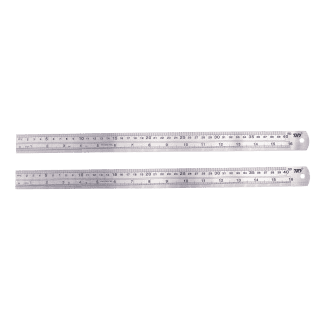
The best kitchen rulers have straight, rigid edges and clear markings that resist fading even after countless washes. Our favorite, the ZZTX Heavy Duty 16-inch Stainless Steel Ruler, is made from sturdy stainless steel and has dark, easy-to-read markings.

Rulers are often underestimated in the kitchen but, much like measuring cups and measuring spoons, they’re versatile tools that can improve your cooking and baking. They can help you cut vegetables into uniform pieces—no more stews with a mix of raw and mushy potatoes. You can use them to measure the thickness of cookie dough as you roll it out so that all your cookies bake evenly. Rulers are also great for checking the distance between oven racks and a broiler so that it’s less likely you’ll burn your food.


Rulers make it easier to cut food such as bars and other baked goods into neat, equal portions. They’re also handy for measuring the length and thickness of rolled-out dough.
Everyday Rulers versus Culinary Rulers
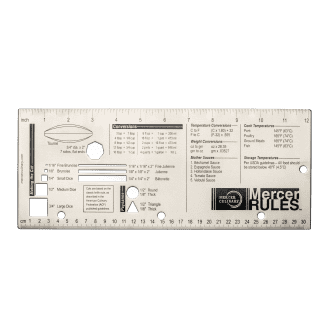
Generally, all rulers are made from stainless steel, wood, or plastic. Long, thin everyday rulers can be used for everything from art projects to homework, while short, wide culinary rulers provide information such as cooking temperatures and cuts of meat. Pastry guides, a specific type of culinary ruler, come in sets of two and work by being placed parallel to each other with the dough in between so that you can roll it out evenly. Some pastry guides can also be used individually like regular rulers. We tested both everyday and culinary rulers since both types are used in kitchens.
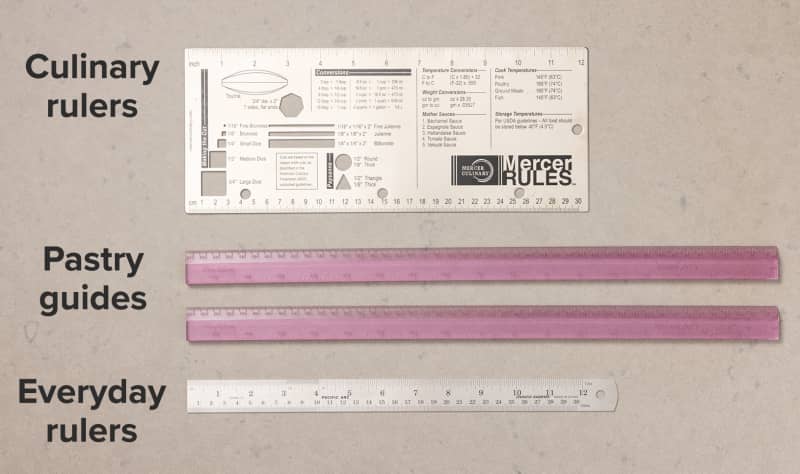
Everyday rulers and culinary rulers also differ in lengths. Everyday rulers are available in lengths varying from 6 to 36 inches while culinary models are typically 6 to 12 inches long.
What to Look For
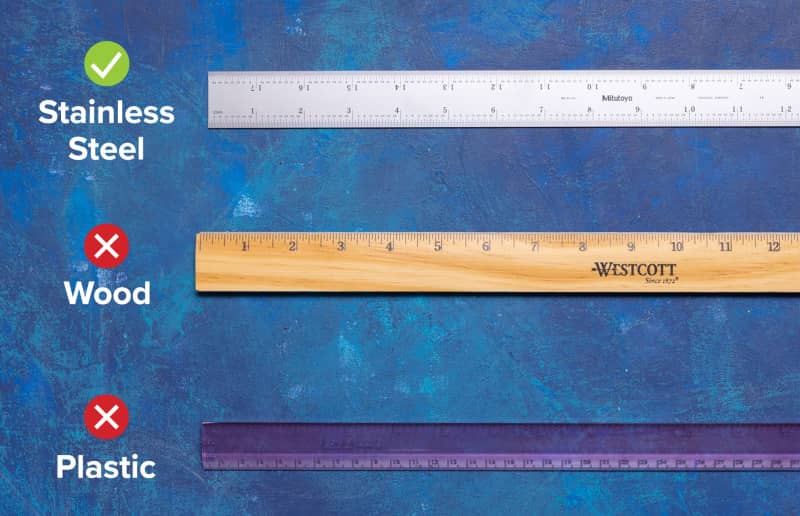
- Stainless Steel: We found stainless-steel rulers to be the most durable. The best withstood frequent washes and had some flexibility so they didn’t break or lose shape when bent. They were easy to clean, didn’t absorb water, and dried quickly. Stainless-steel rulers also resisted warping.
- 16- to 18-Inches in Length: Rulers that were 16 to 18 inches in length were long enough to measure 11-inch-wide galette doughs and 14-inch pizzas but compact enough to still be stored in a drawer.
- Dark, Etched Markings: We preferred dark, legible markings that were etched into the rulers’ surfaces. They allowed us to read measurements quickly and were less likely to wear away over time.

- Straight, Rigid Edges: Rulers with straight, rigid edges allowed us to easily measure from point to point and cut vegetables uniformly.
What to Avoid
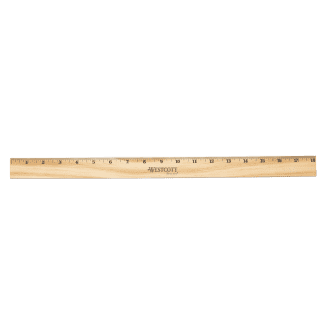
- Wood and Plastic: Wood rulers absorbed water so they took longer to dry after washing. They can become less accurate over time due to the expansion of the material. Plastic rulers tended to be flimsy and not as durable as stainless steel. They also scratched after multiple washes and became harder to read.
- Dual-Purpose Culinary Rulers: The culinary ruler was overkill for everyday tasks as they provided too much unnecessary information such as USDA-recommended cooking times. Most home cooks would benefit more from a straightforward, no-frills stainless-steel ruler.
- Light, Stamped Markings: We often had to squint to make out light-colored markings. These markings were especially hard to read when measuring the interiors of ovens and tall pots. Markings that were stamped on the surfaces of rulers wore away when we rubbed them with oil during testing.
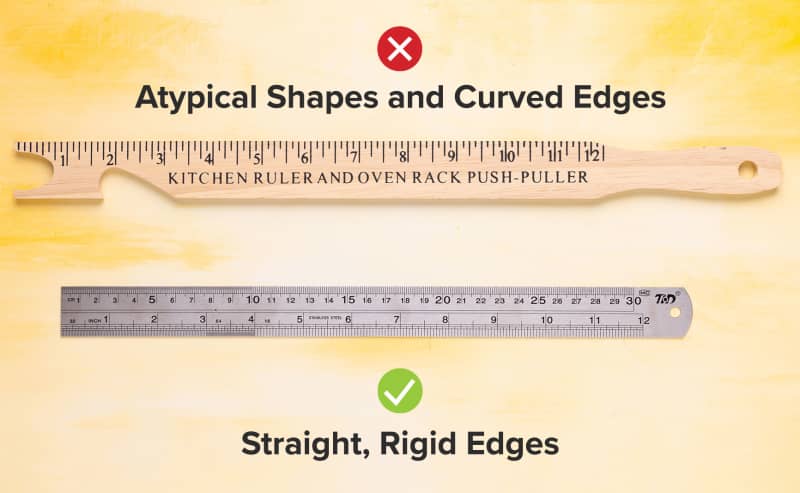
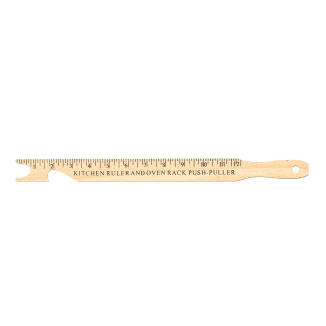
- Atypical Shapes and Curved Edges: Some rulers came in different shapes, including wide rectangles and long trapezoids. These rulers were bulky and awkward to handle, particularly when measuring inside containers and pots. Others had dips and curves along their edges, which made it difficult to cut in straight lines and made their markings hard to read.
Other Considerations
- Rulers with Markings That Begin on the Edge: The markings of most rulers are positioned ¼ inch away from the edge. Manufacturers do this to prevent the markings from rubbing off at the very edge over time. While this shouldn’t be a problem for most people, if you, like us, frequently measure inside of things like tall pots or containers, then you may want to get a ruler with measurements positioned at its edges. Our winner’s markings begin at the very edge and remained visible throughout testing.

The Tests
- Compare markings of each ruler in our lineup to a National Institute of Standards and Technology (NIST)-calibrated ruler
- Measure the distance between an oven’s racks and its broiler
- Cut potatoes into ¼-inch-wide french fries
- Measure the length and thickness of dough for Southern Cheese Straws
- Measure 1 inch of water in a stockpot
- Wash each ruler by hand 10 times
How We Rated
- Accuracy: We examined how accurate the rulers were by comparing them to a NIST-calibrated ruler.
- Ease of Use: We assessed how easy the rulers were to read when measuring dough, vegetables, the interior of an oven, and the inside of a stockpot.
- Durability: We noted whether markings faded after the rulers were rubbed with oil and washed.