

 Buy at Amazon
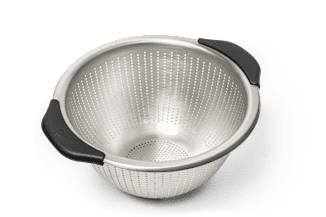
The best colanders sit securely in your sink, drain quickly, and contain foods of different sizes without allowing them to slip through their holes. Our longtime winner, the RSVP International Endurance Precision Pierced 5 Qt. Colander, is well-designed and sturdy. It’s able to hold and drain large volumes of food efficiently, and its tall base lifts food above water as it drains away.

If you’re looking for a tool to rinse rice, strain sauces, or sift ingredients for baking, see our reviews of fine-mesh strainers and small fine-mesh strainers.
Many people use their colanders almost every day for tasks like draining pasta, rinsing produce, and more, so it’s important to have a reliable one. Today, there are many styles of colanders, including collapsible models and over-the-sink designs, but previous reviews have taught us to avoid models with innovative features (see “Skip These Styles”). We’ve also learned that colanders made from silicone or plastic tend to get dingy after multiple washes and aren’t as stable or durable as those made from stainless steel. And we’ve learned that hole size and placement matter. Colanders with holes that were too big allowed small or skinny foods to slip through, while models with clusters of holes and large stretches of unperforated metal drained too slowly. For this review, we focused on simple, no-frills stainless-steel models with capacities of 4.5 or 5 quarts, the sizes we found to be most useful for everyday kitchen tasks; all had lots of small holes.

What to Look for
- Numerous Tiny, Well-Distributed Perforations: From previous reviews, we know that colanders with many holes that are evenly distributed across their bowls drain water quickly and efficiently, preventing foods from sitting in hot water and overcooking. The size of the holes also mattered; the tiniest holes prevented small foods like angel hair from slipping through the bowl. The exact arrangement of the holes didn’t matter as much as the size and number, though. We tested some models with columns of tiny holes, others with concentric circles of tiny holes, and models with tiny holes all over: All were capable of draining effectively.
- Tall, Wide Ring-Shaped Base: When you pour a pot full of hot water and pasta into a colander, a large volume of water can pool in the sink. Models with bases that were at least 1 inch tall provided enough clearance to prevent pasta in the colander from mingling with all that water. We also found that models with wider ring-shaped bases provided enough stability, so the colander didn’t topple over while we strained food.


Colanders with tall, ringed-shaped bases were stable and provided enough clearance to prevent food from mingling with sink water. On the other hand, colanders with short, stubby bases were more prone to tipping over and sat too close to the sink.
- Tall Bowls: Colanders with bowls that were at least 4 inches tall ensured that food never cascaded into the sink when we emptied a pot full of boiling water and pasta into them.
- Wide Loop-Shaped Handles: We had a preference for models with wide loop-shaped handles because they were easier to grip even with oven mitts. This style of handle felt particularly secure in our hands when we carried a full colander from the sink to the counter.


Wide looped handles were easier to grasp, while plastic rings felt less secure.
What to Avoid
- Short Bases and Stubby Feet: Models with short bases measuring less than 1 inch tall sat too low in the sink and increased the possibility of food coming in contact with drained water. We also noticed that colanders that had feet instead of ring-shaped bases were less stable.
- Short Bowls: Colanders with bowls that were 3½ inches tall and shorter were ineffective at containing food. Pasta often cascaded over the sides and fell into the sink.
- Plastic Rims: A few models lacked true handles. Instead, they had rims made of plastic. While they were easy enough for us to grasp and carry, we had a slight preference for the wide loop-shaped handles on the other models.
The Tests
- Drain 1 pound of angel hair pasta cooked in 4 quarts of water
- Drain 1 pound of orzo cooked in 4 quarts of water
- Drain salted cucumber left to sit for 30 minutes
- Drop from counter height to floor three times
- Wash 10 times (five times by hand, five times in dishwasher)
How We Rated
- Performance: We evaluated how quickly and effectively the colanders drained water from cooked pasta and excess liquid from vegetables.
- Ease of Use: We assessed the heights of each colander's bowl and base; we also rated how stable the bases were, especially as they sat in the sink. We noted how easy it was to grip their handles or rims while using oven mitts.
- Cleanup and Durability: We rated how easy it was to clean the colanders by hand and dishwasher and noted whether they dented when we knocked them off a counter.