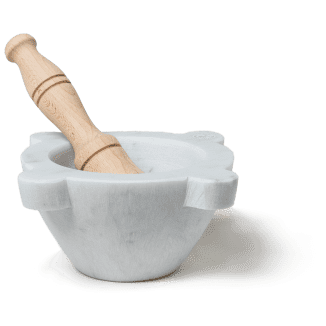


The best mortars and pestles (including molcajetes) are easy to use, letting you grind spices, sauces, and pastes comfortably and relatively quickly. They’re also heavy enough to sit securely on the counter.
Our favorite mortar and pestle is the Cilio by Frieling Goliath Mortar and Pestle. Made of granite, it was one of the biggest and heaviest models we tested. It held 3 cups of food and it allowed us to make spice mixes, guacamole, and even curry paste exceptionally well. If you’re looking for a smaller or more affordable option, try the ImportFood.com Solid Granite Thai Mortar and Pestle, 6".
Our favorite molcajete, a mortar and pestle set traditional to indigenous groups in the region around present-day Mexico, is the Masienda Molcajete. It performed just as well as our favorite mortar and pestle, its broad, porous volcanic-rock interior breaking down even the toughest and most fibrous materials into paste. The molcajete itself is large and sturdy; its relatively short pestle, known as a tejolote, is great for those who prefer a little extra control while pounding and grinding. If you’d like a slightly smaller and less expensive option, we also like the IMUSA Granite Molcajete 8 inches, Grey.

We tested mortars and molcajetes of different sizes and materials, using each to make garam masala, an Indian spice blend.
Before the food processor, blender, and blade grinder existed, there was the mortar and pestle. This ancient tool is a low-tech multitasker: Simply use the pestle (the club-like component) to pound, grind, and scrape inside the mortar (the bowl-like component) in order to blitz whole spices into powder and blend wet ingredients into pastes, sauces, and dips.
Yes, electric tools are faster: You’ll make pesto or salsa more quickly if you use a food processor (about 40 seconds compared with 6 to 16 minutes in the mortars and pestles we tested), and spice blends can be produced in a lot less time in an electric blade grinder (about 15 seconds compared with 8 to 20 minutes in the mortars and pestles).

Pesto made in a mortar and pestle has an especially plush, silky texture.
But fans of these manual tools, including many professional cooks, say that the quality of the foods produced by a mortar and pestle is superior to foods that come out of any electric tool. “Part of experiencing an incredible dish is texture,” chef and author Bricia Lopez told us, “and you can only achieve that special texture with a molcajete,” the mortar and pestle set most commonly used in Mexico. In fact, any good mortar and pestle can improve both texture and flavor. Instead of simply cutting ingredients into tiny pieces as a food processor might do, the pestle crushes them, extracting more of the aromatic oils and flavor compounds in the process. Indeed, as we found during testing, pesto, salsa, and curry paste made with the higher-rated mortars and pestles had a more complex, savory, and cohesive flavor and a softer, more luscious texture than the same foods made in the food processor. The only application where there wasn’t a discernible difference? Spices. Pepper and garam masala were equally fragrant regardless of whether the whole spices were pulverized by a mortar and pestle or chopped by a blade grinder.
There are even more reasons to get a mortar and pestle, though. Mortars and pestles are dead simple—there are only two parts to use and clean and no sharp blades to nick yourself on. The best versions are also nearly indestructible and handsome enough that they can be used to serve the food you make in them, whether that’s a salsa verde or romesco sauce. Finally, there’s a certain romance to using a mortar and pestle. As Jonathan Zaragoza, chef of Birrieria Zaragoza in Chicago, told us, using a molcajete makes you shift your perspective as a cook. “It makes you slow down and think a little more—it’s a more intimate and a tactile experience.” Most important, as Zaragoza says, “It’s a beautiful way to make things.”

There are many different types of mortars and pestles, as these tools are used all over the world. Most mortars and pestles, including the European-style models and the Thai khrok sak that we tested, have a fairly similar design. The mortars are relatively tall and narrow with steep walls and a small, flat area for pounding and grinding; the pestles are moderately long. They can be made from a variety of materials, including stone, ceramic, metal, and wood, as can the pestles. On the other hand, the molcajete looks and feels slightly different. Molcajetes are comparatively broad and short, with shallower walls and bigger, flatter grinding surfaces. Many molcajetes also have three or four short legs that raise them off the counter. The pestle component, called a tejolote or sometimes a piedra de molcajete (“stone of the molcajete”), is often short as well; both it and the molcajete are traditionally made from volcanic rock, though other materials are now used as well.
Since narrower mortars and pestles and broader molcajetes offer somewhat different user experiences, we’ve tested and anointed winners in both styles. We think all four of our winners and Best Buys are great, and the choice of which you should get is ultimately personal. (You can read more about which type is best for you in “Which type of mortar and pestle should I get?” below.) Regardless of origin, each of our favorites is incredibly durable, versatile, and capable of performing a wide range of tasks, from grinding spices to making sauces, dips, and pastes. As Zaragoza told us of his molcajete, “I use mine for everything.”

How to Clean and Care for Your Mortar and Pestle
It’s easy to take care of your mortar and pestle. Here’s how.
Learn MoreWhat to Look For
- Moderate Capacity: While you can get mortars in a wide range of sizes, we recommend looking for medium-size models with a capacity of 1.5 to 4 cups. These gave us plenty of room to make pesto, curry paste, salsa, and spice blends easily without taking up too much room on the counter. (If you’re cooking for a crowd, though, you might want to go even larger. When we asked Lopez what she looked for in a mortar and pestle, she said, “Size—the bigger, the better!”)
- Heavy Mortars: We liked mortars that weighed at least 5 pounds, as these sat more securely on the countertop than lighter-weight models. Our favorites weighed at least twice that much, ensuring that they didn’t budge when we ground and pounded food. One downside? Heavier models are harder to move and clean.
- Relatively Heavy Pestles: Pestles weighing about 1 pound did more of the work for us when we pounded food, efficiently pulverizing whole spices into smithereens and smashing garlic and chile slices into paste. (Heavier tools performed even better but were more tiring to use.)

Mortars with wide, flat interiors and straight walls (right) made it easy to spread out whole spices and grind them to a powdery consistency; mortars with smaller working surfaces and steeply sloped walls (left) struggled, leaving the spices in bigger pieces.
- A Wide, Flat Interior: We preferred mortars with comparatively broad, flat surfaces measuring at least 3 to 5 inches in diameter, since these let us spread out lots of spices and herbs in a single layer to more easily pound and grind them. Molcajetes have a particular advantage here, as they’re typically broader and flatter than the European and Thai models we tested.

Mortars made from coarse-textured materials such as granite (left) were more abrasive, helping to break down spices and aromatics more quickly than mortars made from smoother ceramic (center) and metal (right).
- Coarse-Textured Material: Models made from coarse-textured materials, including granite, volcanic rock, and marble, are more abrasive than mortars made from metal or stoneware, so they easily shred herbs into tiny fragments and reduce garlic, onion, and chiles to paste. These rougher surfaces also hold on to whole spices well and keep them from slipping around so we could more effectively break them down for perfectly ground pepper and garam masala. Coarser mortars do have to be seasoned prior to use to rid them of any gritty particles that could end up in your food, but we think this is a small task and well worth the effort.
What to Avoid
- Small Capacity: Unless you plan to grind only very small batches of spices, sauces, or pastes, avoid mortars that hold less than 1.5 cups.

Small mortars don't give you much room to crush foods.
- Lightweight Mortars and Pestles: Mortars weighing less than 5 pounds were too light; we had to hold them down with our nondominant hand while working to keep them from tipping over and flinging ingredients everywhere. Similarly, pestles weighing significantly less than 1 pound required us to use a lot more force and effort to get the same results as heavier ones—or sometimes failed entirely to achieve them, leaving larger shards of cinnamon bark or pepper when we ground garam masala.
- Overly Narrow Mortars: The narrower a mortar is at the bottom, the less surface area there is for food to sit on, limiting your ability to make contact with and pulverize it and requiring more batches and time to complete a single recipe.
- Mortars Made from Smooth Materials: Smooth metal and stoneware mortars provide no traction, so whole spices skittered around their interiors, resisting our efforts to pin them down as we chased them with the pestle. No matter how hard we tried, it was impossible to grind any spices to a fine powder in these smooth mortars; pepper was coarsely ground at best and left whole at worst, and our attempts to make garam masala were unsuccessful, rendering blends with large, unappetizing shards of cinnamon and coriander seeds.