


 Buy at Ooni


The best outdoor pizza ovens run on propane, reach an ambient temperature of at least 800 degrees Fahrenheit, and have features that help distribute heat more evenly than others. Our favorite is the Ooni Koda 2. With a 14-inch baking stone, it makes beautiful pizzas that are just the right size. If you’d like a larger pizza oven, we also like the Ooni Koda 2 Pro, which can accommodate pizzas up to 18 inches in diameter. For a lighter-weight, more easily transportable pizza oven, we recommend the smaller Ooni Koda 12.

You can make great pizza in a home oven. But because the temperatures of most ovens top out at 500 degrees, it’s hard to get truly professional-quality results. For that, you need temperatures of 800 degrees or more. One option is to install a dedicated pizza oven in your kitchen or backyard, but those can be big, expensive, and more permanent than many people want. Another option is to get an indoor (electric) pizza oven. Our favorites, the Breville Smart Oven Pizzaiolo and the Ooni Volt 12 Electric Pizza Oven, get incredibly hot and make truly impressive pizza. But they’re also relatively expensive.


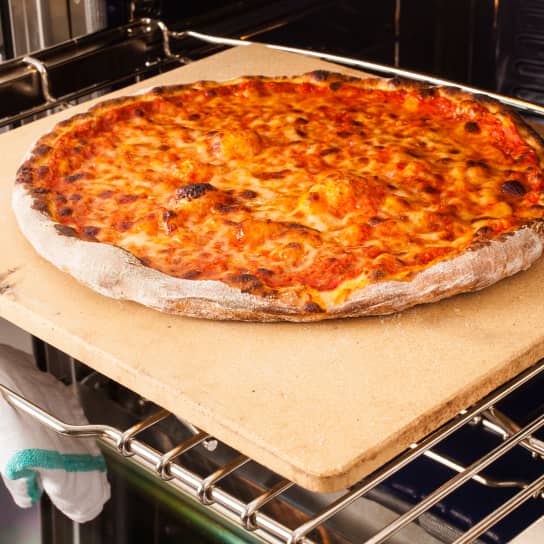
We made (and ate) a lot of pizza as we tested these ovens. The best models produced pies with crisp, leopard-spotted crusts and tender interiors.
The third option is to get an outdoor pizza oven. A good outdoor pizza oven is one of the best ways to take your pizza-making game to the next level. Powered by propane, wood, charcoal, wood pellets, or a combination of these fuels, the best models perform just as well as our favorite indoor pizza ovens, if not better. They are usually easy to assemble and a bit less expensive to boot. Compared to a permanent brick pizza oven, these pizza ovens are also relatively portable, with the smallest models easy enough to pack into a car to bring to a tailgate or campground. That said, the majority of the models we’ve tested aren’t exactly lightweight, as these ovens require some heft for insulation and stability—nobody wants a screaming-hot appliance to blow over in a gust of wind. Most weigh from 20 to 60 pounds, though we’ve tested models as heavy as 80 pounds.

This means that you might need a friend to help you move your oven—something you could have to do more often than you’d think (see below, “What’s the best way to store my pizza oven?”). For these reasons, we recommend taking both your strength and your storage availability into consideration before choosing an outdoor pizza oven—the larger the model, the heavier it will be and the more space it will occupy (see below, “What Size Pizza Oven Should I Get?”).
Cooking pizza in an outdoor pizza oven can be a bit of an adventure—there’s a learning curve to using every model we tested, and you’ll need to tinker a little with your recipes and timing to get the best results. But we think that’s part of the fun! Once you get the hang of using one of these ovens, the results speak for themselves. In just 2 minutes, you can produce perfect Neapolitan-style pizzas with charred, leopard-spotted crusts and tender, chewy interiors. The best ovens can be used to make foods beyond your standard pie. By adjusting the oven’s heat levels, you can not only make different types of pizza (Detroit- or New York–style, for example) but other baked goods and even roast meat, vegetables, or fruit.
Outdoor pizza ovens are not for everyone—their price and size can be prohibitive. But if you love pizza and make it regularly, these ovens are a great investment.

What Are the Different Types of Outdoor Pizza Ovens?
There are two main types of outdoor pizza ovens, and each type is determined by the kind of fuel (or fuels) used. Ovens that use propane gas are the most common. Most come with burners that you attach to a standard 20-pound propane tank—the type you might use for a gas grill or flat-top grill—though a few use smaller 14- to 16-ounce tanks. Multifuel ovens use wood, charcoal, and/or sometimes even wood pellets, which you add to a special fuel chamber in the oven and light. Most can also be used with a gas burner, typically sold separately.
As you’ll read, we think gas ovens are the best choice for most people. They’re very easy to use, allowing you to more reliably achieve and maintain the temperatures you need for different types of pizzas and other foods. They’re also the easiest to clean, leaving no ash to remove afterward.


Pizza ovens use different types of fuel to produce heat; propane and wood are two of the most common.
Multifuel ovens can perform just as well as gas ovens; our top-rated multifuel oven attained even hotter temperatures when loaded with wood than it did when fueled by propane, producing beautifully browned, tender pizza at jaw-dropping ambient (air) temperatures of 900 to 1,100 degrees Fahrenheit. But there’s a longer learning curve to using wood, charcoal, and pellets than there is to using gas. You’ll need to chop any wood down to size in order to fit the relatively small fuel chambers, and it takes some experience to know how much of any of these fuels you need to achieve different temperatures, and in which configurations. You’ll also need to keep feeding the fire in order to maintain the temperatures you want—the fuel chambers for these ovens are often fairly small and can hold only so much wood or charcoal at a time. (In some of the models we’ve tested, the fuel chambers were too small to accommodate enough wood or charcoal to get hot enough to reach the high temperatures needed to make Neapolitan pizza.) And of course, wood, charcoal, and pellets are messier than gas, leaving ash and sometimes half-burnt debris to clean up afterward.

More importantly, wood, charcoal, and pellets won’t improve the quality of your pizza, which cooks too quickly to pick up any wood or coal flavor. Charcoal can be great for low-and-slow cooking such as roasting meat, and you could use wood for shorter cooking stints, such as roasting vegetables. But these are secondary uses for a pizza oven, not to mention ones that you can also carry out much more easily with a gas-powered oven. There’s no harm in getting a multifuel oven if you enjoy the challenges of live-fire cooking or like working with charcoal and pellets—the best options are certainly fun to use, and we’ve highly recommended several over the years. Just know that you’ll often pay more for these fairly limited gains in versatility, especially if you want to add on a gas burner.
What Size Pizza Oven Should I Get?
Outdoor pizza ovens come in a variety of sizes, usually defined by the width of their decks, or baking stones, which can vary from 12 to 18 inches. We think that a pizza oven with a 13- to 14-inch stone is best for most people. It can accommodate 12- and 13-inch pizzas, the size of pizzas that most home cooks are likely to make, while still providing a bit of wiggle room on either side of the baking stone when loading, rotating, and unloading them. A 14-inch pizza oven typically weighs around 30 pounds—heavy enough to stay put on a table but not too difficult to take on the go or move inside in inclement weather. (That said, some we’ve tested have weighed as much as 80 pounds.) These medium-size ovens have prices that fall toward the middle of the range, with most costing about $400 to $500. The Ooni Koda 2 is our top pick for most people.

Some newer, larger models have stones from 16 to 18 inches in width. Bigger ovens can be more versatile, giving you the option to make larger pies, multiple small pies, or several different foods at once. However, they take up more room and are heavier, typically weighing about 45 pounds, so you may need assistance moving them. They also cost more. Still, if you have the space and extra cash—at least $600—a larger oven may be well worthwhile. The Ooni Koda 2 Pro is our favorite larger outdoor pizza oven.
On the other hand, models with 11- to 12-inch stones are best for smaller spaces and for cooks who want a truly portable option. Because these ovens are more compact, they make correspondingly smaller pies, but they’re also easier to store and transport, weighing closer to just 20 pounds. They usually range in price from $200 to $500, with the average price hovering around $400. The Ooni Koda 12 is our favorite smaller, lighter-weight option.
What to Look For
- High—and Easily Adjusted—Temperatures: A good pizza oven should be able to heat both the baking stone and air in the oven to temperatures higher than those a conventional oven generates. We preferred models that were capable of producing an ambient temperature of at least 800 degrees and a stone temperature of at least 700 degrees. (The Associazione Verace Pizza Napoletana, the Italian institute that regulates the protected-origin standards for making Neapolitan pizza, recommends ambient temperatures of about 905 degrees and stone temperatures of about 716 degrees. But we’ve found the slightly lower temperatures above to work well for home use—even when making Neapolitan pizza, a type of pizza that cooks especially hot and fast.) In an oven that can produce these scorching-hot temperatures, pizzas cook extremely quickly—from 90 seconds to just a few minutes. Their crusts are chewy yet tender with great browning on the underside and pleasant char around the edges. More heat isn’t necessarily better, though. Some of the models we’ve tested got even hotter than 800 degrees, generating ambient temperatures of up to 1,200 degrees Fahrenheit. These super-high temperatures aren’t necessarily helpful, as they increase the risk that your pizza’s exterior will burn before the inside can cook through properly, making it more challenging to produce edible results. Plus, some types of pizza, such as Detroit- or New York–style, bake at lower cooking temperatures. For this reason, we liked models that were capable of reaching high temperatures but that also allowed us to adjust the heat level so we could cook at lower temperatures.


We used a variety of methods to monitor the temperatures of the air and baking stone inside each pizza oven.
- Models Fueled with Propane Gas: These were the easiest to use. All we had to do was connect the regulators and hoses attached to the ovens to standard 20-pound propane tanks, just as we do with gas grills. A few models required smaller 14- to 16-ounce propane tanks or the purchase of an additional converter to connect to 20-pound tanks. To ignite each oven, we simply pressed in a dial, twisted it to high, held it for a few seconds, and released it when we saw a flame. Once the ovens were hot, which took 20 to 30 minutes depending on the model, we could adjust the heat by turning the dial.
- Exposed Gas Burners: For an oven to work well, its burner has to heat the baking stone plus the air inside the oven, and its walls and roof have to direct the heat back onto the pizzas as they bake. In the ovens we tested, the gas burners were positioned either beneath the stone or exposed on the sides and/or at the rear of the oven. We preferred models with burners that were exposed. The flames generated by these models arced up and over the baking stones, making for hotter ovens, and browning the pizzas more effectively too.

- Removable Stone: All the ovens we’ve tested come with cordierite baking stones, which sit in the floor of the oven. While most of the ovens had stones that could easily be removed without special tools, a few were fixed in place. There aren’t many occasions that require taking the stone out of the oven, but being able to remove the stone does make cleanup (of burnt flour or stuck-on cheese, for example) a bit simpler. With a fixed stone, your cleaning options are limited to heating the oven to burn off debris and vacuuming or sweeping up that debris once the oven is cool.

What to Avoid
- Gas Burners Under the Baking Stone: Propane-fueled models with gas burners under their baking stones just didn’t perform as well. After preheating these ovens on high for 20 minutes, the maximum amount of time recommended by their manufacturers, the average temperatures of their baking stones were about 580 and 625 degrees. Though hotter than a stone heated in a home oven, both were cooler than the 700-plus degrees we wanted. (Because most companies caution that heating the empty ovens for too long can damage them, we didn’t extend the recommended 20-minute preheating time.) Using these ovens to bake pizza was akin to cooking the pizzas in a skillet on a stovetop burner; the pizzas baked from the bottom up and the crusts absorbed a lot of heat in the time it took the toppings to cook through. All the pizza crusts—whether they were meant to be chewy thin crust or light, airy Neapolitan-style—dried out a little and were even a bit crunchy. They tasted good, but they weren’t true to the intended style.
The Tests:
- Make Thin-Crust Pizza using propane as a fuel source
- Make Neapolitan-style pizza using propane as a fuel source
- With multifuel models, make Neapolitan-style pizza using wood and, if the ovens can accommodate it, charcoal
- Monitor the temperature of the baking stone, internal air temperature just above the cooking surface, and the ceiling of the oven throughout all tests
How We Rated:
- Performance: We evaluated the quality of the pizzas we made with each oven.
- Ease of Use: We considered how easy it was to set up the ovens, connect them to propane tanks, and ignite them. We also rated the models on how easy they were to use with other fuels (wood, charcoal) where applicable. We evaluated how easy it was to produce evenly cooked pizzas, including whether there was enough room to launch, rotate, and remove them.