



 Buy at Amazon
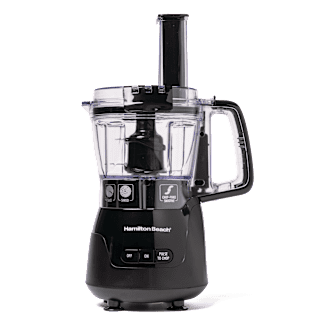
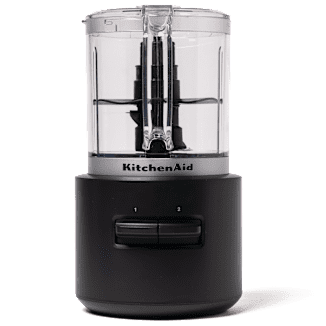
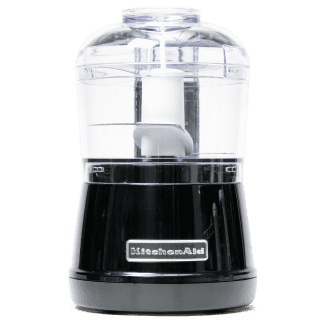
The best small food processors are versatile, efficient, and easy to store. Our favorite is the KitchenAid 3.5 Cup Food Chopper. It’s durable and works quickly without overprocessing.

Standard food processors are workhorses, but they tend to be big and pricey. Smaller food processors are a good choice for budget- or space-conscious cooks—or for those who want to dip a toe in the food processor pond before committing to something that costs upwards of $200. They run the gamut from chintzy choppers to miniature versions of full-size models from major brands. They range from tiny 1.5 cup–capacity models up to 6-cup machines, compared to 11 to 16 cups for larger models. We wanted something that was more than just a toy and could really help speed up our work in the kitchen, so we skipped the small, basic choppers and zeroed in on 3- to 6-cup models.

When Can—and Can’t—You Use a Small Food Processor?
Small food processors can do a lot of the things full-size models can do, but there are some limitations. First, they can’t handle doughs well; their workbowls are too small and their motors too weak. Second, they’re not efficient for large-quantity prep—they don’t have grating or slicing blades, and their smaller workbowls maxed out at about 2 cups of vegetables. But a good small food processor can also excel at mayonnaises, dressings, dips, marinades, and sauces—projects that would otherwise require serious muscle or a food mill. They can also handle smaller-quantity mincing, grinding, and dicing. Overall, these compact appliances are ideal for those with limited counter or storage space who still want some of the efficiency and capabilities of a large-scale food processor.

What to Look for
- 3.5- or 4-Cup Capacity: We liked models that were compact but still big enough to be useful for a range of tasks. The ideal capacity for small food processors was 3.5 to 4 cups, which was large enough to handle mincing vegetables, grating cheese, and making dips.
- Sharp, Straight Blades: We found that processors with sharp, straight blades made clean cuts when mincing or dicing food.
- Low Blade Clearance: We liked models with blades that sat closer to the base of the bowl, with just 3 to 4 millimeters of clearance. These were better at evenly processing food.
- Good Power: Food processors require a certain amount of power in order to perform well. Models that were powerful enough to make smooth, fully emulsified sauces and dips received top marks.

- Responsive Controls: We also liked controls that worked quickly, stopping and starting immediately after we pressed the buttons so that we didn’t overprocess food and accidentally turn a salsa into a vegetable puree.
- A Drizzle Basin with a Large Opening: This is a reservoir in the lid of the food processor that has a small hole in it. We think these are essential for sauces and other condiments that require emulsification. The hole lets oil drip slowly into the mayonnaise or sauce base, allowing it to incorporate properly.
What to Avoid
- Models with Smaller Capacities: Models with capacities smaller than 3.5 cups were too small to allow us to make full recipe yields of sauces or to evenly chop nuts. They’re simply not worth buying and trying to use.
- Serrated Blades: Blades that were serrated cut food roughly and unevenly.


Models with straight blades (right) processed ingredients more precisely than those with serrated blades (left).
- Big Gaps Between Blade and Bowl: Blades that sat too high up from the bottom of the bowl (above 4 millimeters) couldn’t reach all of the food and often underprocessed it as a result. Egg yolks, whole garlic cloves, almonds, and pine nuts remained stranded under their blades instead of incorporating into the recipes we attempted to make.
- Underpowered and Too-Fast Motors: Models that ran too quickly overprocessed food and were hard to control. Processors that didn’t have enough oomph made chunky hummus and pesto that were politely deemed “rustic” by tasters.
The Tests
- Mince whole garlic cloves
- Mince parsley
- Chop mirepoix (onion, celery, and carrot)
- Chop almonds
- Pulse cubes of Parmesan until coarsely grated
- Make basil pesto
- Make mayonnaise
- Make hummus
- Wash parts 10 times in the dishwasher or by hand, according to manufacturer instructions
How We Rated
- Performance: We rated the small food processors on how effectively and uniformly they chopped, emulsified, and pureed a variety of ingredients.
- Ease of Use: We considered how easy the models were to set up, use, clean, and store.