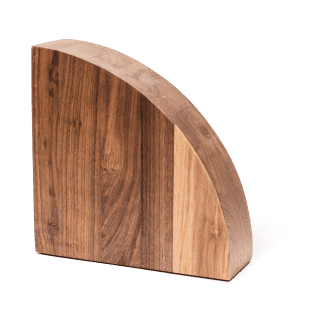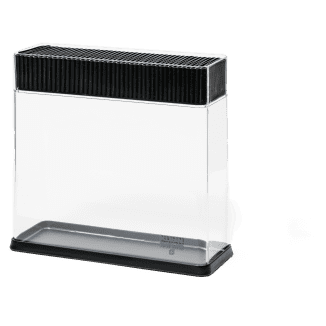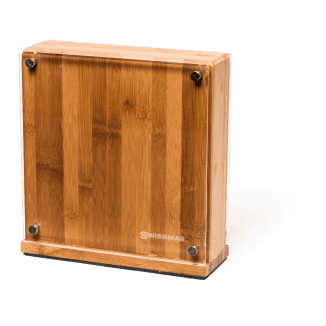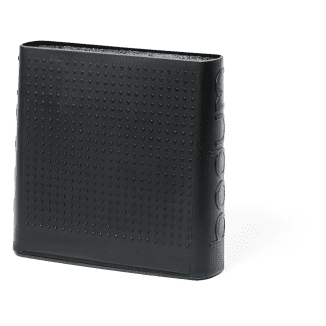

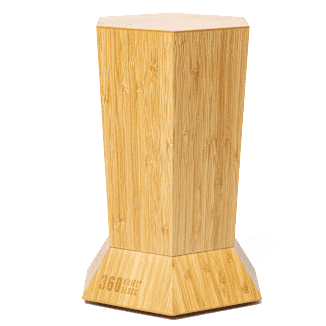

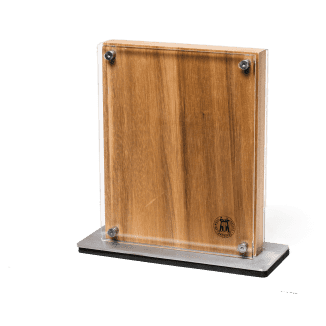

The best knife blocks have good magnetic coverage and strength and are stable due to their heavy weight and/or nonslip bases. Our winner is the 360KnifeBlock “Classic.” With excellent magnet coverage, this block made it easy to attach and remove knives, and a rotating, lazy Susan-esque base allowed for quick access to all six of its sides. For a lower-priced alternative, we also recommend the Schmidt Brothers Midtown Block. Because it has a plastic guard, it was a little harder to use and clean, but it did a good job of holding all our favorite knives securely.

Knife blocks allow you to store your knives without mounting a magnetic strip on your kitchen wall or taking up valuable drawer space with an organizer. We prefer universal blocks, which are designed to accommodate knives of all sizes in any configuration.
What’s the Best Type of Knife Block?
There are two types of universal knife blocks: models that use magnets to secure the knives and models that use a mass of bristles or folds or an open grid to hold them. In testing, we had a distinct preference for magnetic blocks, which generally exposed less of the blades and held the knives more securely—usually in a side-by-side configuration that made it less likely that the knives would scrape against each other and dull or scratch the blades. While nonmagnetic models were often cheaper, they were less durable: Plastic bristles shed and bent out of shape, plastic folds got nicked easily, and wooden grids chipped with extended use. Worse, nonmagnetic models were often smaller and less safe, crowding the knives together and/or leaving larger portions of their blades sticking out.


We preferred magnetic blocks (left) for their ability to securely hold knives in place. Nonmagnetic models (right) held knives less securely and were less durable.
What to Look For
- Good Magnetic Coverage and Strength: We liked blocks with magnets that were strong enough to hold a heavy cleaver without letting it slip. (With models that had strong magnets, we often found it easiest to remove large knives by pulling them straight up, or to pull them toward us while steadying the base with our other hand. Otherwise, some blocks were at risk of tipping over.) To learn more about the magnets in each block, we used iron filings to determine where they were located. We found that we preferred models with evenly distributed magnets, which let us place our knives anywhere we wanted.


We used iron filings to determine the location of magnets on the knife blocks.
- Good Capacity: Top-performing blocks fit all six of the knives and shears we find to be most useful for home cooks. Not all models were able to fully accommodate our favorite slicing knife, but we didn’t find that to be a complete deal-breaker, since its 12-inch blade is unusually long compared to the other knives most home cooks are likely to have.
Our favorite models could easily accommodate our most essential kitchen knives and shears.
- Heavy Weight: Blocks that weighed more sat more securely on the counter than lighter models, proving less prone to tipping over. The trade-off? They were sometimes harder to move or reposition as a result. Still, our top three models all weighed at least 7 pounds, and more weight was better, at least where stability was concerned.
- Nonslip Bases: That said, we still liked certain lighter-weight blocks, provided that they had rubbery nonslip material or feet under their bases. These features also helped keep the blocks from tipping over when we removed knives or bumped the blocks.

Nice to Have
- Discrete Bases: Several models had skirts or bases that jutted out from the main body of the blocks. These discrete bases gave us a safe place to hold on to the blocks as we steadied them with one hand while using the other hand to remove a knife.

What to Avoid
- Poor Magnetic Coverage: Blocks with large gaps between their magnets had less usable space overall and forced us to find the magnetic hot spots in order to secure the knives.
- Magnets That Are Too Strong: With one model, extra-strong magnets made it hard to attach or remove our big, heavy cleaver without tipping over the block.
Other Considerations
- Height: Taller models did a better job of accommodating longer knives. However, they were more prone to tipping over and didn’t always work well under cabinets, where there wasn’t enough overhead clearance to easily remove the knives if we pulled them upwards.
- Double-Sided Models: We liked double-sided models for the added capacity they provided. However, when the blocks were fully loaded with knives on each side, we found that we sometimes had to reach around blades on one side to grab the ones we wanted on the other, which occasionally felt dangerous.
The Tests
- Insert/attach our winning six-piece à la carte knife set
- Insert/attach our Best Buy six-piece à la carte knife set
- Insert/attach our winning cleaver
- Insert/attach and remove brand-new chef’s knife 100 times, checking for block damage and loss of knife sharpness
- Splatter with tomato sauce and clean by hand
- Run through dishwasher five times (for dishwasher-safe models)
- Use iron filings to determine number, size, arrangement, and strength of magnets
How We Rated
- Ease of Use: We evaluated the blocks on how easily knives could be inserted or removed. We also looked at how well they fit our favorite and Best Buy à la carte knife sets.
- Safety: We rated the blocks on their stability and other design features that protected us from coming into contact with any knife edges.
- Durability: We evaluated the blocks on how well they held up after repeated use.
- Cleanup: We rated the blocks on how easy they were to clean.

 Buy at Made In Cookware
 Buy at Zwilling