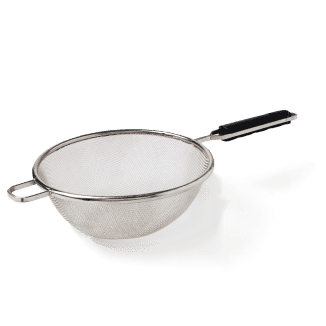


The best fine-mesh strainers are durable and allow you to sift and strain even powdered substances well. They also fit on a wide variety of vessels and are comfortable to handle. We’ve recommended our top choice, the Rösle Fine Mesh Strainer, 7.9 inches, for over a decade. It’s a stellar performer, straining foods perfectly and yielding the finest-textured soups and purées. Its handle is comfortable to hold, and a large hook allows it to sit securely on bowls and saucepans. Although it is expensive, we think it’s a good investment; it’s remarkably durable, and after many years of use ours look nearly the same as they did when we first bought them.

Looking for a smaller version? Check out our review of small strainers.
Fine-mesh strainers are underrated—one of those kitchen tools that you don’t know you want but that turn out to be indispensable once you get one. They’re great for rinsing rice, washing small quantities of herbs or vegetables, sifting flour or powdered sugar, and straining sauces and purées so they are silky-smooth. (If you’ve never eaten a soup that’s been passed through a fine-mesh strainer, prepare to be amazed—the strainer will make even the lowliest vichyssoise feel like something that came out of a Michelin three-star kitchen.)


We use fine-mesh strainers to strain soups and purees (left) and sift sugar (right) and flour.
Fine-mesh strainers come in a range of sizes, usually defined by the diameter of their baskets. For this review, we focused on models with a basket diameter of about 8 inches, the size we think is most useful for home cooks. (We’ve reviewed smaller strainers separately; they’re great for tiny tasks such as sifting small volumes of powdered sugar or cocoa powder onto cakes or straining lemon juice, tea, or cocktails.)
What to Look for
- Truly Fine, Stiff Mesh: It stands to reason that a fine-mesh strainer should have baskets made from really fine mesh. This ensures that any purées that pass through it, such as the gazpacho and berry coulis we tested with it, will be ultrasmooth and silky. Very fine mesh also does a better job of holding back any bran when you sift whole-wheat flour, as we often do when making bread (the bran can add bitterness and make your loaves dense). In addition, we preferred that the mesh be relatively stiff. Stiffer mesh held its shape better than loose and floppy mesh and made it easier for us to push purees through with ladles or spatulas.


Strainers with very fine mesh (left) make the smoothest purees and sift out more bran from whole-wheat flour (a task we perform when making bread). Strainers with coarse mesh let more fiber and bran pass through (right).
- Relatively Large, Shallow Baskets: Although the strainers all had similar diameters across the top of their baskets, the baskets’ capacities varied depending on their shape and depth. We found that models with capacities of about 5.5 cups were ideal and allowed us to strain food in fewer batches. We also liked baskets that had a depth of 3 inches or less; baskets that were deeper sank lower in bowls and pots, sitting in the purees they produced.
- Wide Pot Hooks: All fine-mesh strainers come with a pot hook attached to the side of the basket opposite the handle. This feature allows you to rest the strainer on top of a bowl or pot while straining. We vastly preferred models with wide, curved hooks, which let the strainers sit especially securely on top of a variety of vessels.


Our favorite models had wide pot hooks (left) that gripped the sides of vessels, providing stability as we strained purees. Flat (middle) and small loops (left) just sat on top of vessels, providing no such security.
- Comfortable Handles: We liked models with rounded handles that were comfortable to hold for long periods. Bonus points went to strainers with grippy materials on the handle, which made them especially easy to hold, even when wet.
- Solid Construction: In addition to having stiff mesh, the best models were also impervious to other kinds of damage and stayed intact when we banged them against a counter 10 times to simulate accidental drops or other impact.
What to Avoid
- Coarse Mesh: Coarser mesh produces coarser, grittier purees; the coarsest models we tested strained out less vegetable fiber from gazpacho and fewer seeds from berry coulis. The coarse, loose weave of these strainers also let all the bran pass through when we sifted whole-wheat flour.
- Floppy Mesh: Flexible, floppy mesh sometimes deformed when we pressed on it with ladles and spatulas and warped or detached when we suspended a 12-pound mortar in each model to simulate long-term use.


Strainers with floppy mesh (left) deformed easily over time, while strainers with more rigid mesh kept their shape.
- Small or Flat Pot Hooks: These made the strainers harder to stabilize on pots and pans, causing the models to rock back and forth when we pressed ladles or spatulas into them as we strained foods.
- Wire Loop Handles: We found these uncomfortable to grip for long periods, as when straining soups and coulis.
- Poor Construction: Several models had handles or hooks that flew off when we subjected them to harsh treatment. While these models might be fine if you were careful, we preferred those that held up better under pressure.
The Tests
- Strain Creamy Gazpacho Andaluz
- Strain Berry Coulis
- Sift bran from 1 cup of flour
- Wash 10 times as directed by manufacturer
- Bang each model on counter 10 times; note damage
- Suspend mortar in strainer for half hour; note damage
How We Rated
- Durability: We evaluated how well each strainer resisted warping and breakage.
- Ease of Use: We rated each strainer on how securely it sat on different pieces of cookware and bowls and how easy it was to handle.
- Performance: We evaluated each strainer’s ability to sift bran and make smooth purees.

 Buy at Williams Sonoma