
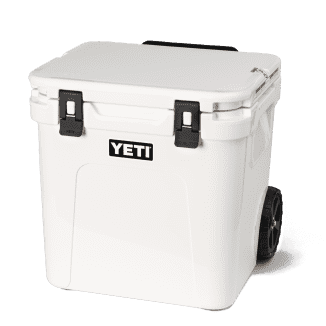


The best coolers keep their contents cold for several days and are sturdy enough to withstand years of outdoor use. They should have lids, latches, and handles that are easy to operate, and they should be portable enough to accompany you on all your adventures. Our favorite wheeled cooler and top choice overall is the YETI Roadie 48 Wheeled Cooler; it’s capacious, durable, and easy to maneuver, and it keeps food and drinks cold for several days. The YETI Tundra 45 and YETI Tundra 65 are our Best Non-Wheeled Cooler and Best Large Non-Wheeled Cooler, respectively. Both are unmatched in their durability and cold retention, but their lack of wheels makes them less portable than our top choice. The Coleman 50 QT Xtreme Wheeled Cooler has a spacious interior and is easy to operate and wheel around, but it’s less durable than our other top picks and doesn’t keep its contents as cold for as long. We’ve named it our Best Buy.
Looking for an even more portable option? You can read all about soft coolers in our dedicated review.

Coolers are indispensable tools, insulating food, drinks, and anything else you need during beach trips, campouts, road trips, parties, and tailgates. They’re also helpful in a pinch: They can preserve the contents of your refrigerator or freezer if you lose power, help you thaw your Thanksgiving turkey, and provide a cold place to stash groceries during a busy errand run.
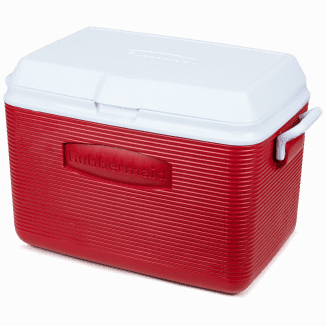
For decades, conventional plastic coolers have been made using injection molding. In this process, molten plastic is injected into molds to form each separate part of the cooler. After they harden, these discrete pieces are bonded together. Coolers produced using injection molding have relatively thin plastic shells and multiple seams where the parts are joined.
In the past 15 years, companies such as YETI and RTIC have transformed the cooler market by introducing premium coolers that can cost $400 or more. These coolers are made using a process called “rotomolding,” which is short for rotational molding. Rotomolding uses powdered plastic that is poured into heated metal molds, which are continuously rotated as the plastic melts and flows to form seamless, hollow shells. Rotomolded coolers have thicker plastic shells and fewer seams through which cold air can escape; they are purportedly more durable and better at insulating than injection-molded coolers. Rotomolded coolers are marketed as the ultimate outdoor accessories—able to keep contents cold for up to a week and last for generations themselves.


Injection-molded plastic coolers are made of several separate, relatively thin plastic parts that are joined together; they have more seams that can allow cold air to escape. Rotomolded plastic coolers are formed in one or a few seamless pieces of ultrasturdy plastic. Newfangled metal “performance” coolers are vacuum-insulated, similar to a travel mug.
A second category of premium coolers is “performance” coolers. These coolers are made entirely from metal, not plastic, and have a double-walled construction with vacuum insulation similar to that of a travel mug. They offer comparable capacities to rotomolded coolers but are lighter and have thinner sides.
What Size Cooler Should I Get?
Coolers are usually marketed using their capacities in quarts. (The YETI Tundra 45, for example, has a 45-quart capacity.) Over the years, we’ve tested models with capacities ranging from 24 quarts all the way up to 65 quarts. We think that coolers with 45- to 50-quart capacities are best for most people. They’re big enough to hold a weekend’s worth of groceries for four people. They can also fit at least 36 cans of soda plus ice packs.
It’s important to remember that insulation and thick plastic walls add a considerable amount to most coolers’ footprints. Top-performing coolers also have thick plastic and insulation that adds weight, so even our favorite 48-quart cooler has a large footprint and is quite heavy when full. Our Best Buy offers a great lightweight, slimmer alternative, though it’s less durable and insulates less effectively than other top choices. Consult listed measurements in the chart below (and your own weightlifting ability) before you buy.

Should I Get a Wheeled Cooler?
We tested a mix of coolers with wheels and without. The wheeled models had long handles attached to their lids or sides, designed to help you pull the coolers around without having to bend over. In general, we found wheeled coolers to be more portable and easier to maneuver around different types of terrain than non-wheeled coolers. But some models had wheels and handles that added too much weight, ate into the usable interior space, and were difficult to use; they didn’t work well enough to be worth the heft. Our favorite wheeled model was only slightly heavier than similarly sized non-wheeled coolers, and we found the added maneuverability and portability to be a worthwhile trade-off.
What to Look for
- Sturdy Rotomolded Plastic: Coolers made of strong, rotomolded plastic were the most durable in our tests. Rotomolded plastic withstood drops, bumps, and scrapes with nary a scratch.
- Thick, Air-Filled Insulation: Rotomolded coolers also insulated most effectively; among these, models with layers of foam insulation that were at least 1.75 inches thick worked best to keep contents cold for at least 4 days. Top-performing models included insulation in their lids as well as their sides and bottoms. However, models with the thickest insulation—up to 3 inches thick in some cases—didn’t always perform the best. We found that the insulation’s density also mattered. Coolers with slightly less-dense foam insulation—measuring less than 40 milligrams per cubic centimeter—performed better. Less-dense foam contains more pockets that trap air and hold it stationary, which creates a strong insulating barrier between the contents of the cooler and the heat outside. A thicker layer of air-filled insulation encased in tough, rotomolded plastic was the winning combination to keep items cold.

Top-performing models had thick layers of foam insulation that trapped air and held it in place, allowing for impressive insulation and cold retention (left). Coolers with thinner insulation (right) lost their chill much faster.
- Well-Designed Latches: Every model we tested had plastic or rubber latches that secured their lids. Our favorite latches were intuitive and easy to operate, often needing just one hand. A few top models had T-shaped rubber tabs that we secured in a plastic bracket; we liked this design because it was always easy to open and close, and it held fast.


Latches that buckled and locked with minimal force and stayed securely fastened (left) were our favorites. Some latches required additional tedious steps or needed us to exert a lot of force to close them (right); these were often the latches that sprang open during our durability tests.
- Easy-to-Use Lids: We preferred lids that opened easily, without getting stuck shut and requiring extra wrenching from us. We also liked hinges that held the lids securely in place when open, rather than lids that slammed shut on our fingers if we accidentally bumped the coolers.

Nice to Have
- Telescoping Handles: Among wheeled coolers, we preferred models with handles akin to those on a rolling suitcase, which extended or stowed on demand and made the coolers simple to maneuver.
What to Avoid
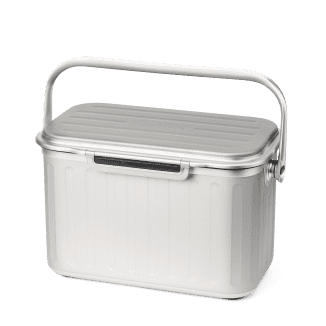
- Flimsy Shells: Some coolers simply weren’t as durable as our leading models. Injection-molded plastic was more likely to scratch or crack during durability tests. The aluminum model we tested was particularly fragile, denting in multiple areas throughout testing.

We loaded the coolers with cans of soda and flung each one off the back of an SUV to see how well they could handle rough use.

- Thin Insulation: Coolers with thinner layers of insulation—usually less than 1.75 inches thick in most areas—didn’t insulate their contents as well as those with thicker layers, letting soda and food get warmer quicker.
- Non-Insulated Lids: Lids that didn’t have insulation allowed cold air to escape more easily, letting the contents of the cooler warm more quickly.
- Poorly Designed Latches: Latches that required extra force, additional steps, or two hands to open or close slowed us down.


Poorly-designed lids that were difficult to open or close—or whose tops didn’t stay perched open—slowed us down (left). We preferred lids that were fully insulated, which helped keep contents cold, and those that stayed open on their own (right).
- Stubborn Lids: Some coolers’ lids seemed to get stuck closed, requiring extra force from us to open.
The Tests
- Place 8 frozen ice packs and 36 sodas (all at 40 degrees) into cooler; open 1 soda and record its temperature at 8 regular intervals each day, tracking how long it takes for sample soda to reach 50 degrees
- Attempt to fit weekend’s worth of groceries for 4 people inside
- Carry or wheel cooler across asphalt, concrete, grass, and gravel and haul up and down stairs
- Fill with 40 pounds of weight and load into, remove from, and push out of SUV 5 times
- Operate all latches and handles at least 100 times
- Open and close lids at least 100 times
- Saw in half and measure thickness and density of insulation
How We Rated
- Performance: We evaluated how well the coolers kept ice, food, and drinks cold.
- Durability: We assessed how well the coolers withstood damage over the course of testing.
- Ease of Use: We tested how simple it was to open, fill, close, and drain the coolers and how easy it was to operate their latches, handles, and drain plugs.
- Portability: We noted if coolers were easy to carry or wheel across multiple types of terrain when full.