

 Buy at Amazon
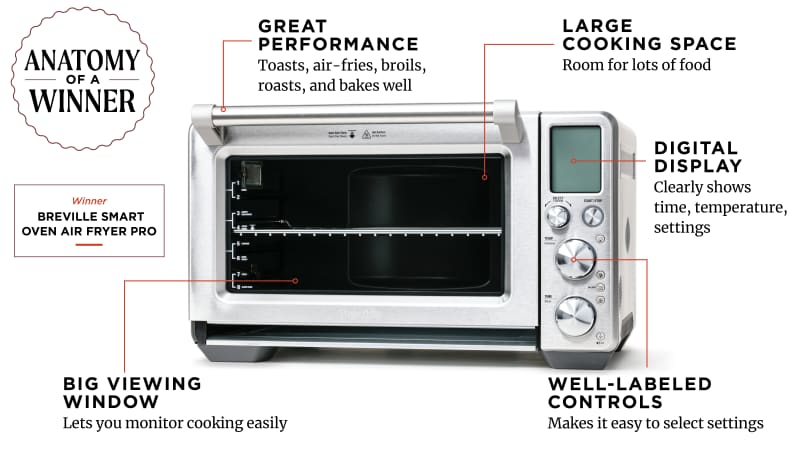
Our favorite air-fryer toaster oven—the Breville Smart Oven Air Fryer Pro—excelled in all our cooking tests: air frying, roasting, baking, broiling, and toasting foods perfectly. It’s also one of the most user-friendly machines we’ve tested, with intuitive controls, an easy-to-read digital display, and a host of other features that make it a pleasure to operate.
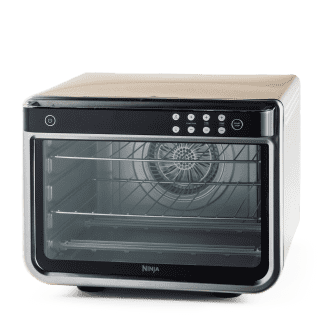
We also loved the Ninja Foodi 10-in-1 XL Pro Air Fry Oven, which performs just as well as our favorite and is generally less expensive. Oddly, while it’s got a slightly bigger footprint than our favorite, its actual capacity is slightly smaller.
Finally, our Best Buy is the Instant Oven 18L Air Fryer Toaster Oven. It does a great job of air frying, roasting, and broiling, though it’s a little underpowered as a toaster. Its digital interface is not as easy to navigate as those of our top options, but considering that this model is less than half the price of our winner, we think that’s a fine tradeoff
Want a simpler, less expensive option for air frying? Read our review of air fryers or watch our video comparing the two best types of air fryer options.
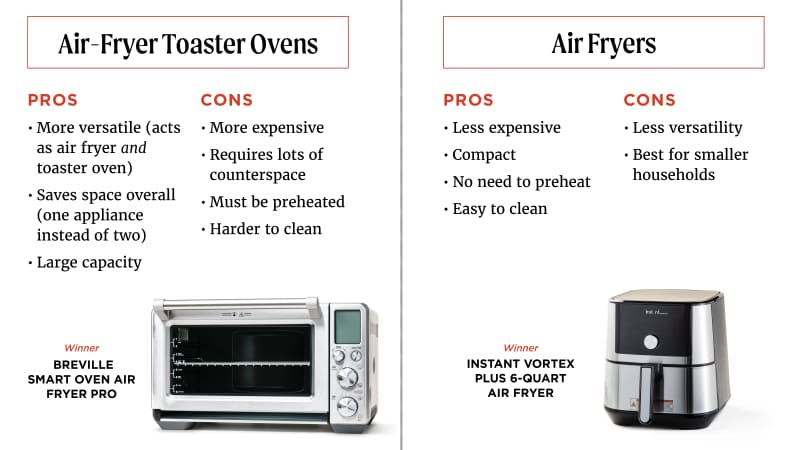
What can’t the best air-fryer toaster ovens do? Serving as both air fryers and toaster ovens, these hybrid machines are more versatile than either of those appliances, allowing you to air-fry, toast, bake, roast, and broil different types of food. They’re also bigger than both air fryers and toaster ovens, providing plenty of room to air-fry mozzarella sticks for a crowd, roast a whole chicken, or even bake a 9-inch round cake. Because they’re bigger, you have to preheat them before many applications, unlike with conventional air fryers. But they still preheat more quickly than a standard oven, saving you time and helping you get a faster start on your meal.
Like air fryers, air-fryer toaster ovens don’t actually fry your food. Instead, they’re essentially powerful countertop convection ovens, using fans to circulate hot air so that food cooks swiftly and evenly, its exterior crisping and browning while the interior remains tender and moist. (A mesh basket holds the food in the air-fryer toaster oven so that the air can circulate above and below.) And in contrast to smaller convection toaster ovens, air-fryer toaster ovens have fans that operate at higher speeds, allowing them to crisp and cook the surfaces of food more quickly when air frying, baking, or roasting.
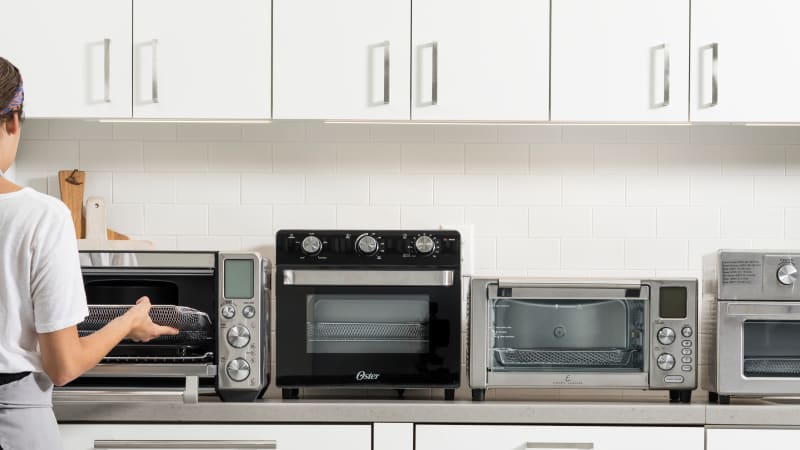
Not all air-fryer toaster ovens are good at all tasks. In fact, only a few excel at everything from air frying to roasting. We’ve tested dozens of models over the years, and we’ve found that a few simple features make all the difference.
What to Look For
- Good Air Frying: The best models were able to evenly crisp pounds of fries and up to four cutlets’ worth of chicken parmesan to a perfect, golden brown.
- Good Toasting: A good air-fryer toaster oven should be able to replace your toaster oven. We preferred models that could make toast in a range from light to dark and performed consistently regardless of whether we were toasting one piece of bread or six.

As the name implies, a good air-fryer toaster oven should be able to make toast in a range of light to dark, as seen on the bottom row. Many models, including the one that made the toast on the top row, couldn't do it all.
- Good Roasting and Baking: We liked models that could maintain more moderate heats for roasting and baking. About half the models we tested were capable of producing beautiful roast chickens with crisp, evenly golden skin and moist meat.
- Good Broiling: Our favorite models made Simple Broiled Asparagus that was tender but not overcooked and were even able to give them a good char. Rack position was key: Models with racks that sat closer to the top heating element—within 2.6 inches or less—produced the most evenly browned asparagus.
- Clearly Marked, Easy-to-Use Digital Controls: We liked air-fryer toaster ovens with controls that were clearly labeled, making it easy to select the setting, time, or temperature we wanted. While we didn’t dislike models with analog dials, we preferred those with digital controls and displays, as these were generally more precise, letting us choose the exact temperature or time we wanted instead of forcing us to choose them in 50-degree or 10-minute increments as was the case with some models.
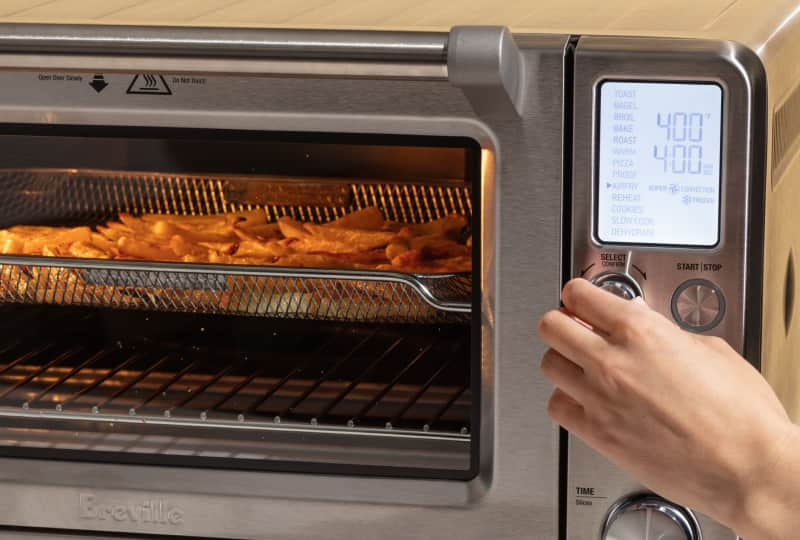
- Large Cooking Space: The bigger the cooking space, the more food we could fit in it. This applies not only to the volume of the interior, though the best air-fryer toaster ovens had more than enough room to roast a whole chicken or even, in the case of our winner, a small turkey. With air frying, interior volume is less important, since you can only position food in a single layer to allow hot air to circulate properly. Here, the surface area of the air-fryer basket included with each model was key. Our favorite machine came with an especially large air-fryer basket that had nearly 175 square inches of room for food—enough to fit 3 pounds of chicken wings in a single layer.

- Large Viewing Windows: The best air-fryer toaster ovens had large viewing windows, allowing us to monitor our food’s progress as it cooked.
- Auto-Pause Timers: When air frying, you’ll often need to flip, rotate, or shake the food to get it to cook evenly. We preferred machines that paused the cooking time automatically when we opened the door to do this; cooking resumed automatically after we shut the door again, so we didn’t have to reset the time or account for lost seconds.
Nice to Have
- Clearly Marked Rack Locations: We liked models that indicated exactly where you should put your oven rack, sheet pan, or air-fryer basket for different settings (roast, bake, toast, air-fry), as this made it easier to cook foods successfully, without guessing the correct position.
What to Avoid
- Poor Performance: Very few of the air-fryer toaster ovens that we’ve tested excelled at all tasks. Many of the air-fryer toaster ovens we tested just weren’t very good at toasting, either failing to get toast to a medium brown even after two rounds or toasting unevenly, rendering some pieces of toast dark while others in the same batch looked untouched. Others couldn’t air-fry evenly, possibly because their fan speeds were too low, leaving some french fries crisp while others were either charred or limp and undercooked. Some produced pale, flabby-skinned roast chicken or forced us to extend our cooking time by more than 20 minutes to ensure that the chickens were cooked through. And others simply couldn’t char food while broiling, either because their top rack was too low or because the machine didn’t generate enough heat at that setting.
- Limited Controls: The markings on some of the models’ time knobs were divided into 10-minute increments, while the temperature knobs of other models were divided into 50-degree increments. These controls offered less precision, preventing us from customizing our cooking time and temperature to our liking.
- Low Top-Rack Position: Models that had a top rack position 3 or more inches away from the top element struggled to char food while broiling.
The Tests
- Make toast at various settings
- Make Air-Fryer French Fries
- Make Air-Fryer Chicken Parmesan
- Make Simple Broiled Asparagus
- Roast whole chicken
- Clean after every test
How We Rated
- Cleanup: We rated the models on how easy they were to clean.
- Ease of Use: We evaluated the models on how simple it was to select settings and times and how easy it was to handle and maneuver the various parts.
- Performance: We rated the models on how well they toasted, roasted, broiled, baked, and air-fried.