

 Buy at Amazon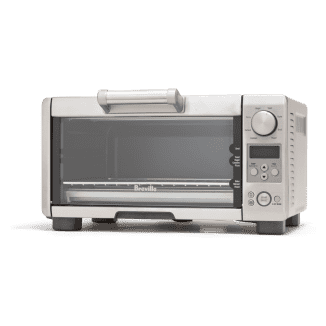
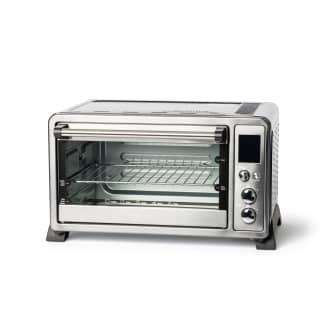
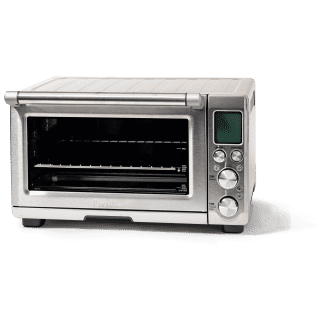
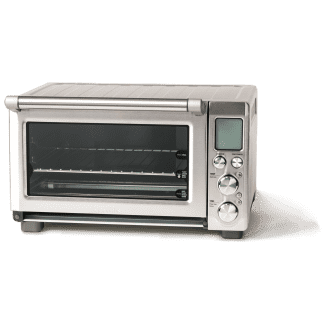
The best toaster ovens are easy to use and toast, bake, roast, and even broil foods well. We prefer larger models that can fit six slices of toast. Our longtime favorite is the Breville Smart Oven. This large toaster oven is a stellar performer, making perfect toast, cakes, and even roast chicken. It’s durable; reliable; and has a great, user-friendly interface. The Toshiba Large 6-Slice Convection Toaster Oven is our Best Buy. Its console is trickier to navigate and it can’t broil well, but it excelled at every other task and costs much less than the Breville does.
If you’re looking for a smaller toaster oven, we also like our top choice’s little sibling, the Breville Mini Smart Oven. It performs nearly as well as our favorite and can still fit six slices of toast, but its dimensions are a lot more compact, making it a great option for those with limited space.
Just want a good piece of toast, no fancy functions needed? A conventional toaster is probably your best option.
And if you’d like a toaster oven that can also air-fry, we recommend checking out our review of air-fryer toaster ovens.

At its most basic, a toaster oven lets you toast bread of any type, shape, and thickness; it’s great for handling rustic hunks of artisanal bread and thinly sliced sandwich bread alike. But a good toaster oven can do much more than simply make toast. The best are truly versatile, functioning as a second oven or even taking the place of your big oven for small jobs. Our favorite models are great for toasting nuts or bread crumbs, roasting a vegetable side dish or a 4-pound chicken, baking an 8-inch square cake or a small batch of cookies, or broiling a few fillets of fish. They’re handy for holidays or parties when you need more cooking space, and they won’t heat up your kitchen as much as a full-size oven would on hot days. Better still, they preheat faster, use less energy, and are easy to clean.

The best toaster ovens, including our winner by Breville shown here, are capable of roasting chickens beautifully.
What Size Toaster Oven Should I Get?
Toaster ovens come in a variety of sizes. In general, we prefer those that are big enough to function as mini ovens—spacious enough to fit at least 6 slices of bread and tall enough to accommodate a 4-pound chicken with a few inches on all sides to allow for heat to flow properly. The bigger the toaster oven, the more versatile it will be, letting you do more with your small appliance. Smaller toaster ovens not only fit less food, but they also often have more limited functions: Some only let you bake or roast for short periods of 10 to 25 minutes and/or lack a broil setting.
That said, large toaster ovens take up more space and often cost more than smaller ones. And the bigger the toaster oven is, the longer it will take to make toast in it, since the bread is farther away from the heating elements that brown your food. If space or money is short, you typically make toast for just one or two people at a time, or you don’t plan to roast a chicken or bake a cake in your toaster oven, a more compact model might be a better option. These usually hold fewer pieces of toast but will still give you enough room to bake a few potatoes or cookies and make an open-faced tuna melt, and take less time to make toast as well. (Our favorite small toaster oven actually holds six pieces of toast, but it has a lower profile, so you can’t fit a 4-pound chicken in it.)
What to Look For
- Clearly Labeled, Easily Adjusted Digital Controls: We liked models that had straightforward, clearly labeled dials or buttons that let us choose functions (bake, broil, toast) and settings (time, temperature, toast doneness) easily. In general, we preferred models with digital displays, as these let us see our selections and cooking progress. We also liked models that let us set specific times and temperatures—these were more precise and easy to use than models with dials that could only spin in approximate or large increments. And finally, we appreciated models that allowed us to adjust time and temperature during use—a key feature that helped us get our toast to the right level of brownness or roasts and baked goods to the right temperature without having to reset the entire cooking process.
- Accuracy: All oven temperatures—even those of wall ovens—fluctuate during use, as heating elements cycle on and off to produce the desired target temperature. We preferred toaster ovens that consistently kept temperatures within a few degrees of the ones we’d selected, however, letting us bake cookies and cakes more successfully. (We’ve found that toaster ovens that average as much as 60 degrees lower than the target temperature usually take 20 percent to 30 percent longer to fully cook most recipes.) For similar reasons, we also preferred models that had dedicated and well-calibrated settings for light, medium, and dark toast. There’s always a certain amount of tinkering needed to get your toast to the darkness of your choice—breads vary widely in terms of size, thickness, moisture, and sugar content and can require different toasting times as a result. But we don’t want to have to guess the precise time we’d need to brown our bread, as we did with several models that had no discrete color settings. Models with good preset options gave us clear timing baselines and didn’t require us to stand at attention by the toaster, waiting to pull the toast as the minutes ticked by. Instead, they got us into the right ballpark and often hit home runs with the simple press of a button.

- Even, Relatively Quick Toasting: It’s hard to pinpoint a single feature that determines how well a model toasts. Several factors contribute to the ability of a toaster oven to produce good, evenly browned toast, including the number, power, and positioning of the heating elements. Regardless, we preferred models that were capable of browning bread evenly, from edge to edge and on top and on the bottom, and in a wide range of donenesses. We also liked models that were able to make good toast relatively quickly—the longer your bread heats before it browns, the more likely it is to dry out and become an unpalatable, desiccated rusk. Many toasters’ dark settings ticked on for 8 or 9 minutes, and the toast was scorched by the time the cycle ended. One model toasted for more than 12 minutes on its highest setting, ultimately delivering toast that smoked like a chunk of charcoal. We could have pulled the bread a bit sooner, but we think even 8 minutes is far too long to wait for a decent piece of toast.

Samples of toast made in different countertop convection ovens sit for comparison during testing of this small appliance staple.
- Quartz Heating Elements: In general, we found that models with quartz heating elements performed better than those with nichrome heating elements. Quartz elements are remarkably consistent and responsive, heating up and cooling down faster than those made from nichrome. We’ve found that models with them are better at maintaining accurate temperatures, with fewer and smaller fluctuations. As a result, they bake, roast, and brown foods efficiently, within recipe times.
- A Range of Rack Positions: Many of the toaster ovens we tested struggled to broil properly, taking as many as 20 minutes to cook through asparagus with little or no charring. Here, the issue is the distance between the top heating element and the top rack. Since toaster oven heating elements aren’t as powerful as those in traditional ovens, foods need to sit close to the broiling element to roast fully. One toaster oven had only two rack positions; the highest, at 3.75 inches from the broiling element, was still pretty far away. This oven took double the time of any other oven to broil asparagus and melt cheese onto sandwiches. Racks that sat too close weren’t much better—we wanted to be able to see food as it broiled, and models that offered about 1.5 inches of space between the top rack and the broiler were hard to keep an eye on. The best toaster ovens had a range of rack positions, letting us broil, bake, and toast equally well.
- A Crumb Tray: The best models came with a crumb tray, which sits in the base of the toaster oven and collects stray crumbs, grease, and other food debris for easy cleanup.
What’s the Deal with Convection?

All but one of the ovens we tested has convection technology, a setting where a fan circulates the hot air, purportedly resulting in faster and more even cooking. However, when we used each toaster oven’s convection setting, most foods cooked slower than those we cooked in our conventional kitchen ovens. Only when we baked cookies did the convection settings seem to speed up cooking and promote better browning.
Our research science editor explained that convection isn’t all that helpful in small toaster ovens because heat already distributes better in smaller spaces. But even in big kitchen ovens, we've found that using a convection setting doesn’t cook food much faster than a conventional setting. Instead, our research science editor said convection works best when baking very moist items (like cookie dough or cake batter) because the fan helps speed evaporation by wicking away insulating vapor. This explained why the cookies baked faster and more evenly when we used the toaster oven convection settings.
What to Avoid
- Poor Toasting: Many of the toaster ovens we tested simply didn’t make great toast at any setting or failed to evenly toast larger batches of bread slices.
- Low Top Rack Position: Models that had a top rack position 3 or more inches away from the top element struggled to char food while broiling.
The Tests
- Toast single slices of white sandwich bread on light, medium, and dark settings
- Melt cheese on tuna melts under broiler
- Prepare Simple Broiled Asparagus
- Make Best Baked Potatoes
- Heat frozen pepperoni pizza
- Bake slice-and-bake sugar cookies
- Make Weeknight Roast Chicken
- Where possible, test fit with various pans: rectangular and square glass baking dishes, 13 by 9-inch metal baking dish, 8-inch square baking pan, broiler-safe 13 by 9-inch baking dish, small rimmed baking sheet
- Track time to preheat when set to 250, 350, and 450 degrees
- Set ovens to 350 degrees and track temperature over 2-hour period using thermocouples
- Clean baking accessories with soap and water after each test
- Evaluate any additional functions or presets (winner and best buy only)
- Make 365 pieces of toast to simulate a year’s worth of use (winner and best buy only)
How We Rated:
- Performance: We evaluated how well the models toasted, roasted, baked, and broiled.
- Versatility: We rated the models on how many different functions they were able to perform.
- Ease of Use: We evaluated the models on how easy it was to set different functions, temperatures, and times, and on how easy they were to clean.
- Accuracy: We rated the models on how accurately they maintained different temperatures.