

 Buy at Amazon
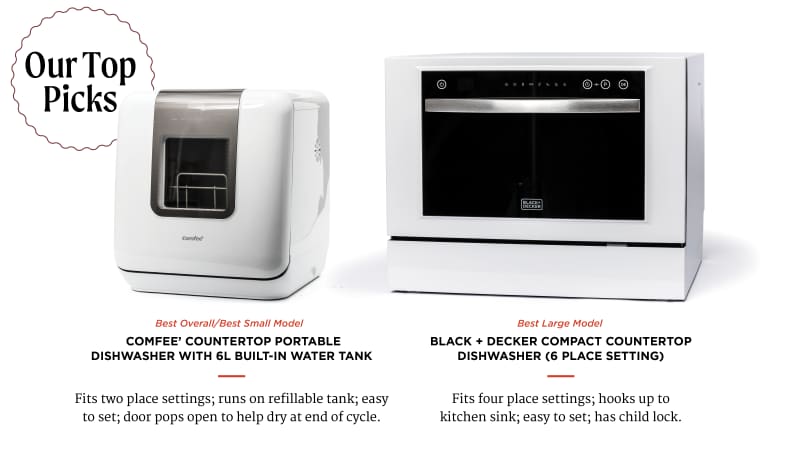
Love to cook but hate doing dishes? Same here. If you don’t have a dishwasher in your apartment, home, RV, or vacation place, consider a compact countertop model. They come in two sizes and styles. We tested both and have recommendations in each category. Our overall top pick was compact: The Comfee’ Countertop Portable Dishwasher with 6L Built-in Water Tank, which holds about two place settings and draws water from a refillable tank, cleaned well and was easy to use. It was the only model with a door that popped open at the end of the cycle, helping dishes air-dry. The larger models we tested, which hold about four place settings and must be latched onto your kitchen faucet for their water supply, all worked similarly and are recommended. Of these we slightly preferred the easy-grab handle and child-lock feature of the Black + Decker Compact Countertop Dishwasher (6 Place Setting).
Josephine Cochrane of Shelbyville, Illinois, invented the automatic dishwasher in 1886. As the story goes, she was unhappy when her household staff chipped the family china and began doing her own dishes. This spurred her to invent a machine to take over the chore. In 1893, her creation won a top prize at the World Columbian Exposition in Chicago and became popular in hotels and restaurants. After her death, Cochrane’s business was bought by the company we know today as KitchenAid, which launched its first home dishwasher in 1949 based on Cochrane’s design.
If you’re also ready to quit hand-washing dishes, but can’t install (or don’t need) a full-size dishwasher, a countertop dishwasher might be a good solution.
It could also save money and energy. According to the federal Energy Star program, a full-size dishwasher that’s energy-efficient costs an average of about $35 per year to run. By contrast, it rated our countertop versions as costing between $17 and $27 yearly.
We bought a half-dozen machines and methodically dirtied and washed dishes for many hours, trying the range of available cycles, to determine whether countertop models perform on par with standard installed dishwashers and whether they would be convenient to use. All of them heat cold tap water for washing and use regular dishwasher detergent. In our temperature testing, all reached safe temperatures for effective cleaning. Our models were priced from about $340 to nearly $400.
We covered dishes and cutlery with a sticky mixture that included chopped spinach, sunny-side-up fried eggs, cooked oatmeal and rice. We let this dry on, and then washed them in each dishwasher to compare cleaning performance.
Every model performed similarly in our cleaning tests. They came in two styles: Larger machines held about four place settings (10¼-inch dinner and 7¼-inch salad plates, a deep 6-inch-wide bowl, and a 4-inch tall mug) plus flatware, and attached to a sink for their water supply. Smaller models held about two place settings and ran on refillable water tanks—but also included hoses for sink hookup as an option.
We found more differentiation between the two smaller models than among the four larger ones, where only the control panels, user manuals, and a few features varied. (They were likely made in the same factory and customized for each brand.) If you want one of the larger models, you might compare current prices and pick the least expensive.
Choosing the best countertop dishwasher is about what matters for your space and needs. Below we’ve laid out what to do if you’re in the market for a portable dishwasher.
Choosing the Right Model for You
- Start with Size: If your household is more than two people or you cook a lot, pick a larger model. The roll-out dish racks in small machines were tiny: just 11½ by 13¼ inches (plus a petite, removable shelf). On larger models, dish racks were 18 by 19 inches (plus a long, narrow shelf and removable silverware basket). Small models also have spinning spray arms at the top inside, which shouldn’t be blocked from turning, meaning that plates larger than 10.5 inches might not fit, unless set at an angle. That said, if you can get by with a small model, our top pick overall was the COMFEE’ Countertop Portable Dishwasher with 6L Built-in Water Tank.


Smaller dishwashers held about two place settings, while larger models held about four place settings (despite some that claimed to hold six place settings).
- Check Your Faucet: If you want a larger model and have a standard kitchen faucet, you’re all set: Large dishwashers came with simple adapters that easily screwed on. (You just clip the dishwasher hose to this adapter when you’re ready to run it). But if your faucet is nonstandard, with a larger, extendable spray head, either pick a tank-style dishwasher that won’t need a sink hookup or ask a plumber to help you find the right attachment hardware. None of the manufacturers sold additional styles of adapters, and their customer service departments couldn’t advise us. We tried faucet-adapter kits that we found online, and we still failed to attach our dishwashers to any nonstandard faucets.
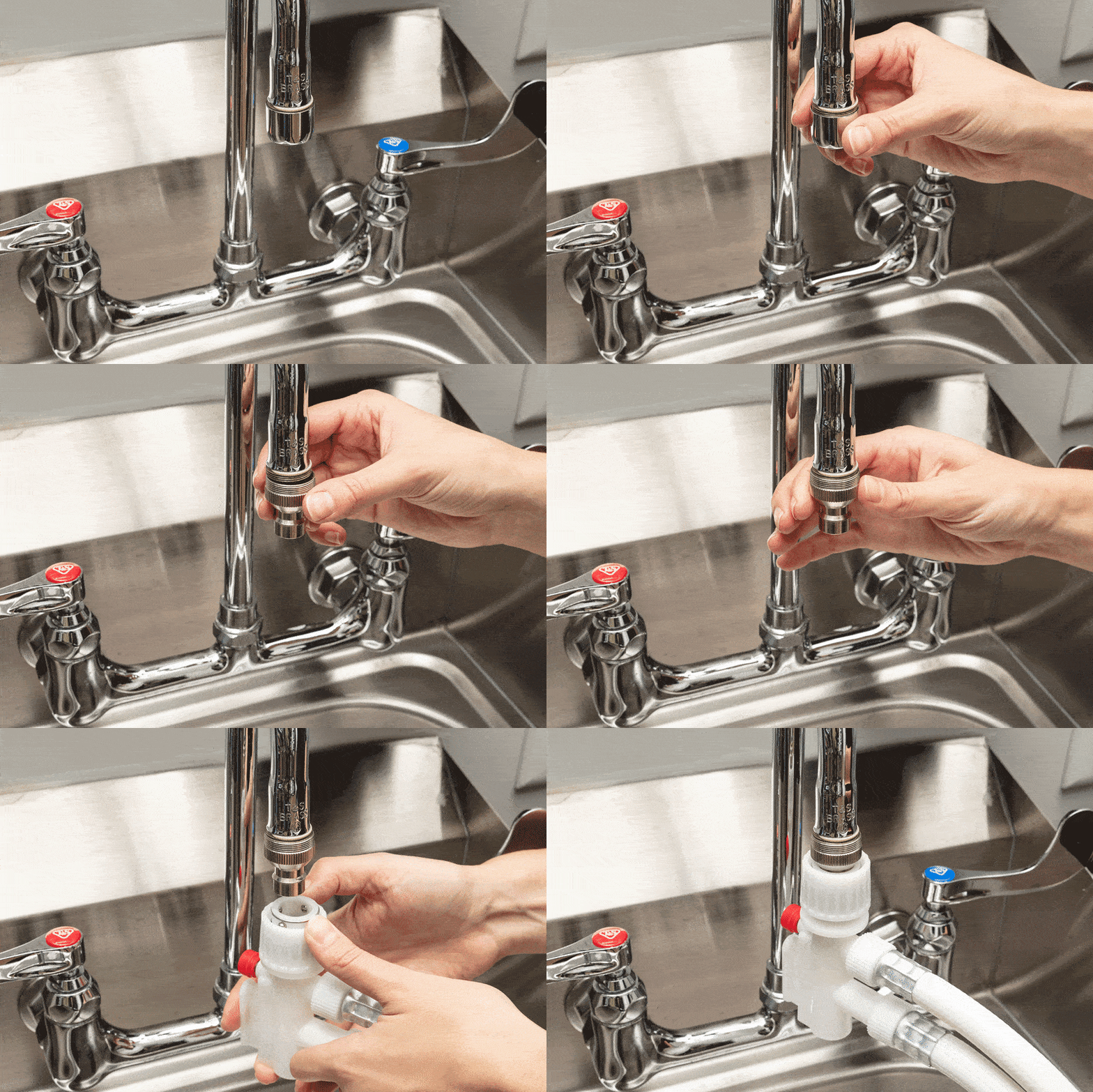
- Think About Your Sink: Most dishwasher cycles are slow, lasting around 2 hours. Models that hook to your faucet monopolize your kitchen sink. By contrast, tank-style models leave your sink free and can run anywhere there’s an electrical outlet. While you can let their drain hose run into the sink, this doesn’t prevent you from using the sink (nor does it spray wildly while draining). If you really want your tank-style dishwasher out of the way, let it drain into a bucket. These machines require about 1½ gallons of water, which you pour into a hole in the top of the machine using the included pitcher.
Pro Tip: Keep a Bucket Handy
Models that attach to faucets have couplings that hold two hoses together—one for water input and one for draining. After the cycle ends, it’s easy to detach them from the faucet. But no matter how carefully we tried to drain them first, the hoses inevitably spilled water as we moved them. We learned to have a bucket ready to catch any sudden spills.
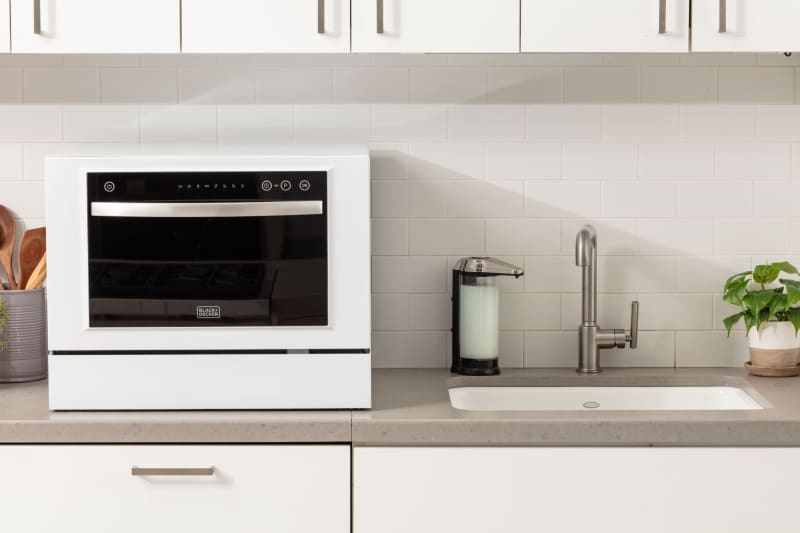
- Consider Counter Space: These might be countertop models, but the big ones are especially bulky. You might want to keep yours on a rolling cart for easy storage between uses.
Other Considerations
- Baby Care Cycles: Three models offered “baby care” cycles, which their manuals explained were for washing baby bottles. While one added UV light and another steam (the third just ran a bit longer and hotter than usual), none promised sanitation or sterilization. Items emerged clean, but if you need to sterilize or sanitize baby bottles, don’t rely on these machines.
- Fruit Wash Cycles: The two small models featured cycles (and provided sievelike plastic baskets) for cleaning “hard-skinned” fruits such as apples. We put in a dozen apples and watched them vigorously spraying cold tap water (no soap) over the fruit for about 20 minutes. It seemed excessive.

The Tests
- Set up and run dishwashers multiple times on range of available cycles
- Compare capacity using standard dishware and flatware
- Test cleaning ability using dishes and utensils painted with mixture of dried-on, sticky foods, including sunny-side up eggs, thawed frozen chopped spinach, cooked oatmeal and rice, shredded cheddar, and mashed cannellini beans
- Measure maximum hot temperature achieved by dishwasher on normal setting
- Evaluate condition/appearance and rate durability at conclusion of testing
- Compare estimated yearly energy cost figures provided by EnergyGuide, a federal government program. (Numbers are based on four wash loads per week, in home with an electric water heater.)
How We Rated
- Setup: We considered whether dishwashers were easy to set up and disassemble after each use.
- Performance: We rated dishwashers on their cleaning ability.
- Ease of Use: We considered whether the controls, capacity, design, features, and other factors made the dishwashers user-friendly.
- Cleanup/Durability: We rated how easy models were to keep clean and maintain and evaluated their condition after testing to assess the sturdiness of their construction.