


 Buy at Amazon
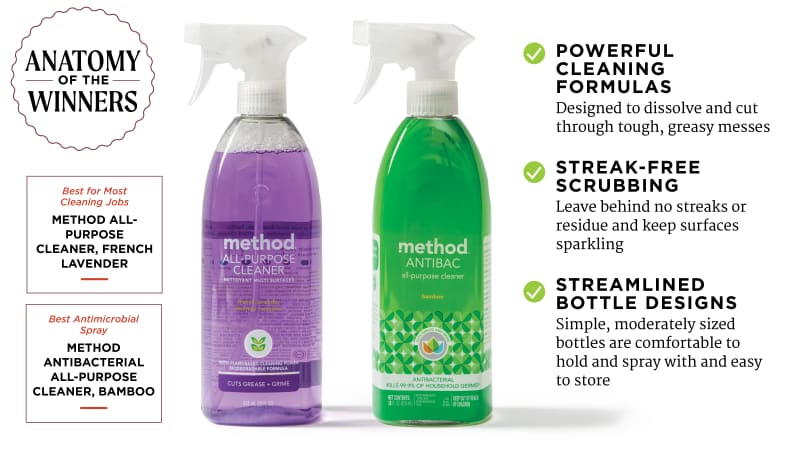
Multipurpose cleaning sprays are formulated to tackle messes on a wide array of home surfaces. Only a few products consistently cleaned well in testing. Method All-Purpose Cleaner, French Lavender dissolved stubborn messes in our homes and test kitchen, leaving behind virtually no streaks or residue. Its reliable cleaning power and pleasant scent make it the best option for most home cleaning jobs. We also think it’s a good idea to keep a safe yet effective antimicrobial product to disinfect high-contact surfaces or clean up after working with raw meats. Method Antibacterial All-Purpose Cleaner, Bamboo is our favorite antimicrobial spray. It excelled in all our cleaning tests, and it killed germs effectively when used properly. It contains fewer harmful chemicals than most of the antimicrobial sprays we tested but outperformed them all in our tests. It has a strong scent that a couple testers disliked.
If you're looking for multipurpose cleaning products designed to use less plastic, check out our review of eco-friendly multipurpose cleaners.
As their name suggests, multipurpose spray cleaners (also labeled “all-purpose” or “multi-surface” cleaning sprays) are intended to be versatile. They’re designed to work on a variety of surfaces in your home, from kitchen counters to stovetops to bathroom sinks. To accomplish this goal, they use chemicals from three main categories: surfactants, solvents, and buffering agents.
Surfactants alter the surface tension of grease and soil particles, allowing solvents (usually water) to penetrate and loosen stains. Buffering agents (also called pH adjusters) help stabilize the cleaning product. They balance out the pH of the spray’s components to a level that will be effective at fighting grease and soils. By stabilizing pH, these ingredients help the sprays clean a variety of messes.

Some sprays also contain ingredients called antimicrobials, which “disinfect” (or kill germs on) surfaces. Many popular products use traditional antimicrobials, called quaternary ammonium compounds, or “quats” for short, that work well but are potentially harmful to inhale or touch. Some newer antimicrobial products use milder disinfectants such as citric acid. These alternatives are widely thought to be safer and similarly effective (more on this below).
We talked to industrial chemists, laboratory scientists, and public health and cleaning experts to learn more about multipurpose cleaners. Then we put our lineup through a litany of tests. Only a few products excelled across the board, and we homed in on what set them apart.

What to Look For
- Effective Formulas: Our favorite sprays cleaned every stain in our tests without fail, including sticky vegetable oil and cooked-on pasta sauce. Our winning products had powerful ingredients that allowed them to dissolve and power away stains without extra effort on our part. Formulas are usually proprietary, but our ranking chart (below) highlights our favorite products based on performance.
For a particularly difficult test, we spread tomato paste on a steel prep table and let it dry overnight. The best sprays were still able to loosen and scrub away most of the dried paste, but many products struggled and left behind remnants of the mess, as you can see above.
- Sprays That Work on Many Surfaces: The best sprays cleaned every mess well, no matter the surface. Jason Marshall, director of the cleaning lab at University of Massachusetts Lowell’s Toxics Use Reduction Institute (TURI), explained that companies formulate their products using combinations of surfactants and buffering agents to increase the types of surfaces they can work on (a concept known as “material compatibility”). Stabilizing sprays in this way keeps them from reacting with and damaging surfaces. Exact formulas are proprietary, but many products list what surfaces they’re safe for on their bottles or brand websites. Choosing a product that lists as many different types of surfaces as possible will ensure that you don’t damage your kitchen accidentally. When in doubt, test the product on a small, out-of-sight corner.


We tested the sprays on stainless steel cooktops and prep tables, sealed granite (left) and Corian synthetic stone (right) counters, porcelain and ceramic sinks, glass surfaces, and the plastic displays and insides of microwaves. Our favorite products excelled at cleaning on every surface throughout testing, fulfilling their “multipurpose” promises.
- No Streaks: Our favorite products left few or no streaks behind and didn’t deposit any oily or sticky residue. This ensured that we could finish cleaning and not worry about what chemicals were still hanging around on our surfaces. (It’s still important to rinse according to manufacturer instructions or after using any antimicrobial sprays, though. More on this below.)
- Pleasant Scents: Fragrances may be an afterthought for some people, but we found them to be strong motivators for consistent cleaning. Testers were more likely to use pleasantly scented sprays to clean their homes routinely. Our favorite scents were mildly citrusy or floral and not overpowering.
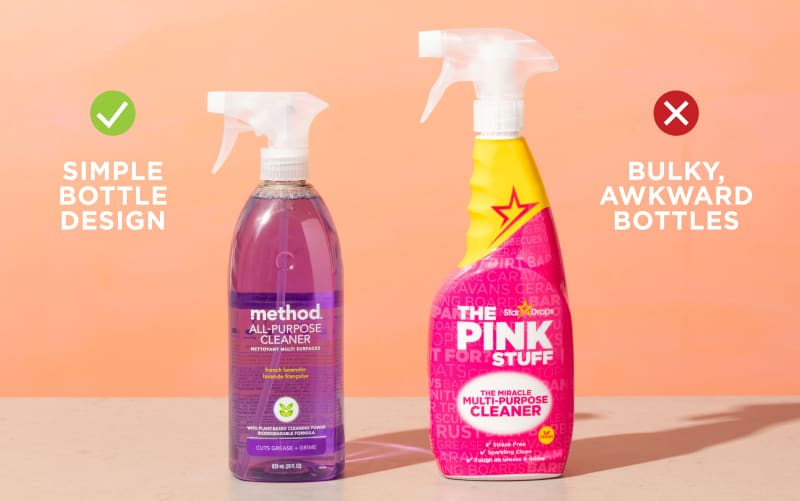
- Simple Bottle Designs: We prized compact, streamlined bottles without specific grooves or notches for our fingers. They allowed us to fit into tighter corners and grip and spray in multiple configurations.
- Powerful Spray Nozzles: The best bottles had nozzles that dispersed a lot of product per spray over a wide area. Cleaning with these sprays required fewer pumps of the trigger to cover large messes, which made things faster.


Our winning bottles sprayed cleaning solution in wide arcs that saturated large portions of stains at once. We preferred this widespread coverage to the concentrated, narrow sprays of other products, which made us spend more time spraying.
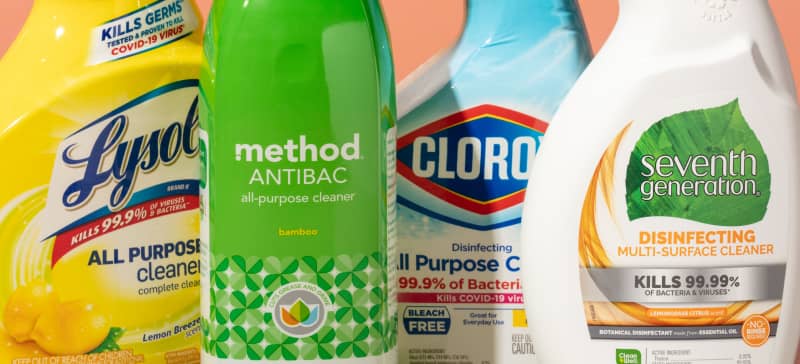
- Safer Antimicrobials: Some of the products we tested advertise their ability to kill “99.99% of bacteria and viruses” to disinfect home surfaces. These products contain antimicrobials, a class of chemicals that disrupt germs’ cell membranes or proteins, neutralizing them. We were interested in whether citric acid, the antimicrobial found in our winning disinfectant spray, was as effective at killing germs as the more traditional quats present in products such as Lysol All-Purpose Cleaner. We worked with an independent ISO-accredited lab to test both styles of antimicrobials and found they were equally effective at eliminating salmonella when used according to manufacturer instructions. We think it’s best to choose antimicrobial products that have active ingredients from the Environmental Protection Agency/TURI list of safer disinfectants, such as the citric acid present in our winning antimicrobial spray from Method. These chemicals are less likely to cause harmful health effects, including worsening asthma or skin irritation, which are common complaints of quat exposure, according to industrial chemist and public health researcher Amina Salamova.
Nice to Have
- Listed Ingredients: Manufacturers aren’t legally required to list every ingredient on their cleaning product labels, but it’s better for consumers when they do. They are required to list hazardous or toxic ingredients in guides called “safety data sheets” (SDS), which can often be found at product web pages or through a simple web search. For more information on specific chemicals, you can use online chemical databases such as the EPA’s CompTox Dashboard.
What to Avoid
- Ineffective Formulas: Some products cleaned some surfaces effectively but not others. A few did poorly across the board, leaving traces of messes behind. Mixed results are usually due to formulation, including ingredients and proportions that brands don’t disclose on labels. We preferred sprays that were formulated to clean every messy surface, which you can read more about in the chart below.
- Sprays That Streak: Streaks and residue kept surfaces from feeling clean. Products with harsher antimicrobial ingredients streaked more in our tests, but so did a few non-antimicrobial products. Streaking occurs when ingredients such as solvents or surfactants don’t release from surfaces easily, whether from slow evaporation or inadequate wiping or scrubbing. Some heavier-duty surfactants can leave behind sticky, oily traces that linger on kitchen surfaces and contaminate food. Always follow manufacturer instructions for rinsing after using a cleaning product. And if a manufacturer doesn’t include rinsing as a required step but the product leaves behind residue, rinse anyway.
Some sprays left streaks that were visible even after we let them dry. We preferred products that left no trace (except, perhaps, a pleasant scent).
- Bulky, Awkward Bottles: Boxy or overly tall bottles felt cumbersome in confined spaces such as microwaves, and they slowed us down. Some bottles had grips with finger notches that were bothersome to hold and spray with.
- Poorly Designed Sprayers: One nozzle dispersed the product in a narrow stream that took forever to cover stains. It also kept spraying continuously for a few seconds after we stopped pumping the trigger, which we never got used to.
One product’s nozzle was designed to spray continuously as we pumped its trigger. It even continued spraying for a couple seconds after we stopped, which we never got used to (and made it difficult to aim).
- Acrid Fragrances: Pungent and strong fragrances, especially antiseptic formulas that made us think of hospitals, felt suffocating. Strong scents can also be harmful, exacerbating breathing problems and other conditions. Manufacturers usually add cloying fragrance compounds to cover up the stench of harsh chemicals, which we found made a bad problem worse.
The Tests:
- Clean oil from stainless-steel cooktops, Corian synthetic stone countertops, sealed granite countertops, and wood-composite cabinet panels
- Spread jarred pasta sauce onto sealed granite countertops, let sit for 2 hours, then clean
- Spread tomato paste onto a stainless-steel work table, allow to dry overnight, then clean
- Clean the inside of a microwave splattered with cooked-on pasta sauce
- Have multiple testers use sprays in their homes for a few weeks and then provide input, including scent evaluations
- Work with an independent lab to test antimicrobial efficacy of product samples and a simple soap and water solution against salmonella
How We Rated
- Cleaning Performance: We tested how effectively the sprays cleaned an assortment of messes on stainless steel, sealed granite, Corian synthetic stone, wood-composite cabinets, hard plastic, and glass surfaces. We noted whether the sprays left behind residue or visible streaks.
- Ease of Use: We evaluated how easy each spray was to clean with, factoring in bottle design and spraying power.
- Scent: We asked multiple testers whether they liked the sprays’ scents.


