

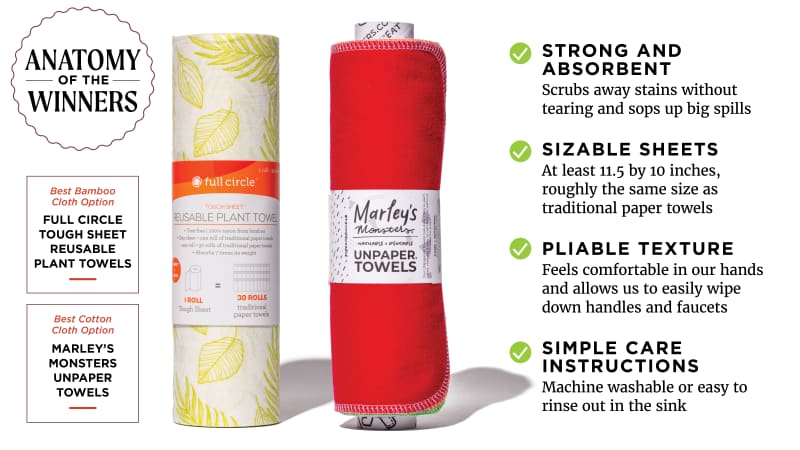
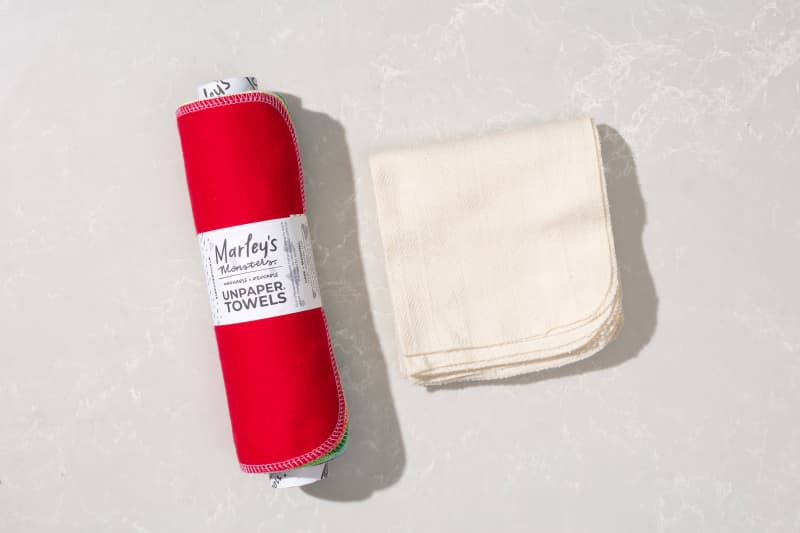
We use paper towels because they’re convenient and hygienic. The best towels strike a balance between strength, absorbency, and softness. Although we love our traditional paper towel winner from Bounty, we wanted to find more eco-friendly alternatives. Our favorite bamboo option is the Full Circle Tough Sheet Reusable Plant Towels, similar to regular paper towels but sturdy enough to be washed and reused. They’re absorbent, excellent at scrubbing dried-on messes, efficient at cleaning various surfaces, and easy to rinse clean. These are great for people who prefer perforated sheets that they can easily tear off and don’t mind washing by hand. Marley’s Monsters UNpaper Towels are the best cotton cloth option. These flannel towels, which are similar to cotton dish towels, are great for drying dishes, absorbing spills, and cleaning multiple surfaces, and they come on a cardboard core that can fit on a paper towel holder. They’re perfect for people who are partial to the look and feel of cotton.
Paper towels are versatile. We reach for them when sopping up spills, blotting raw meat, wiping counters, drying our hands, and cleaning our bathrooms. While it might be second nature for us to tear off a sheet, overuse of them negatively impacts the environment.
Traditional paper towels are made from wood pulp derived from trees, usually from virgin or old-growth forests, according to a report published by the Natural Resources Defense Council (NRDC), an international environmental advocacy group. Wood pulp production contributes to deforestation and the destruction of ecosystems. Even though we can compost paper towels in some cases (see FAQ below), many people do not, which means most of them end up in landfills, contributing to methane emissions.


Reusable paper towels might not be the best option for some tasks, such as draining fried food. However, they're great, if not better, for jobs like drying dishes.
Recently, reusable products intended to replace or reduce the use of paper towels have emerged. Some, such as Swedish dishcloths, also attempt to replace sponges (you can read our review of Swedish dishcloths here.) In this testing, we focused on bamboo and cotton products also marketed as “unpaper” or “tree-free” towels, meaning they are made without wood pulp.
There are a few differences between cotton towels and bamboo sheets besides the materials used. We found products made from cotton were typically thicker, mirroring the look and feel of regular dish towels. The bamboo sheets were thinner like traditional paper towels and often perforated like them, too, allowing you to tear off a sheet quickly. Bamboo fiber is supersoft, smooth, and silky—especially when turned into rayon, a material made from regenerated cellulose. Like regular paper towels, bamboo and cotton options sometimes come on a cardboard core. After you use and wash them, you can reroll them when they’re dry for storage on a paper towel holder. If they don’t come on a cardboard core, you can store them on the counter or in a drawer, as you would cloth dish towels.
We tested various options, comparing them to traditional paper and dish towels in many tests. Read on to see what mattered.
What to Look For
- High Absorbency: Some reusable products were ready to use straight from the package, while others became more absorbent after we laundered them. Regardless of style, we liked those that could absorb at least three times their weight in liquid.
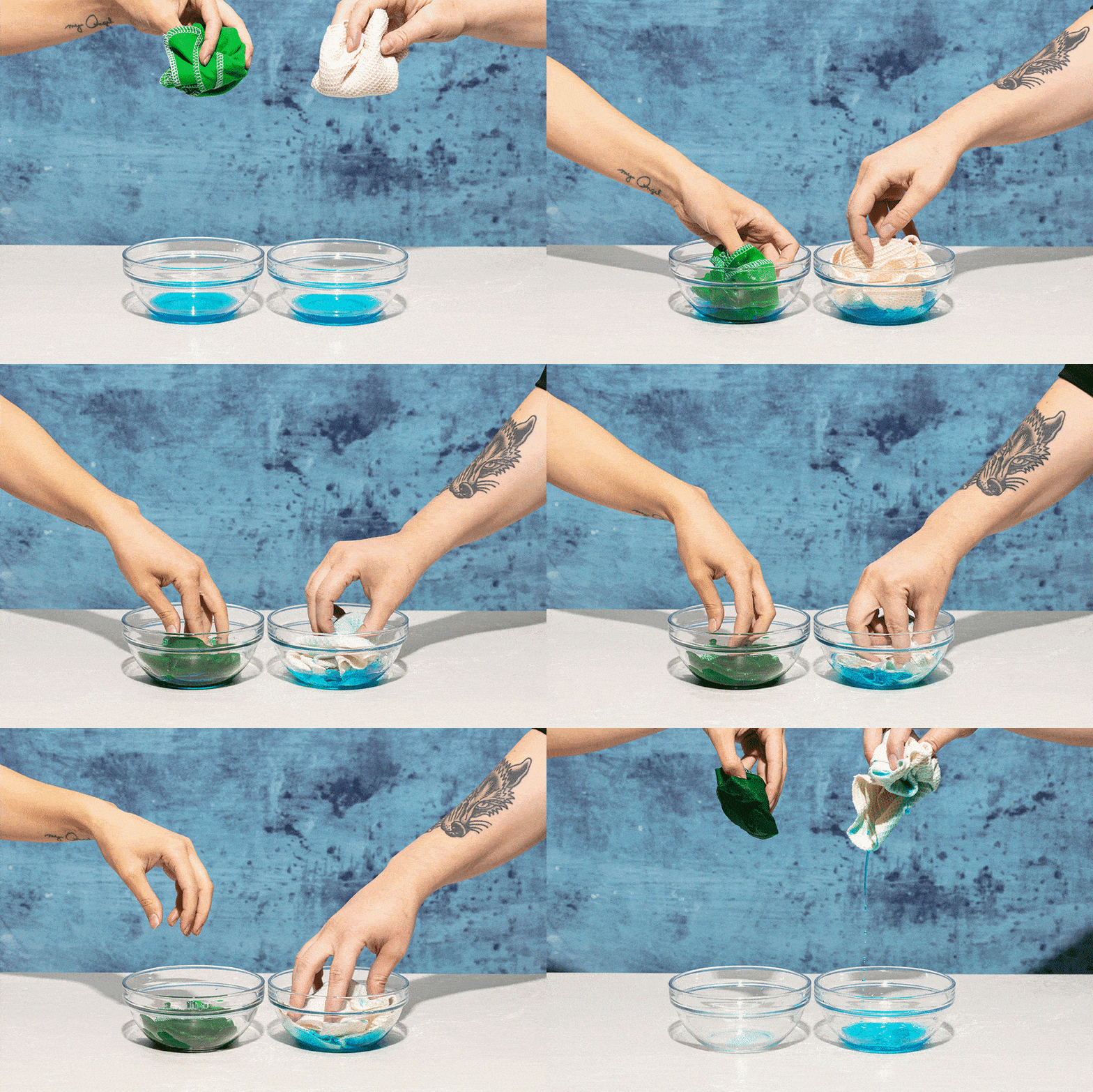
- Strength: Towels and sheets that easily scrubbed dried stains on the kitchen countertop without tearing received top marks.
- Pliable, Soft Texture: We favored products comfortable to hold and move with our hands while scrubbing messes and wiping handles or faucets.
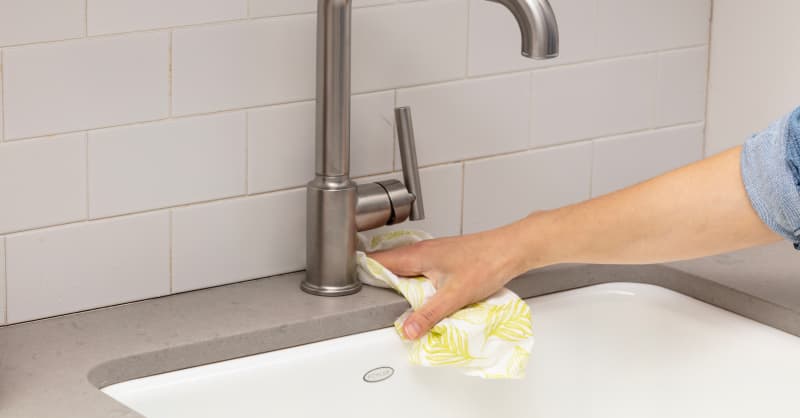
- Sizable Sheets: Towels and sheets that measured at least 11.5 by 10 inches were big enough to wipe down surfaces effectively. We liked those that were the closest in size to traditional paper towels.
- Simple Care Instructions: Hassle-free care helps make the transition from traditional paper towels to reusable options a lot easier. Some reusable cloth and bamboo products were machine washable, while others were meant to be washed by hand. Although the manufacturer of our winner suggested washing the towels by hand, messes and stains quickly rinsed out in the sink. Use a machine-washable option if you want to avoid dealing with hand washing. Care instructions are noted in the chart below.
What to Avoid
- Linting: Bamboo and cotton products that left behind fibers on our glasses or cutting boards created more work for us during testing. We were also concerned about fibers ending up in our food or drinks.
- Small Sheets: Smaller towels and sheets—less than 10 by 10 inches—were harder to use when cleaning big messes. It was difficult to avoid touching the mess when our hands hung over the edge of the cloth.
Minor Flaws
- Pilling: Some of the reusable cotton paper towels were prone to pilling after using them for a week. While we didn’t see this as a deal breaker, it did make these products look older faster, but it did not affect their performance.

Other Considerations
- Bamboo versus Cotton—Which Is Right for You?: Deciding between purchasing a bamboo or a cotton paper towel alternative depends on several factors. Choose bamboo if you want to replace paper towels but want the convenience of perforated sheets. Cotton is your best option if you prefer having a stash of matching, utilitarian dish towels. Both cotton and bamboo are great for various tasks like wiping down counters, drying dishes, and other household tasks.
Which Paper Towel Alternative Is Right for You?
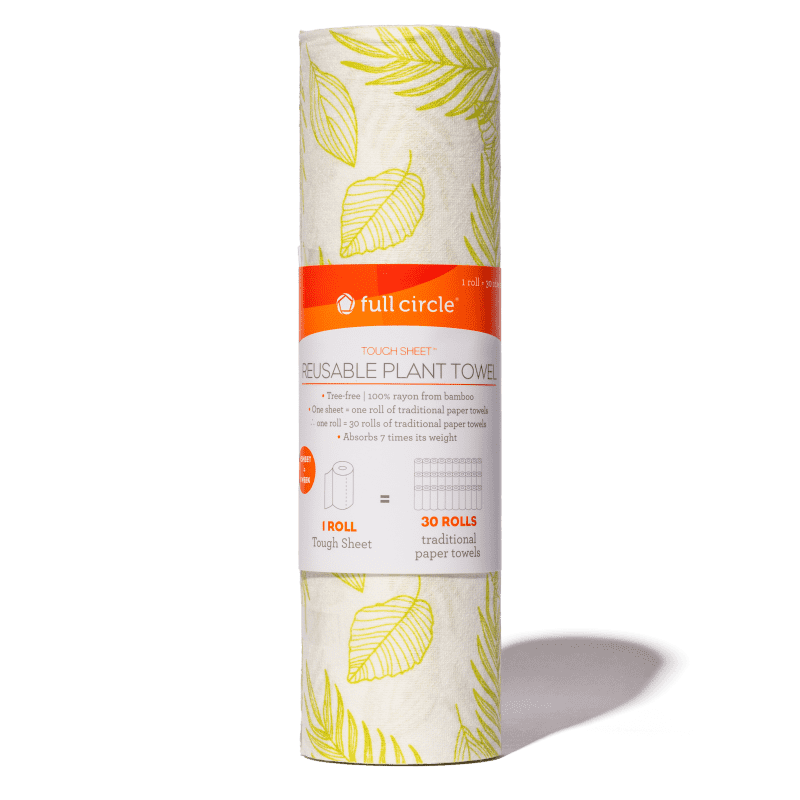 Best Bamboo Cloth Option Full Circle Tough Sheet Reusable Plant TowelsBuy now |
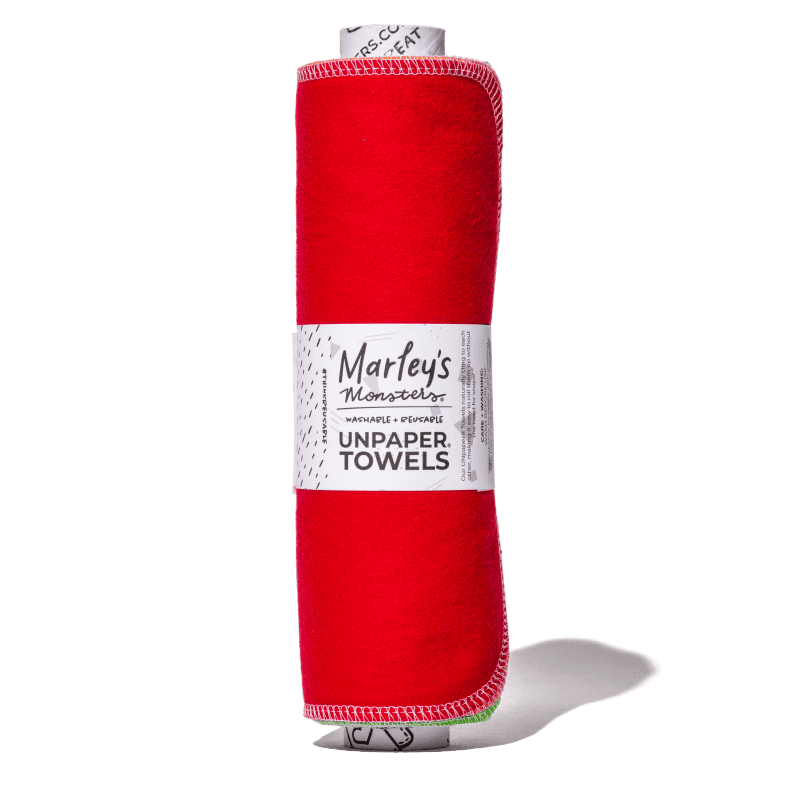 Best Cotton Cloth Option Marley’s Monsters UNpaper TowelsBuy now | |
|---|---|---|
| Description | Description A roll of perforated sheets that come on a cardboard core | Description A roll of individual towels that come wrapped around a cardboard core |
| Materials | Materials Bamboo rayon | Materials Cotton fleece |
| Why We Like Them | Why We Like Them These thin yet absorbent sheets are easy to tear off, pliable enough to fit in tight corners, and strong enough to scrub dirty counters | Why We Like Them These durable towels resemble dishcloths but are softer, extra-absorbent, and have fun colors that allow you to categorize them for specific uses |
| Fits on a Paper Towel Holder | Fits on a Paper Towel Holder yes | Fits on a Paper Towel Holder yes |
| Machine Washable | Machine Washable no | Machine Washable yes |
| Buy Them if | Buy Them if You want a product that mimics the experience of using traditional paper towels but with the benefit of reusability | Buy Them if You want a set of durable, multipurpose cotton cloths and a convenient way to store them |
- Storing Your Paper Towel Alternative: Although we liked the option to reroll towels on a cardboard core as you clean them, some people might see this as an inconvenience. You can always store your towels in a basket or drawer.
- Caring for Your Paper Towel Alternative: Some companies, including the makers of our winning bamboo sheets, suggest hand washing and hanging to dry. Before buying towels or sheets that require this type of care, consider whether you have the patience and space. We recommend washing the sheets as you use them and using a bag drying rack or a clothesline for a simpler way to dry them.
The Tests
- Weigh each towel and sheet dry
- Weigh each towel and sheet after being submerged in ¼ cup of water for 1 minute
- Dry a load of dishes (11 separate items) with each towel and sheet
- Pass each towel and sheet 100 times across semiabrasive plastic cutting board
- Use to scrub all-purpose cleaner off wood, stainless-steel, and glass surfaces
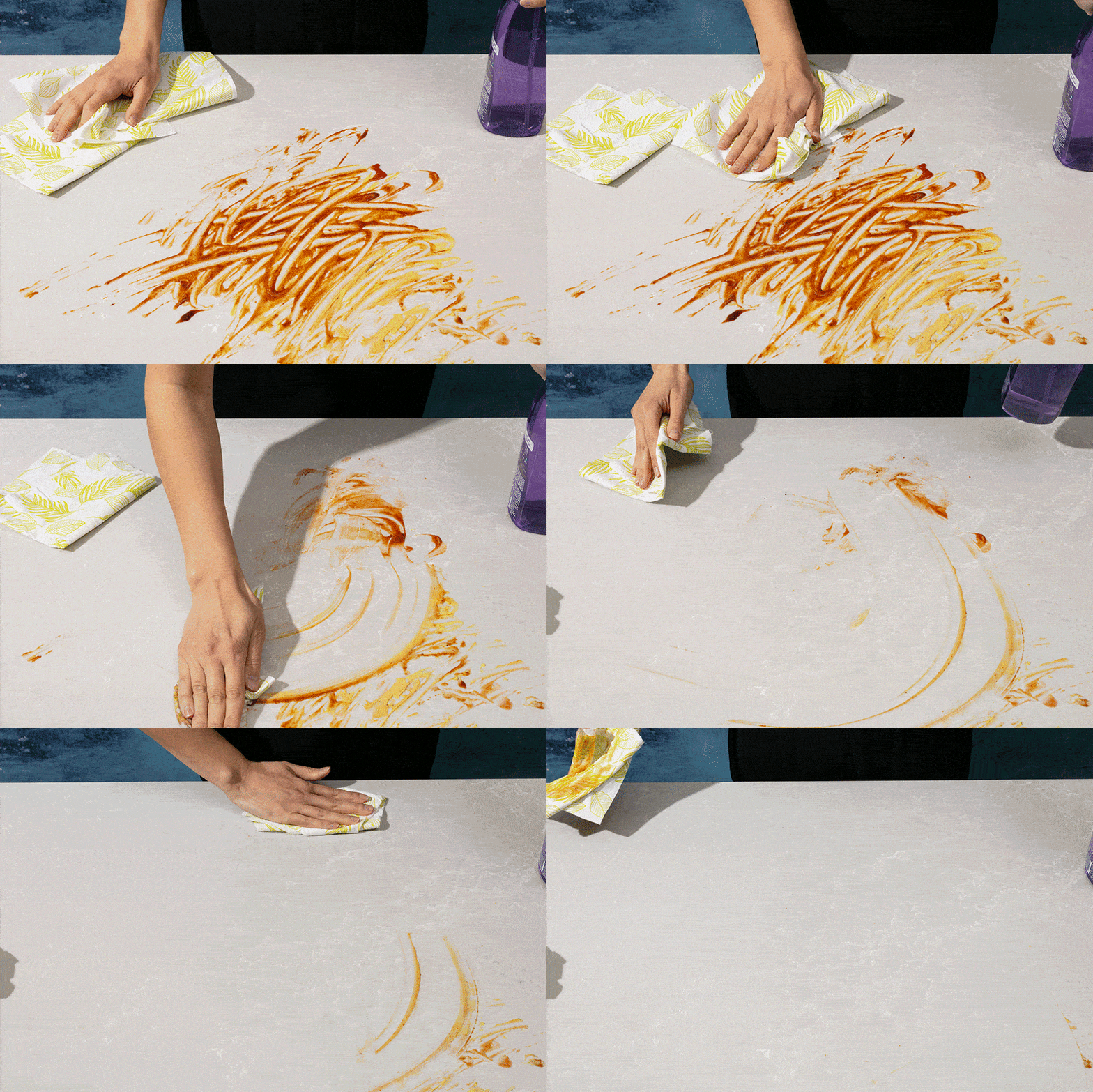
- Use to clean countertop littered with crumbs and dried-on condiments
- Test durability by lifting 100-, 200-, and 500-gram weights on both dry and wet towels and sheets
- Have 13 home testers use towels or sheets over a 1-week period
- Wash according to manufacturer instructions 10 times
How We Rated
- Absorbency: We tested how much water the towels and sheets could absorb and how quickly they dried dishes.
- Ease of Use: We evaluated how easily we could clean various surfaces. We considered whether towels and sheets were uncomfortable to hold.
- Durability and Linting: We assessed how well towels and sheets scrubbed dried messes and noted whether the towels deteriorated after rubbing them against abrasive surfaces. We observed how long the towels and sheets lasted before we replaced them with a new one.
- Storage: We assessed how easy it was to reroll or store the towels and sheets after use.