


 Buy at Amazon

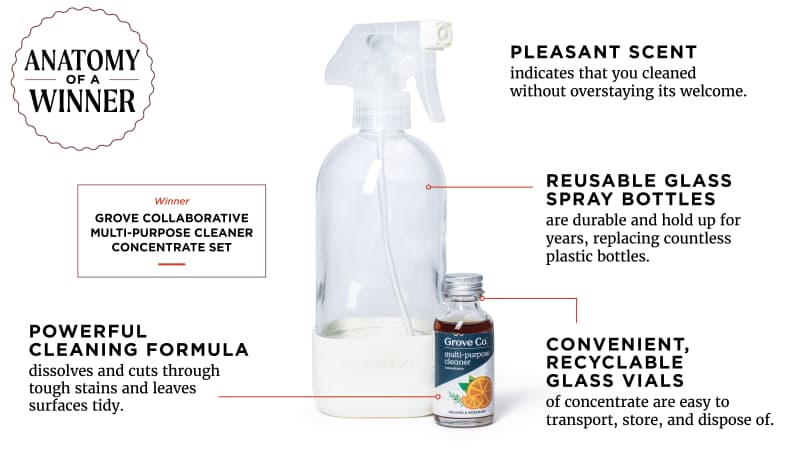
Want to reduce the single-use plastics in your home? Consider a more eco-friendly multipurpose cleaner. Several brands sell liquid concentrates or tablets that can be diluted at home in reusable glass bottles. Others ship sustainably packaged regular-strength refills straight to your door. But beware—only a few products work well. The Grove Collaborative Multi-Purpose Cleaner Concentrate Set is our overall favorite. We loved its recyclable glass vials and pleasant citrusy, herbal scent. Grove’s powerful grease-fighting formula easily powered through messes throughout testing. It left a few more streaks than our conventional cleaning spray winner in one test but otherwise cleaned just as effectively and required no single-use plastic. Our favorite tablets are the Simplehuman Multi-Surface Cleaning Tablets, Geranium. They’re compact and easy to transport and store. They cleaned well but took a while to dissolve.
If you're looking for the best cleaning sprays sold in single-use plastic bottles, read our review of conventional multipurpose spray cleaners.
When you buy a conventional cleaning spray at your supermarket, a huge portion of what you’re paying for is water packaged in single-use plastic bottles. When the cleaner runs out, many consumers throw away or recycle those bottles without reusing them.

Several brands have launched sustainable multipurpose cleaners to help reduce that waste. Their products are designed to use less water and plastic packaging, keeping more of the latter out of oceans and landfills. They also weigh less and take up less space during shipping or storage, requiring less fuel and ideally reducing greenhouse gas emissions.
Some products are dehydrated into dissolvable tablets that come packaged in compostable paper packets. Some are concentrated into liquids contained in beeswax pods or glass vials. Other liquid concentrates are sold in single-use plastic cartridges, but create less plastic waste compared to conventional full-strength liquid cleaners. To use these sprays, you mix the tablet or liquid concentrate with tap water, reconstituting it into a full-fledged cleaning product.


Eco-friendly cleaners work in a few different ways. Some are dehydrated and compressed into dissolvable tablets (left). Others are sold as liquid concentrates, which are stored in glass vials or beeswax pods and decanted as needed (middle). Other liquids are contained in plastic cartridges that pop open and dispense when connected to their corresponding bottles (right).
One company sells small capsules of vinegar and salt that users mix with tap water and activate using an “electrolyzer.” This device catalyzes the mixture into hypochlorous acid, a simple cleaner and disinfectant. Another company doesn’t concentrate its spray but ships full-strength refills in paper cartons instead of plastic.
Many products are sold as part of starter kits or sets that include refillable spray bottles. Most of the options we reviewed are available online, but many products are sold in supermarkets as well. We were interested in whether any of these innovative sprays were effective, versatile, and convenient enough to replace our winning conventional multipurpose spray. Read about which factors influenced our decisions below.
What to Look For
- Powerful, Effective Formulas: Our winning sprays contained specific combinations of surfactants, a class of chemicals that alter the surface tension of soil particles, and buffering agents, which keep cleaning chemicals stable. When working together, surfactants and buffering agents allow cleaning solutions to penetrate and dissolve stains effectively. Specific formulas are proprietary, but our favorites excelled at powering through tough messes. The winning sprays also left few or no streaks.


The most important factor we considered was whether these sprays actually cleaned well. Our favorites dissolved stubborn, stuck-on messes such as pasta sauce (left) with ease and left surfaces shining and spotless (right).
- Easy, Speedy Setup: Our favorite products were simple to reconstitute or dilute according to manufacturer instructions. Liquid concentrates in glass vials or plastic pods were easy to pour into spray bottles and shake a few times to thoroughly mix.
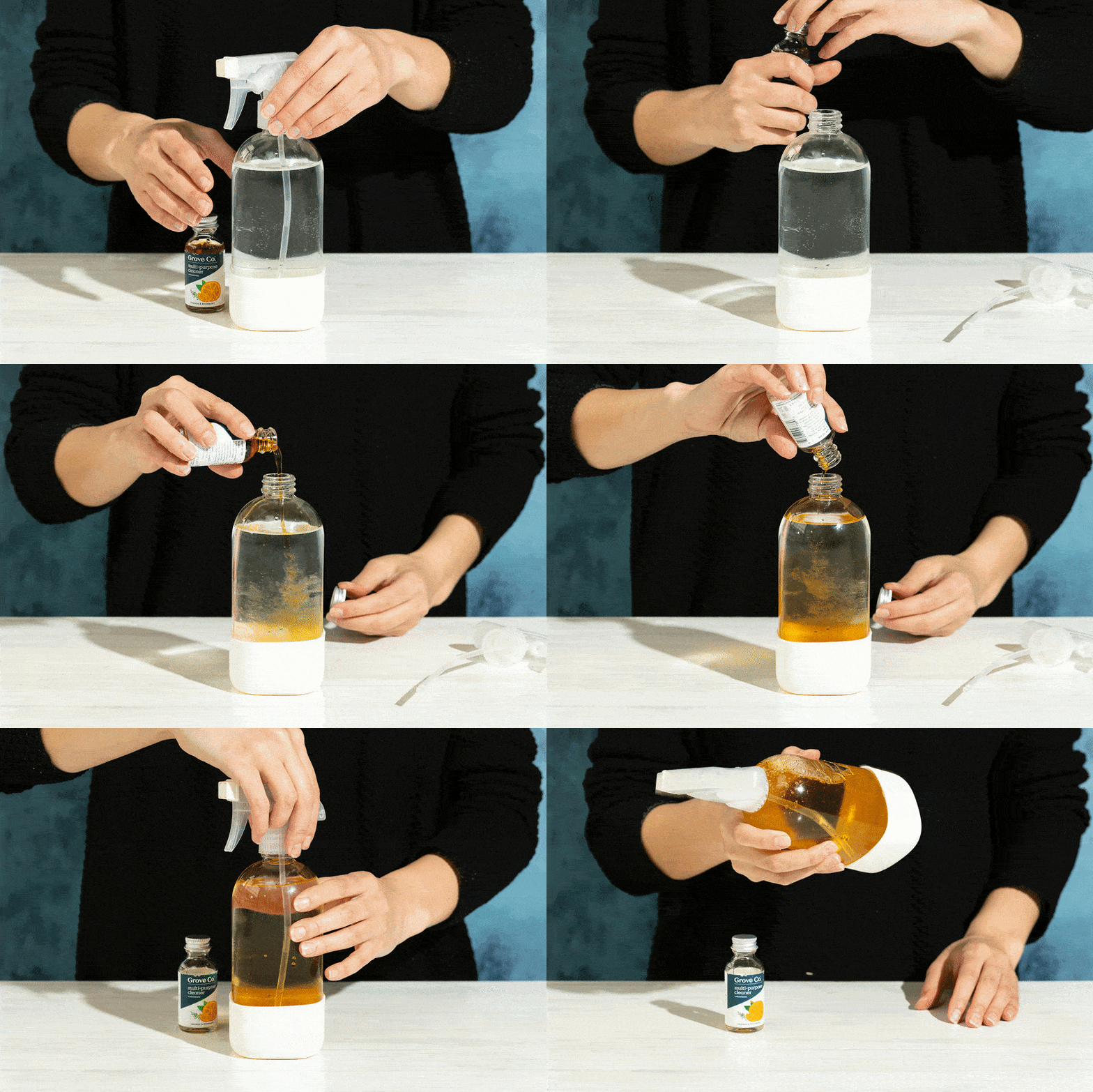
- Durable Packaging: We liked tablets and concentrates that were packaged in durable wrappers, vials, or pods, which made them easy to transport and store without damaging them. Our favorite packages were made of sturdy paper or glass.
- Pleasant Scents: We preferred gentle fragrances with citrus or floral notes, which smelled fresh and indicated that we had cleaned. Testers were more likely to use pleasantly-scented sprays to clean their homes routinely.
- Long Shelf Lives: Our favorite sprays were formulated to clean effectively until they ran out, often for months or up to a year after reconstituting them. We preferred longer-lasting products to those that expired after only a couple weeks.
Nice to Have
- Sustainable Packaging: Every product in our lineup was designed with the goal of reducing or eliminating plastic. Some concentrates were still packaged in single-use plastic pods or cartridges. While we thought these were a step in the right direction, we preferred fully recyclable or compostable paper wrappers or glass vials.

What to Avoid
- Ineffective Formulas: Several sprays struggled to clean stains on multiple surfaces in our tests. These products’ weak formulas—including one product that didn’t contain surfactants—couldn’t break down difficult messes as quickly or effectively as other cleaners we tested. They often required additional applications and more time to do the same amount of work.


A few products just weren’t that good at cleaning. When we used them to clean microwaves splattered with cooked-on sauce (left) they left behind stains and splotches (right) even after extra soaking time and scrubbing.
- Slow Setup: We didn’t like sprays that took a lot of time or effort to reconstitute or mix. A few tablets took more than 25 minutes to fully dissolve—who needs that delay when they’re trying to get cleaning done?
Force of Nature sells small capsules of salt and vinegar that you catalyze into hypochlorous acid using a device called an electrolyzer (above). It’s fairly simple, but the process takes about 10 minutes, and the disinfecting power of the solution fades within two weeks.
- Fragile Packaging: Concentrates or tablets packaged in flimsy materials got damaged during shipping or transport home from our office. One liquid concentrate was housed in beeswax pods that were delicate and ruptured easily, which led to spills and leaks for multiple testers.

- Unpleasant Fragrances: The fragrances in this lineup were overall less smelly than the conventional sprays we’ve tested. We still found that a few products smelled unpleasantly bitter, enough to avoid using them if given the choice.
- Short Shelf Lives: One product in our lineup only remained potent as a cleaner for about two weeks after mixing, which wasn’t enough time to use it all up. We preferred sprays that didn’t give us a cleaning deadline.
Other Considerations
- Disinfecting: Two sprays in our lineup contained antimicrobials, which are chemicals that kill germs. We’ve interviewed cleaning experts and industrial chemists, all of whom said it’s not necessary to use antimicrobials for most of your cleaning. Soap or standard multipurpose sprays without antimicrobials usually clean effectively without exposing you to the more harmful disinfectants present in conventional antimicrobials, such as popular quaternary ammonium compounds (“quats” for short). It is, however, important to keep an antimicrobial product around the house if you have a family member who is sick and want to disinfect high-contact surfaces or to sanitize a counter after working with raw meat. Unfortunately, both of the antimicrobial products in this eco-friendly lineup failed to clean stains as effectively as our winning conventional antimicrobial spray. For more information about a plastic-reducing DIY antimicrobial cleaner that uses bleach, check out our article on the correct way to use spray cleaners.
The Tests:
- Clean oil from stainless-steel cooktops, Corian synthetic stone countertops, sealed granite countertops, and wood-composite cabinet panels
- Spread jarred pasta sauce onto sealed granite countertops, set aside for 2 hours, and then clean
- Spread jarred pasta sauce onto a stainless-steel work table, allow to dry for 3 hours, and then clean
- Clean the inside of a microwave splattered with cooked-on pasta sauce
- Have multiple testers use sprays in their homes for a few weeks then provide input, including evaluations of the sprays’ scents
How We Rated
- Cleaning Performance: We tested how effectively the sprays cleaned an assortment of messes on stainless steel, sealed granite, Corian synthetic stone, wood-composite cabinets, hard plastic, and glass surfaces. We noted whether the sprays left behind residue or visible streaks.
- Ease of Use: We evaluated how easy each spray was to reconstitute and clean with.
- Scent: We asked multiple testers whether they liked the sprays’ scents.


