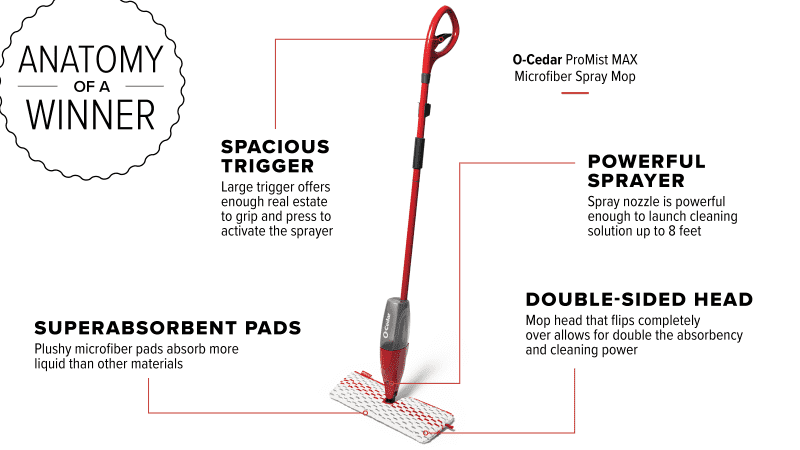
A spray mop won’t replace a regular mop for cleaning tough stains and large spaces, but the best spray mops are great for handling small spills, routine cleanings, and the messes of cooking and daily life. Our favorite model, the O-Cedar ProMist MAX Microfiber Spray Mop, has spacious, double-sided pads that are about twice as absorbent as any of the other pads we tested. It also has a comfortable handle and spraying trigger, so using it didn't tire us out. It’s lightweight but sturdy, and it performed impressively throughout our cleaning and durability tests.
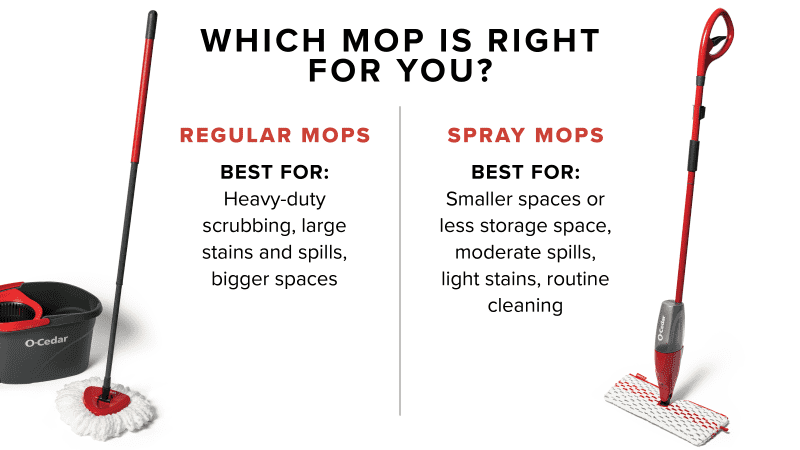
If you’re looking to keep your floors sparkling but don’t have space to store a bulky mop and bucket set, a spray mop might be your best bet. Because they can't be wrung out, even the most capable spray mops can’t match the absorbency of our winning regular mops. But they still offer a portable and space-saving alternative that is great for handling touch-ups, smaller spills, moderate stains, and light routine cleaning. We think they’re perfect for apartment and dorm dwellers and others with less living and storage space.
Swiffer popularized automatic spray mops in the early 2000s, but most models today—including the majority of our lineup—are manually operated. Their trigger-style spraying levers are similar to those on spray bottles, and their attached refillable plastic bottles can be filled with any cleaning solution. Most have reusable microfiber pads that either slip over the heads or attach to the bottoms of the mops using Velcro-like strips.

We did test a Swiffer model, which was an outlier: It had a battery-powered spray mechanism that worked with the press of a button. It also employed single-use, disposable mopping pads.
What to Look For
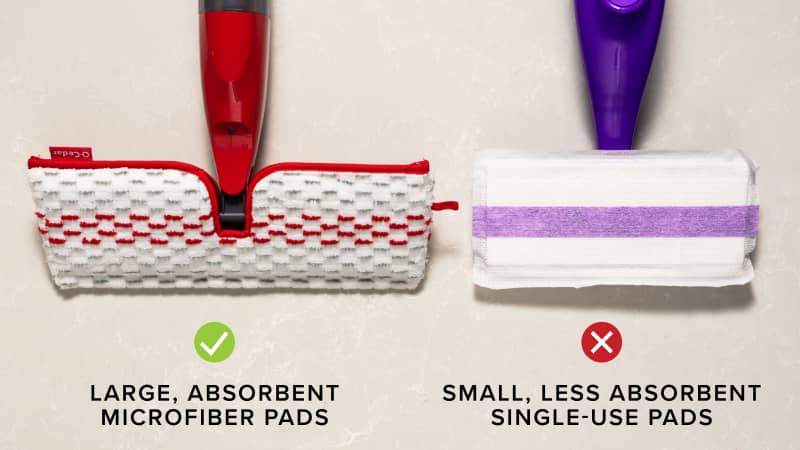
- Large, Absorbent Microfiber Pads: The mops’ effectiveness came down to their pads. The best pads were made completely of microfiber, an ultra-absorbent fabric made of millions of microscopic polyester or nylon fibers. We preferred microfiber pads that were at least 15 inches wide, which helped cover more ground with each pass. Our favorite pads were also thick and double-sided, making them twice as absorbent as those of other models. Plushier pads also clung more effectively to dirt particles, grime, and pet hair.
- Machine-Washable Pads: Pads that could be cleaned in the washing machine were the most convenient. Our favorites emerged nearly dry from the washer and were ready for the next cleaning session after a brief air dry. A few models’ pads were also safe to dry in the dryer.
- Lightweight yet Sturdy Construction: Our favorite mops were light enough to easily maneuver with one hand without tiring us out yet heavy enough to help us apply pressure as we scrubbed. We liked models that weighed between 3 and 4 pounds when filled with cleaning solution.
- Long Handles: Longer handles helped us cover more ground with each pass and kept us from bending over unnecessarily. We preferred models with handles that were at least 50 inches long.

- Comfortable Grips with Large Spray Triggers: We preferred long, roomy grips made of soft, comfortable plastic. Our favorite grips were at least 4 inches long. Our favorite models also had secondary plastic grips halfway down their handles, which helped with leverage. We also liked large spray triggers that gave us room to hold and apply pressure. The best triggers were at least 2.75 inches long.
- Powerful Spraying Mechanisms: We liked powerful spray nozzles that allowed us to distribute cleaning solution across a small space and over a wide area. The reach of our favorite model’s spray was dependent on how hard we pulled the trigger. We liked its customizability and were impressed that its maximum reach was about 3 times farther (almost 8 feet) than most other models.

Nice to Have
- Multiple Mop Pads: While most brands sold additional mop pads separately, we preferred the mops that came with multiple pads. This allowed us to switch out pads and continue cleaning after the first pad became dirty. We had no such luck with single pads; once they were saturated we had to pause to clean them, often in the washing machine, before we could continue cleaning our floors.
What to Avoid
- Mops That Are Too Heavy or Too Light: The heaviest mops tired us out quickly, and the lightest mops felt flimsy. Lighter mops also made us feel like we were gliding over the floors without applying sufficient pressure and actually scrubbing.
- Small, Less-Absorbent Pads: Smaller, narrower pads covered less ground with each pass and were less efficient, while less-absorbent pads became oversaturated quickly, limiting their effectiveness.


Our favorite pads were absorbent enough to sop up spills in one pass without smearing messes around like other models did.
- Uncomfortable Grips and Spray Triggers: Grips and spray triggers that were too short grew uncomfortable as we scrubbed. Most testers felt that there wasn’t enough space to rest their hands and found the shorter triggers more difficult to grasp.
Other Considerations
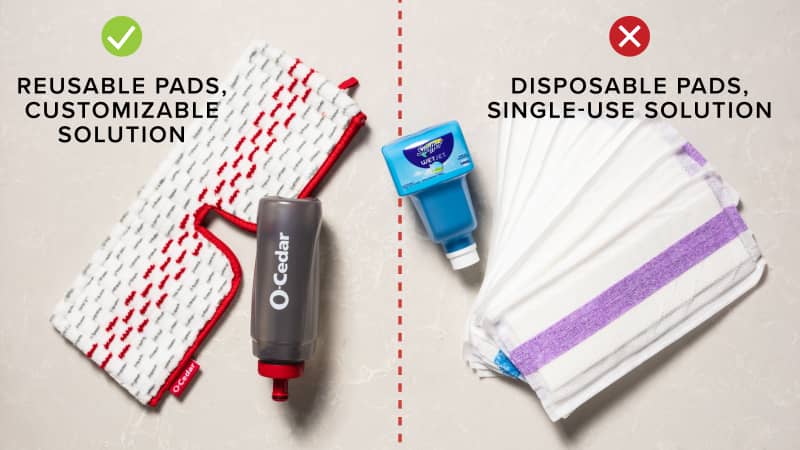
- Single-Use Cleaning Solution and Pads: Disposable pads and single-use cleaning solution bottles may be more convenient for some people, but they are more expensive in the long run. We preferred reusable microfiber pads because they were more absorbent and effective, and we liked that refillable bottles allowed us to customize the cleaning solution.
- Automatic Sprayers: Most of the mops in our lineup had manual sprayers that we engaged by pulling triggers similar to those on a standard spray bottle. One model was automatic; it worked using a battery-powered motor attached to the handle that was activated with a simple button. It made spraying cleaning solution delightfully easy, but we didn’t like that the batteries would eventually need replacing. The motors and batteries also make automatic spray mops heavier and less maneuverable.
- Assemble the mops
- Weigh the mop pads when they are dry and fully saturated to evaluate absorbency
- Use the mops on a dry hardwood floor and under cabinets and appliances to assess their maneuverability and ease of use
- Track dirt and mud on a tile floor and use the mops to clean them up
- Spill coffee on a tile floor and use the mops to clean it up
- Spread honey and heavy cream on a tile floor, allow them to dry, and use mops to clean up the mess
- Measure the spray angles and distances
- Have multiple testers use the mops
- Wash the reusable mop pads five times in a washing machine
- Insert and remove the cleaning solution bottles 20 additional times
- Pull the spray triggers or push the spray buttons 100 additional times