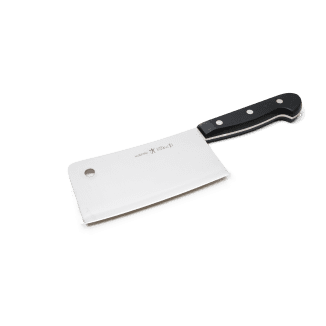

 Buy at Williams Sonoma
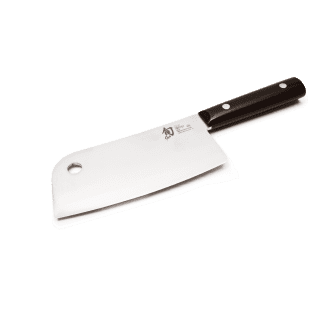
 Buy at Chef Knives To Go
The best cleavers are durable, easy to handle, and make quick work of light butchery. Our favorite meat cleaver remains the Global G-12 Meat Cleaver. It cuts through bone effortlessly, thanks to its strong, ultrasharp, powerful blade; its handle is long and relatively comfortable for hands of all sizes to hold. Our Best Buy is the Fuji Cutlery Chinese-Style Cleaver. It performs very well at a much lower price point. It’s lighter in weight and easier to wield than our top choice, though it’s also a bit less sharp, powerful, and durable.

For some kitchen tasks, there’s no tool more perfect than a cleaver. It's made for rough use—its heft and size make it ideal for jobs that might otherwise damage or wear down your chef’s knife, allowing you to chop through whole chickens, whole lobsters, or large squashes with impunity. If you make a lot of stock, for example, a cleaver is a solid investment, as it allows you to expose more of the bone and meat to the water for better flavor extraction. Once you have a cleaver, you might find it handy for other tasks too: mincing raw meat, crushing garlic, bruising lemongrass, cracking open coconuts, and chopping cooked bone-in meat into bite-size pieces. The flat of the blade can even be used like a bench scraper to scoop up chopped items or to flatten and tenderize cutlets.


We use cleavers to chop through chicken parts when making stock and to cut through dense butternut squash.
For this review, we examined models that ran the gamut from heavy, axe-shaped, Western-style cleavers to Chinese-style cleavers—lighter-weight knives with thinner, more rectangular blades—to hybrid styles that combined attributes from both. And we asked professional cooks and butchers to help us evaluate them.

How to Use a Meat Cleaver
Never used a cleaver before? We have some simple tips to use it safely and effectively.
Learn MoreWhat to Look For
- Medium Weight: Meat cleavers need to have some heft to them in order to power through flesh and bone. We preferred cleavers in the middle of the weight range, though; those that weighed 14 or 15 ounces were best. These provided enough force to chop bone-in meat and butternut squash but were still light enough to direct effortlessly, allowing us to hit the exact spot we wanted every time. Heavier blades weighing over a pound let gravity do more of the work for them, providing extra power as we chopped. But they were harder to lift repeatedly, which made them more onerous to use for long periods. By contrast, lighter-weight blades were easy to wield but didn’t always have enough power, forcing us to use more muscle to get through bone.
- Good Balance: We preferred knives whose weight was evenly balanced between the blade and the handle, as we found these easier and more comfortable to wield for long periods.

- Long, Tall, Slightly Curved Blades: We preferred cleavers with blades that were between 6.75 and 7.25 inches long, as these gave us plenty of room to strike larger pieces of chicken or bisect whole butternut squash. Blades that were at least 3 inches tall helped guide the knife straight down through bigger items such as the butternut squash and duck and provided larger surface areas for scooping up chopped food. And we had a small preference for slightly curved blades rather than straight-edged ones; the curved blades allow users to rock back and forth to finish cuts that haven’t been delivered with enough force to get through the food.
- Sharpness: The sharpness of any blade is determined in part by the angle of the blade on either side of its cutting edge. The narrower the angle, the thinner the cutting edge and the sharper the knife can feel in action—but the more prone that thinner edge can be to chipping or folding. Historically, Western-style cleavers have relatively large edge angles of 20 degrees or more, to help protect the blade against chipping—a bigger concern with cleavers, whose job it is to work through hard bone. While we liked some of the models with these large edge angles well enough, our favorite model had a slightly smaller edge angle of 15 degrees, which made it feel especially sharp and agile. In practice, the sharpness of many of the blades was also determined by a second factor: how well they had been sharpened and honed at the factory or in the shop. Our favorite cleavers were sharp from the get-go and remained so.

- Moderately Thick Spines: Meat cleavers typically have blades with thicker spines than those seen in most other kitchen knives, with most models measuring 3 to 6 millimeters at their thickest. These thick spines give their blades the extra power and durability they need to make their way through bone. (Thinner blades lacked this power.) That said, we didn’t like cleavers with the very thickest spines, as their blades felt axe-like, wedging into chickens and cracking and tearing butternut squash instead of cleaving it neatly. We preferred those with more moderately thick spines of about 2.5 to 3.3 millimeters, which were thick enough to be powerful and durable, but still felt relatively agile.

- Long, Broad, Grippy Handles: We liked handles measuring at least 4.75 inches in length, as these accommodated both small and large hands easily. And we preferred handles that were neither so thick that we had a hard time keeping our fingers around them nor so narrow that other testers felt they had to clench them tightly to control them: A circumference of 3.25 inches was about right for most people. We generally preferred handles that were made with wood or rubbery plastics, which helped us keep our grip on the cleavers—an important consideration when combining big knives with slippery raw meat. That said, both wood handles and more conventional plastic handles sometimes loosened or even cracked during use—a tendency that diminished their durability.
The Tests:
- Chop 4 pounds of chicken wings
- Chop 5 pounds of chicken leg quarters
- Chop butternut squash into quarters
- Break down a whole roast duck and chop it into serving-size pieces
- Ask five test cooks of different hand sizes, dominant hands, and levels of butchering experience to chop 1 pound of chicken parts with each knife
- Ask two professional butchers to evaluate and test each knife
How We Rated:
- Performance: We rated each cleaver on how easily and neatly it chopped through raw chicken wings and leg quarters, a whole roast duck, and a butternut squash.
- Ease of Use: We rated each cleaver on how easy it was to maneuver—how heavy it was and how well balanced.
- Blade: We rated each cleaver on the design of its blade, characterized by its height, curvature, angle, and thickness at spine and edge.
- Handle: We rated each cleaver on the design of its handle, as determined by its length, width, affordance, and grippiness.
- Durability: We rated each cleaver on how well it withstood damage (chipping or dulling of the blade and cracking or loosening of the handle).


 Buy at WebstaurantStore