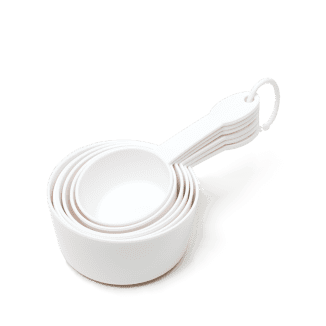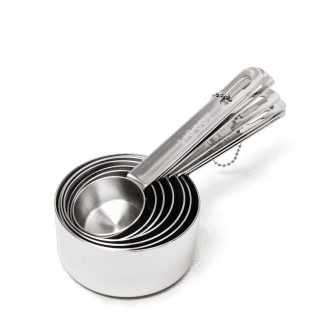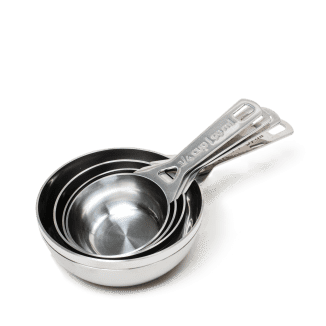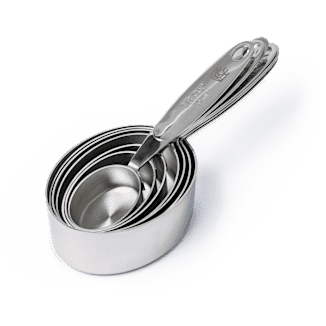

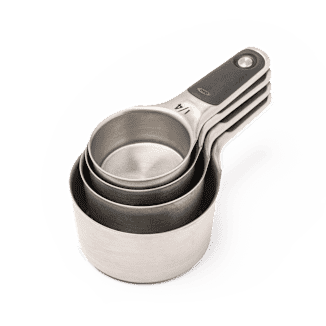
An accurate and durable set of dry measuring cups is a useful addition to any kitchen. Our top-rated set is the Sur La Table Stainless Steel Measuring Cups, Set of 4. These cups are made from thick, sturdy steel, with clearly legible, etched markings that won’t rub off and a convenient design that makes it easy to dip the cups into flour or sugar and level them off. The OXO Good Grips Stainless Steel Measuring Cups are our Best Buy. These lighter-weight steel cups are also accurate and solidly built, though their plastic-topped handles can collect flour and debris and their measurement markings may wear off over time.

Have other measuring tools in mind? Check out our reviews of liquid measuring cups, digital scales, and precision kitchen scales.
Baking perfect breads, cakes, or pastries requires precise measurements of flour, leaveners, and other dry ingredients. While we recommend using a digital scale for the most reliable and accurate results, it’s sometimes simpler or more convenient to use dry measuring cups instead. Our recommended method for using dry measuring cups is to dip them into bags or containers of ingredients and scoop up heaping mounds, then scrape off the excess with the back of a knife or offset spatula. Many people also pour bulkier ingredients such as chocolate chips or nuts directly into the cups. While weighing ingredients is more precise than measuring by volume, choosing measuring cups that are easy to use, durable, and designed to measure as accurately as possible can help ensure your success.

It’s important to note that as their name implies, dry measuring cups are exclusively for use with dry ingredients. While a dry measuring cup can hold the same volume as a liquid measuring cup, design differences make them harder to use and less accurate for measuring liquids. For more information, see our explainer for why you should keep both styles of measuring cups on hand.
We tested dry measuring cup sets that included cups in at least ¼-cup, ⅓-cup, ½-cup, and 1-cup sizes, since we’ve found these to be most useful across recipes. A few sets contained cups in additional sizes. The cups in our lineup were made of plastic or stainless steel; of the latter group, some were entirely stainless-steel, whereas others had plastic grips.
What to Look for
- Accurate Measurements: In everyday practice, each scoop of a measuring cup will yield a slightly different amount of ingredients, but we sought cups that exactly matched their listed sizes to give us the best chance for success. We carefully filled each cup to its maximum capacity with water and weighed it on a calibrated lab-quality scale; we then compared these weights to standardized weights for each volume measurement and did the math to determine whether it held the correct volume indicated by the cup. Our top performers were either spot-on or off by just a fraction of a percentage point.
- Big, Etched Markings: The measurement markings on our favorite sets were large and clearly displayed on the handles; these helped us identify sizes at a glance. Almost all the stainless-steel sets had etched markings, which we preferred because they remained intact and clearly legible after several cleanings.


Measuring cups generally have measurement markings on their handles. They can be etched, which we prefer for their durability, or printed.
- Durable Materials: Cups made of sturdy, high-quality stainless steel or plastic withstood testing without their handles bending or warping.
- Seamless Construction: Cups molded from single, seamless pieces of plastic or steel were easier to clean, as they had fewer crevices for ingredients to get trapped.

- Moderately Long, Perfectly Flush Handles: Cups with handles that were at least 3 inches long allowed sufficient space for hands of all sizes to comfortably grip. We preferred sets with flat handles that were perfectly flush with the cups’ rims, which allowed us to sweep across the handle and cup to remove excess ingredients without getting stuck on any obstacles. These flat handles also felt more natural to wield and allowed the cups to stack together neatly for storage.

- Lightweight, Well-Balanced Designs: We prized cups that weighed 4 ounces or less; these lighter-weight designs were less fatiguing to maneuver. We also preferred models that were evenly balanced between handle and cup; these sat steady on our counters without tipping and spilling ingredients.

What to Avoid
- Inaccurate Measurements: Some cups’ measurements were off by as much as 6 percent when we used them to weigh water. We didn’t recommend these, as this error margin can be enough to affect a recipe’s ratios and throw off the end results.
- Hard-to-Read, Impermanent Markings: Cups with tiny or hidden markings were irksome, since it was hard to see which size we were using. Some plastic sets and one stainless-steel set had measurement markings printed in ink, which came off after very little scrubbing.
- Flimsy Materials: Most cups made from lighter-weight steel or plastic bent or warped when we repeatedly dug them into densely packed wet sand to simulate years of use.

- Short, Offset, or Angled Handles: Handles less than 3 inches long weren’t big enough for us to comfortably grip. Handles that were offset from the cup rims, rather than flush, created a jarring catch to our sweeping motions that occasionally jostled the cups and required us to start over. One set’s handles were angled sharply upward, which contorted our hands into awkward positions when we measured; the cups also couldn’t be stacked tidily.

- Heavy or Unbalanced Cups: A few sets were especially hefty—with 1-cup measures weighing more than 4 ounces when empty—which tired out some testers’ wrists and arms. And some cups’ weights were poorly distributed, causing a few models to tip and spill their contents when we set them down on counters.
Other Considerations
- Additional Cup Sizes: A handful of the sets we tested included additional cups in sizes ranging from ⅛ cup to ¾ cup. These extra cups were occasionally helpful: using a ⅔-cup measure in the place of two scoops with a ⅓-cup measure, for example, saved us a small amount of time. But some testers felt the added convenience wasn’t worth the extra storage space taken up by the additional cups.
- Storage: All the sets we tested stacked together for storage. Some sets were sold with removable connector rings, which threaded through holes on the ends of the handles to keep the cups corralled while stowed in drawers or hung from storage hooks. Other models had magnets or grooves on their handles that snapped together. All of these methods were equally effective at keeping the cups contained; while some testers found these features helpful, others were ambivalent, as they preferred to be able to quickly pick up and use just one cup at a time.
- Soft Plastic Grips: A few models had handles topped with or enclosed in soft plastic. These were comfortable to hold but had a tendency to collect dust and particles of flour and other ingredients. Those interested in slightly more plush, more comfortable grips should consider these models, with the caveat that they’re harder to keep clean.
Editor’s Note: America’s Test Kitchen and Sur La Table are owned by the same parent company, Marquee Brands, but our Reviews Team maintains full editorial independence.
The Tests
- Fill with water and weigh three times using a calibrated laboratory scale, and compare weights to standardized weights for corresponding volumes of water at room temperature
- Dip and sweep flour
- Dip and sweep wet sand
- Clean 10 times in dishwasher
- Scrub markings with scouring pad
- Set empty cups on counter to gauge stability
- Set cups filled with flour on counter to gauge stability
How We Rated
- Accuracy: We assessed whether the cups’ measurements matched standard volume measurements.
- Durability: We evaluated how sturdy the cups were, including how well the cups held up to repeated use and multiple cleanings and whether their markings faded or rubbed off.
- Ease of Use: We tested how comfortable the cups were to hold, how easy their markings were to read, how simple it was to use them, and whether they sat stably on counters.