
America's Test Kitchen LogoCook's Country LogoCook's Illustrated Logo

Reviews You Can Trust.
See Why.

The Best Paring Knives

The best paring knives prove good things come in small packages.

Headshot of Miye BrombergHeadshot of Hannah Crowley
By Miye Bromberg & Hannah Crowley

Last Updated September 3, 2025

What You Need To Know

The best paring knives are sharp, nimble, and easy to hold. We think that most people will be happy with our overall winner, the Mercer Culinary Renaissance Paring Knife. Its sharp, fairly narrow blade peels, hulls, slices, and minces beautifully; the handle is comfortable for hands of all sizes to hold. Our Upgrade Pick is the Suisin Inox Paring 3.1" knife. While the price is substantially higher, you get a more luxurious user experience, a beautiful, nicely finished wooden handle, and an exceptionally sharp, hard blade. Our Best Buy is a longtime favorite, the Victorinox Swiss Classic Paring Knife. You won’t find a better value than this inexpensive paring knife, with a relatively sharp, pointy blade and a grippy plastic handle. It looks and feels utilitarian but works well. Finally, if you do a lot of intricate off-the-board tasks (peeling asparagus, de-veining shrimp), you might prefer a bird’s beak paring knife. They’re less versatile than regular paring knives but perform niche, off-the-board tasks exceptionally well.

A good paring knife is one of the three essential knives we think every home cook should have. (Chef’s and serrated are the other two.) We love using paring knives for small, intricate cuts, where bigger knives would feel awkward or oversized. They afford more precision and agility.

A paring knife tip piercing the side of a potato round held by a pair of tongsHands holding a peeled orange and a paring knife making cuts in it

We use paring knives for a wide variety of tasks, including checking the doneness of potatoes (left) and segmenting citrus (right).

We use paring knives both on a cutting board—slicing limes and lemons into wedges and mincing shallots and garlic—and off a cutting board, for tasks we perform in hand, such as peeling apples, hulling strawberries, and stemming tomatoes. We use the tip to check the doneness of different foods, poking boiled potatoes to gauge how soft they are, or subtly nicking salmon fillets to see if they’ve cooked through. We even use paring knives for light butchery, making surgical incisions into pork chops we want to stuff, deveining shrimp, and deboning chicken breasts.

What Are the Different Types of Paring Knives?

Paring knives come in a number of styles, each defined by the shape of the blade. Classic paring knives resemble mini chef’s knives: the blade is roughly triangular, with an edge that is lightly curved or sloped and meets the relatively straight spine to form a pointy tip. By contrast, spear-point paring knives have blades that are quite narrow from heel to tip, and resemble, well, spears, with acute, symmetrical points. More rarely, you’ll also see sheep’s-foot paring knives, which resemble mini santoku. These have straight blade edges and spines that have a pronounced downward curve toward the tip, forming a blunt, rounder “foot.”

Three paring knives sit in parallel on a marble counter with text annotations calling out the different types: a “classic” paring knife on top, a spear-point paring knife in the middle, and a sheep’s foot paring knife on the bottom.
Paring knives are categorized by the shape of their blades; these are the three most common types you’ll encounter.

We didn’t have a distinct preference between the different styles and appreciated models in all three categories. That said, the shape of the blade does determine the kinds of tasks at which each type excels. Like the chef’s knives they resemble, classic paring knives and the one sheep’s-foot-esque paring knife we tested were best for on-the-board tasks: their taller blades elevated our knuckles higher above the board, so they didn’t scrape as much when we minced shallots or garlic, and their sloped or slanted edges let us rock through the cuts. Spear-point paring knives shone brightest with off-the-board tasks, their narrow blades proving especially easy to control when peeling apples or hulling strawberries.

A paring knife is used to hull (take the green top off) a strawberry.
Narrow-bladed spear-point paring knives are particularly good at finicky tasks that are performed off the cutting board, such as hulling strawberries.

Which type of paring knife is best for you? The good news is that you can’t go too far wrong, as our top choices can do it all. Our winner is something of a hybrid, with a blade that’s triangular (like a classic paring knife) but fairly narrow (like a spear-point paring knife.)

That said, if you have large hands and never plan to peel an apple by hand and exclusively use your paring knife to chop fruit, vegetables, and cheese on a cutting board, you might prefer a more traditional classic model. And if you primarily use your paring knife for off-the-board peeling and hulling or precise incisions, a spear-point model such as our Best Buy might be the way to go.

Do You Need to Buy an Expensive Paring Knife?

Not necessarily. Spending more money on a paring knife will usually get you a few things. First, expensive paring knives are more likely to have a blade that is made from harder steel and is sharpened and honed more finely, which makes for very keen cutting. They may also have handles that are made from nicer materials than plastic (often wood) and are finished more carefully (sanded edges, nicely varnished or oiled surfaces). Overall, options like our Upgrade Pick, the Suisin Inox Paring 3.1" knife, look and feel a bit nicer than your average knife. But we don’t think you need to spend a lot to get a paring knife that’s sharp, nimble, and durable. Our top choice, the Mercer Culinary Renaissance Paring Knife, is all of these things and more and costs about a fifth of what the Suisin model does. Our Best Buy, the Victorinox Swiss Classic Paring Knife, is even less expensive; it’s not the most beautiful knife on the market, but it offers amazing value for your dollar.

Nine apples sit in a sheet pan with their peels next to them and the paring knives that were used to peel them above each one.
We tested each knife using a range of tasks, including peeling the apples seen here, noting which models testers found the most comfortable and easiest to maneuver.

What to Look for

  • A Sharp Blade: A sharp blade is essential for any knife, but particularly a paring knife, since it performs some of the most fussy, precise tasks in the kitchen. Two main factors determine sharpness. One is edge angle—the angle of the blade on either side of its cutting edge. The narrower the angle, the thinner the cutting edge and the sharper the knife can feel in action. Most of the knives we tested had fairly narrow edge angles of 10 to 20 degrees, which would—in theory—be enough of an angle to make a knife feel sharp. (A few Japanese models had asymmetrical blades, where the two sides of the blade’s bevel are cut at different angles.) In practice, the sharpness of many of the blades came down to a second factor: how well they had been sharpened and honed at the factory or in the shop. The best paring knives were razor-sharp, gliding through tomatoes and paper with nary a hitch.
  • A Relatively Short Blade: While paring knives come in a variety of sizes, those with 3- to 4-inch-long blades are most common, comprising the bulk of the models we’ve tested. There’s no wrong size here, just tradeoffs. The longer the blade, the bigger the food it can handle on the cutting board, but the less control you’ll have over that blade for off-the-board tasks. In general, our testers preferred knives with blades on the shorter end of the spectrum; 3 to 3.5 inches gave us a bit more control and precision as we sliced, peeled, and hulled.
A blue cutting board sits with nine paring knives on it. Bowls with strawberry tops, quartered strawberries, and washed strawberries sit around it.
We used each paring knife to hull and quarter strawberries.
  • Thin to Moderately Thin Spines: We prefer blades with spines thinner than 1.5 millimeters, as these were able to glide through food especially easily, making the most delicate, precise cuts in shallots and cheese. Blades with thinner spines tended to be thinner overall, too, with the thinnest blades becoming somewhat flexible—which was ideal for peeling the rounded contours of an apple or lemon.
  • Light Weight: None of the paring knives we tested was exactly a burden to hold, but we still preferred models that were fairly light, weighing about 20 to 60 grams (0.7 to 2.1 ounces). These were easier to wield for longer periods of time, especially for intricate tasks such as hulling strawberries.
  • A Moderately Long, Grippy Handle: We preferred handles of about 4 inches long. Shorter handles were harder for large-handed testers to grip comfortably, and longer handles sometimes bumped into our wrists as we cut. We also preferred wood or textured plastic handles; they were easier to grip, especially with wet or messy foods.
A paring knife with a black, textured handle sits on a marble countertop.
We liked paring knives with textured, grippy handles; these were easiest to hold even when wet.

What to Avoid

  • A Dull or Poorly Sharpened Blade: A dull blade will crush food instead of slicing it—the worst possible fate when performing the kinds of delicate tasks you use a paring knife for. For this reason, it’s especially important that the knife be properly sharpened at the factory or shop. Some of the knives we tested came out of the box disappointingly blunt, incapable of all but the most basic tasks (cutting cheese or quartering apples).
  • Thick Spines: While thick spines can be useful in chef’s knives, conferring extra power, they don’t make sense for paring knives, which excel at intricate tasks. Paring knives with thick spines—1.6 millimeters or greater—wedged into blocks of cheese, apples, and shallots instead of slicing through them smoothly.
We see two paring knives from the top. The knife on top has a blade with a thick spine, whereas the one on the bottom has a much thinner one.
Blades with thick spines (bottom) wedged into food, making it harder to slice cleanly; blades with thin spines (top) sailed through food easily.

Other Considerations

  • Knuckle Clearance (Blade Heel Height): As mentioned above, classic paring knives have more triangular blades that taper distinctly from heel to tip. Because the blades are usually taller at the heel than spear-point and sometimes sheep’s-foot knives, they lift your hand higher above the cutting board for slicing and mincing. If you have large hands or work with your paring knife on a cutting board exclusively, you might prefer a more classic model with a heel height greater than 0.75 inch. Spear-point paring knives have blades that are narrow from heel to tip, and most don’t elevate your hand far above the cutting board, though some models have handles that are slightly offset from the blade to help keep your knuckles from dragging. Because they have a slimmer, narrower profile (usually with a heel height shorter than 0.75 inch), spear-point paring knives are best for peeling, hulling, and other off-the-board tasks. Our winner and Upgrade Pick both split the difference between the styles. Both have triangular blades, but moderate heel height, so they can perform both on- and off-the-board tasks well; they just don’t provide quite as much knuckle clearance as some of the more classic paring knives do.
A hand holding a paring knife attempts to cut a block of cheese, but the knuckles bump into the board.
Spear-point paring knives, such as the one seen here, don’t leave much room for your knuckles when you use them on a cutting board. They’re best for off-the-board tasks.

The Tests

  • Evaluate sharpness using industrial sharpness-testing machine and paper test at beginning and end of testing
  • Mince shallot
  • Hull and quarter 5 strawberries
  • Peel and segment oranges into supremes
  • Peel, quarter, core, and slice apples
  • Slice 8-ounce block of cheddar cheese
  • Have 5 users with different dominant hands evaluate

How We Rated

  • Blade: We evaluated the design of the blade and how it contributed to the knife’s ability to cut foods evenly and precisely.
  • Handle: We evaluated the design of the handle and how comfortable it was for hands of different sizes to hold and grip.
  • Sharpness: We rated the blades on how sharp they were straight out of the box and how well they retained their edge over the course of testing.

FAQs

Not sure if your knife is sharp? Use this simple test to find out.

While paring knives are best known for handling fruits and other small produce, we also like using them for certain protein-related tasks. Check out our article on using a paring knife to de-bone and trim chicken, pork, and more.

Everything We Tested

Good 3 Stars out of 3.
Fair 2 Stars out of 3.
Poor 1 Star out of 3.

Highly Recommended

  • Blade
  • Handle
  • Sharpness

WinnerMercer Culinary Renaissance Paring Knife

Our top paring knife is solid, well-made, and agile, excelling at every task we gave it. We were particularly impressed with its blade, which was sharpened to a razor-like finish that rivalled that of much more expensive knives. The shape was great too. It’s got the triangular profile of a classic paring knife, so it minces shallots and slices fruit on the cutting board nicely. But because the blade is relatively narrow, it’s still nimble and easy to control for peeling fruit or hulling strawberries. (The one downside to the blade? Because it’s narrow, there isn’t a ton of room for knuckles when we’re mincing or slicing on the cutting board.) Testers liked its weight, which made it feel substantial but not heavy in hand. The moderately long handle was easy for hands of all sizes to hold, though a few users found the smooth plastic slippery when wet. Best of all, you don’t have to pay too much for great performance and durability; it’s one of the least expensive models we tested.

Model Number: M23540

Weight: 60 g

Spine Thickness: 1.4 mm

Blade Length: 3.5 in

Edge Angle: 18°

Heel Height: 0.75 in

Handle Length: 4 in

Blade Material: X50 high-carbon stainless steel

Handle Material: Delrin (plastic)

Price at Time of Testing: $26.79

  • Blade
  • Handle
  • Sharpness

Our top paring knife is solid, well-made, and agile, excelling at every task we gave it. We were particularly impressed with its blade, which was sharpened to a razor-like finish that rivalled that of much more expensive knives. The shape was great too. It’s got the triangular profile of a classic paring knife, so it minces shallots and slices fruit on the cutting board nicely. But because the blade is relatively narrow, it’s still nimble and easy to control for peeling fruit or hulling strawberries. (The one downside to the blade? Because it’s narrow, there isn’t a ton of room for knuckles when we’re mincing or slicing on the cutting board.) Testers liked its weight, which made it feel substantial but not heavy in hand. The moderately long handle was easy for hands of all sizes to hold, though a few users found the smooth plastic slippery when wet. Best of all, you don’t have to pay too much for great performance and durability; it’s one of the least expensive models we tested.

Model Number: M23540

Weight: 60 g

Spine Thickness: 1.4 mm

Blade Length: 3.5 in

Edge Angle: 18°

Heel Height: 0.75 in

Handle Length: 4 in

Blade Material: X50 high-carbon stainless steel

Handle Material: Delrin (plastic)

Price at Time of Testing: $26.79

  • Blade
  • Handle
  • Sharpness

Upgrade PickSuisin Inox Paring 3.1"

Testers loved this beautiful, expensive knife. Its blade is thin and exceptionally sharp and makes clean, precise cuts. Most testers also liked its especially short blade length, which brought our hands extra-close to food for finicky tasks such as hulling strawberries or peeling apples, though when slicing larger fruit or cheese, a few wished the blade were a little longer. Its handsome, two-tone wood composite handle was finished perfectly, with rounded contours and just enough natural wood texture to give some grip. (The handle is also a tiny bit shorter than we prefer, but all but the largest hands found its size to be adequate.) If you have the means and would like a stellar performer with a more luxurious feel and more visual pizzazz than our top pick, this is the model for you. Note The blade angle is asymmetrical and ground for righties, which can sometimes mean that lefties have trouble controlling it. That said, our leftie tester had no issues with it as is; if you are concerned, however, Korin, the retailer, allows the blade to be altered for lefty use.

Model Number: HSU-INPA-80

Weight: 55 g

Spine Thickness: 1.2 mm

Blade Length: 3.1 in

Edge Angle: 70/30

Heel Height: 0.8 in

Handle Length: 3.9 in

Blade Material: AUS-8

Handle Material: Birch tree composite

Price at Time of Testing: $98.00

  • Blade
  • Handle
  • Sharpness

Testers loved this beautiful, expensive knife. Its blade is thin and exceptionally sharp and makes clean, precise cuts. Most testers also liked its especially short blade length, which brought our hands extra-close to food for finicky tasks such as hulling strawberries or peeling apples, though when slicing larger fruit or cheese, a few wished the blade were a little longer. Its handsome, two-tone wood composite handle was finished perfectly, with rounded contours and just enough natural wood texture to give some grip. (The handle is also a tiny bit shorter than we prefer, but all but the largest hands found its size to be adequate.) If you have the means and would like a stellar performer with a more luxurious feel and more visual pizzazz than our top pick, this is the model for you. Note The blade angle is asymmetrical and ground for righties, which can sometimes mean that lefties have trouble controlling it. That said, our leftie tester had no issues with it as is; if you are concerned, however, Korin, the retailer, allows the blade to be altered for lefty use.

Model Number: HSU-INPA-80

Weight: 55 g

Spine Thickness: 1.2 mm

Blade Length: 3.1 in

Edge Angle: 70/30

Heel Height: 0.8 in

Handle Length: 3.9 in

Blade Material: AUS-8

Handle Material: Birch tree composite

Price at Time of Testing: $98.00

Recommended

  • Blade
  • Handle
  • Sharpness

Togiharu Inox Steel Paring 3.3"

With a short, relatively sharp blade, this paring knife offered superior control when performing detail-oriented tasks such as hulling strawberries or making supremes from lemons and oranges. The blade itself has a fairly tall heel, providing decent knuckle clearance too. Its composite handle was easy for hands of all sizes to hold, though it proved a touch slippery when wet, and the metal tang stuck out a little on top of the handle, rubbing roughly against our palms. Note Like our upgrade pick, this knife has an asymmetrical blade angle that is intended for right-handed use. While our lefty tester had no problems using it as it is sold, lefties may prefer to have the edge reground by Korin.

Model Number: HTO-INPA-85

Weight: 66 g

Spine Thickness: 1.61 mm

Blade Length: 3.25 in

Edge Angle: 70/30

Heel Height: 0.9 in

Handle Length: 4 in

Blade Material: AUS-8

Handle Material: Wood composite

Price at Time of Testing: $79.50

  • Blade
  • Handle
  • Sharpness

With a short, relatively sharp blade, this paring knife offered superior control when performing detail-oriented tasks such as hulling strawberries or making supremes from lemons and oranges. The blade itself has a fairly tall heel, providing decent knuckle clearance too. Its composite handle was easy for hands of all sizes to hold, though it proved a touch slippery when wet, and the metal tang stuck out a little on top of the handle, rubbing roughly against our palms. Note Like our upgrade pick, this knife has an asymmetrical blade angle that is intended for right-handed use. While our lefty tester had no problems using it as it is sold, lefties may prefer to have the edge reground by Korin.

Model Number: HTO-INPA-85

Weight: 66 g

Spine Thickness: 1.61 mm

Blade Length: 3.25 in

Edge Angle: 70/30

Heel Height: 0.9 in

Handle Length: 4 in

Blade Material: AUS-8

Handle Material: Wood composite

Price at Time of Testing: $79.50

  • Blade
  • Handle
  • Sharpness

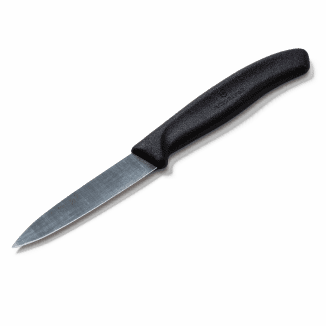
Best BuyVictorinox Swiss Classic Paring Knife

This inexpensive paring knife has proved its value again and again over the years. Weighing just 21 grams, it’s the lightest model we’ve ever tested, and while some users found it a bit insubstantial or toy-like, others loved how easy to wield it was as a result. Its blade could have been a touch sharper but was still keen enough to execute all tasks well. And the blade’s thinness, flexibility, and narrow, spear-point shape meant it was particularly good at off-the-board tasks such as hulling strawberries and peeling apples. The knife’s utilitarian handle is long and made from grippy plastic, which makes it easy to hold; because it’s offset slightly from the blade, it provides a little more clearance for knuckles than other spear-point models when slicing or mincing on the cutting board. This might not be the most attractive knife you own, but at its incredibly low price point, it offers extraordinary value for your dollar.

Model Number: 6.7603

Weight: 21.0 g

Spine Thickness: 1.2 mm

Blade Length: 3.25 in

Edge Angle: 18-20°

Heel Height: 0.6 in

Handle Length: 4 in

Blade Material: Unspecified stainless steel

Handle Material: Polypropylene

Price at Time of Testing: $12.25

  • Blade
  • Handle
  • Sharpness

This inexpensive paring knife has proved its value again and again over the years. Weighing just 21 grams, it’s the lightest model we’ve ever tested, and while some users found it a bit insubstantial or toy-like, others loved how easy to wield it was as a result. Its blade could have been a touch sharper but was still keen enough to execute all tasks well. And the blade’s thinness, flexibility, and narrow, spear-point shape meant it was particularly good at off-the-board tasks such as hulling strawberries and peeling apples. The knife’s utilitarian handle is long and made from grippy plastic, which makes it easy to hold; because it’s offset slightly from the blade, it provides a little more clearance for knuckles than other spear-point models when slicing or mincing on the cutting board. This might not be the most attractive knife you own, but at its incredibly low price point, it offers extraordinary value for your dollar.

Model Number: 6.7603

Weight: 21.0 g

Spine Thickness: 1.2 mm

Blade Length: 3.25 in

Edge Angle: 18-20°

Heel Height: 0.6 in

Handle Length: 4 in

Blade Material: Unspecified stainless steel

Handle Material: Polypropylene

Price at Time of Testing: $12.25

  • Blade
  • Handle
  • Sharpness

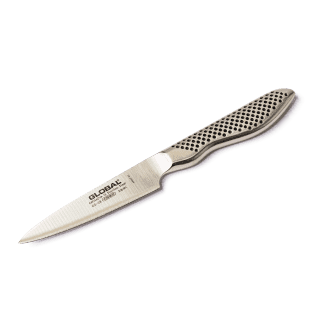
Global Classic 3.5" Paring Knife

With one of the sharpest blades we evaluated, this paring knife sailed through tests, making clean, precise cuts throughout. Measuring 3.8 inches in blade length, it was a little longer than some testers preferred, though that length meant that it was particularly good at quartering large apples and slicing blocks of cheese. Despite being made entirely of metal, it wasn’t overly heavy, either, with a pleasant weight that testers liked. Testers had mixed feelings on the handle, though. It’s short, so larger hands felt cramped; a few folks found that its length made the knife feel less well-balanced on the whole, given its longer blade. And while some folks liked the ergonomic bumps on the underside, others felt that it limited the ways that they could hold the knife. The divots in the handle helped us keep our grip on the otherwise slippery metal but were prone to getting little bits of food stuck in them.

Model Number: GS-38

Weight: 61 g

Spine Thickness: 1.6 mm

Blade Length: 3.8 in

Edge Angle: 10-15°

Heel Height: 0.8 in

Handle Length: 3.7 in

Blade Material: CROMOVA 18 stainless steel

Handle Material: CROMOVA 18 stainless steel

Price at Time of Testing: $49.95

  • Blade
  • Handle
  • Sharpness

With one of the sharpest blades we evaluated, this paring knife sailed through tests, making clean, precise cuts throughout. Measuring 3.8 inches in blade length, it was a little longer than some testers preferred, though that length meant that it was particularly good at quartering large apples and slicing blocks of cheese. Despite being made entirely of metal, it wasn’t overly heavy, either, with a pleasant weight that testers liked. Testers had mixed feelings on the handle, though. It’s short, so larger hands felt cramped; a few folks found that its length made the knife feel less well-balanced on the whole, given its longer blade. And while some folks liked the ergonomic bumps on the underside, others felt that it limited the ways that they could hold the knife. The divots in the handle helped us keep our grip on the otherwise slippery metal but were prone to getting little bits of food stuck in them.

Model Number: GS-38

Weight: 61 g

Spine Thickness: 1.6 mm

Blade Length: 3.8 in

Edge Angle: 10-15°

Heel Height: 0.8 in

Handle Length: 3.7 in

Blade Material: CROMOVA 18 stainless steel

Handle Material: CROMOVA 18 stainless steel

Price at Time of Testing: $49.95

  • Blade
  • Handle
  • Sharpness

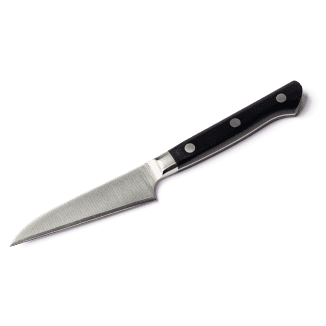
TOJIRO CLASSIC Paring Knife 90mm

This Japanese paring knife had an unusual, sheep’s foot-like blade that users generally liked, though it took a little getting used to. Although the tip is blunt-nosed, its edge is still pointy and sharp enough to do delicate tasks such as hulling strawberries, though it was best for on-the-board tasks such as mincing shallots or cutting cheese or fruit. Its relatively tall heel height gave users a bit more knuckle clearance for these tasks too. Its plastic handle was similar to several others we tested long enough for most hands to hold comfortably, if a touch slippery when wet.

Model Number: F-800

Weight: 58 g

Spine Thickness: 1.51 mm

Blade Length: 3.8 in

Edge Angle: 15°

Heel Height: 0.9 in

Handle Length: 4 in

Blade Material: San Mai construction with VG10 edge, stainless-steel cladding

Handle Material: Black Micarta (plastic)

Price at Time of Testing: $60.00

  • Blade
  • Handle
  • Sharpness

This Japanese paring knife had an unusual, sheep’s foot-like blade that users generally liked, though it took a little getting used to. Although the tip is blunt-nosed, its edge is still pointy and sharp enough to do delicate tasks such as hulling strawberries, though it was best for on-the-board tasks such as mincing shallots or cutting cheese or fruit. Its relatively tall heel height gave users a bit more knuckle clearance for these tasks too. Its plastic handle was similar to several others we tested long enough for most hands to hold comfortably, if a touch slippery when wet.

Model Number: F-800

Weight: 58 g

Spine Thickness: 1.51 mm

Blade Length: 3.8 in

Edge Angle: 15°

Heel Height: 0.9 in

Handle Length: 4 in

Blade Material: San Mai construction with VG10 edge, stainless-steel cladding

Handle Material: Black Micarta (plastic)

Price at Time of Testing: $60.00

  • Blade
  • Handle
  • Sharpness

Wüsthof Classic 3 1/2" Paring Knife

With a very sharp, slightly flexible, and fairly narrow blade, this classic paring knife excelled at off-the-board tasks, hulling strawberries and peeling apples precisely and effectively. It also did a good job with on-the-board tasks, slicing and mincing well, though it provided a little less knuckle clearance than we’d prefer. We just wish that its handle were a bit longer—measuring just 3.5 inches, it didn’t give much room for large-handed testers to operate—and that its plastic build was a touch less slippery when wet.

Model Number: 4066-7/09

Weight: 64 g

Spine Thickness: 1.1 mm

Blade Length: 3.25 in

Edge Angle: 14°

Heel Height: 0.75 in

Handle Length: 3.5 in

Blade Material: Unspecified stainless steel

Handle Material: Polyoxymethylene (POM, a plastic)

Price at Time of Testing: $85.10

  • Blade
  • Handle
  • Sharpness

With a very sharp, slightly flexible, and fairly narrow blade, this classic paring knife excelled at off-the-board tasks, hulling strawberries and peeling apples precisely and effectively. It also did a good job with on-the-board tasks, slicing and mincing well, though it provided a little less knuckle clearance than we’d prefer. We just wish that its handle were a bit longer—measuring just 3.5 inches, it didn’t give much room for large-handed testers to operate—and that its plastic build was a touch less slippery when wet.

Model Number: 4066-7/09

Weight: 64 g

Spine Thickness: 1.1 mm

Blade Length: 3.25 in

Edge Angle: 14°

Heel Height: 0.75 in

Handle Length: 3.5 in

Blade Material: Unspecified stainless steel

Handle Material: Polyoxymethylene (POM, a plastic)

Price at Time of Testing: $85.10

  • Blade
  • Handle
  • Sharpness

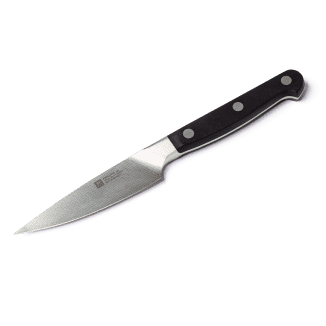
ZWILLING Pro 4-inch, Paring Knife

Large-handed testers loved this paring knife’s extra-long handle and tall heel, which gave their knuckles a bit more clearance when using the knife to slice or mince foods on the cutting board. Smaller-handed testers found it a touch unwieldy, however, especially when they had to choke up on the blade for detail work such as hulling strawberries; the long handle often hit their wrists awkwardly. Users were also divided on this knife’s blade. While very sharp, it was on the long side—great for cutting larger foods but less precise for fine tasks such as peeling or hulling. And it had a fairly classical triangular shape; some users found that its large, curved belly got in the way during off-the-board tasks, but others liked that they could rock through cuts when mincing shallots more easily. As with other plastic handles, it got a bit slippery when wet.

Model Number: 38400-103

Weight: 82 g

Spine Thickness: 1.16 mm

Blade Length: 3.8 in

Edge Angle: 15°

Heel Height: 0.9 in

Handle Length: 4.25 in

Blade Material: SIGMAFORGE (high-carbon German stainless steel)

Handle Material: Plastic

Price at Time of Testing: $69.95

  • Blade
  • Handle
  • Sharpness

Large-handed testers loved this paring knife’s extra-long handle and tall heel, which gave their knuckles a bit more clearance when using the knife to slice or mince foods on the cutting board. Smaller-handed testers found it a touch unwieldy, however, especially when they had to choke up on the blade for detail work such as hulling strawberries; the long handle often hit their wrists awkwardly. Users were also divided on this knife’s blade. While very sharp, it was on the long side—great for cutting larger foods but less precise for fine tasks such as peeling or hulling. And it had a fairly classical triangular shape; some users found that its large, curved belly got in the way during off-the-board tasks, but others liked that they could rock through cuts when mincing shallots more easily. As with other plastic handles, it got a bit slippery when wet.

Model Number: 38400-103

Weight: 82 g

Spine Thickness: 1.16 mm

Blade Length: 3.8 in

Edge Angle: 15°

Heel Height: 0.9 in

Handle Length: 4.25 in

Blade Material: SIGMAFORGE (high-carbon German stainless steel)

Handle Material: Plastic

Price at Time of Testing: $69.95

  • Blade
  • Handle
  • Sharpness

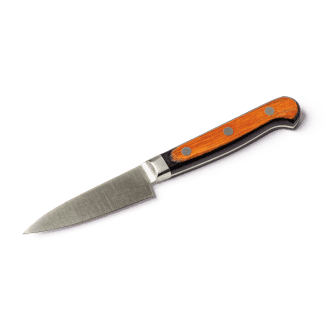
MAC Professional Paring Knife 3¼"

This paring knife did a good job on most tasks, with its very sharp, short, narrow blade doing an especially good job with off-the board tasks such as hulling strawberries and peeling apples. But because it had a fairly thick spine, it sometimes wedged into foods, which made it harder to quarter apples or slice blocks of cheese. It also didn’t provide much knuckle clearance for on-the-board slicing and mincing. Its plastic handle was long enough for hands of all sizes to hold comfortably, though it got a little slippery when wet.

Model Number: PKF-30

Weight: 61 g

Spine Thickness: 1.71 mm

Blade Length: 3.25 in

Edge Angle: 15°

Heel Height: 0.75 in

Handle Length: 3.9 in

Blade Material: Proprietary stain-resistant steel alloy

Handle Material: Pakkawood (plastic-impregnated wood)

Price at Time of Testing: $69.95

  • Blade
  • Handle
  • Sharpness

This paring knife did a good job on most tasks, with its very sharp, short, narrow blade doing an especially good job with off-the board tasks such as hulling strawberries and peeling apples. But because it had a fairly thick spine, it sometimes wedged into foods, which made it harder to quarter apples or slice blocks of cheese. It also didn’t provide much knuckle clearance for on-the-board slicing and mincing. Its plastic handle was long enough for hands of all sizes to hold comfortably, though it got a little slippery when wet.

Model Number: PKF-30

Weight: 61 g

Spine Thickness: 1.71 mm

Blade Length: 3.25 in

Edge Angle: 15°

Heel Height: 0.75 in

Handle Length: 3.9 in

Blade Material: Proprietary stain-resistant steel alloy

Handle Material: Pakkawood (plastic-impregnated wood)

Price at Time of Testing: $69.95

  • Blade
  • Handle
  • Sharpness

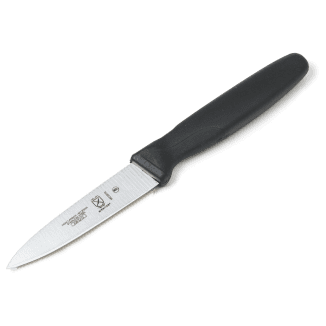
Mercer Culinary Millennia 3" Slim Paring Knife

We really liked this little, inexpensive knife at first. It looked and felt just like our Best Buy, with a spear-point blade and a similar black plastic handle. But the handle was a touch broader and less grippy than the Victorinox, which made it less comfortable to hold. And the blade wasn’t quite as sharp as we wanted it to be. Like our Best Buy, its narrow blade means it shines brightest for off-the-board tasks such as hulling strawberries or peeling fruit, though it can serviceably execute on-the-board slicing and mincing, too, albeit with slightly less knuckle clearance.

Model Number: M23900P

Weight: 28.16 g

Spine Thickness: 1.22 mm

Blade Length: 3.25 in

Edge Angle: 16°

Heel Height: 0.7 in

Handle Length: 4 in

Blade Material: X30 Cr13 High Carbon, Stain Free Steel

Handle Material: Polyoxymethylene (POM, a plastic)

Price at Time of Testing: $5.13

  • Blade
  • Handle
  • Sharpness

We really liked this little, inexpensive knife at first. It looked and felt just like our Best Buy, with a spear-point blade and a similar black plastic handle. But the handle was a touch broader and less grippy than the Victorinox, which made it less comfortable to hold. And the blade wasn’t quite as sharp as we wanted it to be. Like our Best Buy, its narrow blade means it shines brightest for off-the-board tasks such as hulling strawberries or peeling fruit, though it can serviceably execute on-the-board slicing and mincing, too, albeit with slightly less knuckle clearance.

Model Number: M23900P

Weight: 28.16 g

Spine Thickness: 1.22 mm

Blade Length: 3.25 in

Edge Angle: 16°

Heel Height: 0.7 in

Handle Length: 4 in

Blade Material: X30 Cr13 High Carbon, Stain Free Steel

Handle Material: Polyoxymethylene (POM, a plastic)

Price at Time of Testing: $5.13

Recommended with Reservations

  • Blade
  • Handle
  • Sharpness

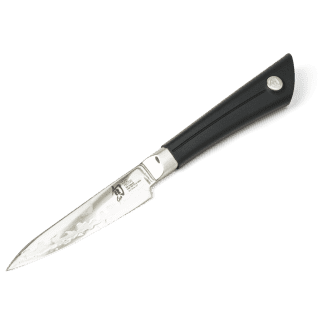
Shun Sora Paring Knife

This knife’s long, narrow blade was very sharp, but its thick spine meant that it wedged into foods we cut on the cutting board—apples, shallots, and blocks of cheese. Worse, its handle was off. It was too long and bumped into our wrists when we had to choke up on the blade when peeling apples or hulling strawberries. It was also awkwardly shaped, with a broader end that tapered toward the blade, forcing our hands to slide toward the blade as we worked on the cutting board. And its somewhat smooth plastic was a bit slippery when wet.

Model Number: VB0700

Weight: 58.36 g

Spine Thickness: 1.52 mm

Blade Length: 3.5 in

Edge Angle: 16°

Heel Height: 0.75 in

Handle Length: 4.5 in

Blade Material: San Mai construction with San Mai with VG10 core and 420J stainless steel cladding

Handle Material: Polypropylene and thermoplastic elastomer (plastic)

Price at Time of Testing: $64.95

  • Blade
  • Handle
  • Sharpness

This knife’s long, narrow blade was very sharp, but its thick spine meant that it wedged into foods we cut on the cutting board—apples, shallots, and blocks of cheese. Worse, its handle was off. It was too long and bumped into our wrists when we had to choke up on the blade when peeling apples or hulling strawberries. It was also awkwardly shaped, with a broader end that tapered toward the blade, forcing our hands to slide toward the blade as we worked on the cutting board. And its somewhat smooth plastic was a bit slippery when wet.

Model Number: VB0700

Weight: 58.36 g

Spine Thickness: 1.52 mm

Blade Length: 3.5 in

Edge Angle: 16°

Heel Height: 0.75 in

Handle Length: 4.5 in

Blade Material: San Mai construction with San Mai with VG10 core and 420J stainless steel cladding

Handle Material: Polypropylene and thermoplastic elastomer (plastic)

Price at Time of Testing: $64.95

Not Recommended

  • Blade
  • Handle
  • Sharpness

Dexter Russell Sani-Safe 3 1/4" Cook’s Style Paring Knife

“Is that an oyster knife?” asked almost every person who walked by this knife in the kitchen. The answer is no, but it does look like one—and much like an oyster knife, its blade was extremely dull, so it couldn’t slice, hull, or peel very effectively at all. Its textured plastic handle was long and grippy but so thick that most testers found it uncomfortable to wield for long periods.

Model Number: 15303 S104

Weight: 31.44 g

Spine Thickness: 1.07 mm

Blade Length: 3.25 in

Edge Angle: 18°

Heel Height: 0.55 in

Handle Length: 4 in

Blade Material: Proprietary

Handle Material: Plastic

Price at Time of Testing: $11.00

  • Blade
  • Handle
  • Sharpness

“Is that an oyster knife?” asked almost every person who walked by this knife in the kitchen. The answer is no, but it does look like one—and much like an oyster knife, its blade was extremely dull, so it couldn’t slice, hull, or peel very effectively at all. Its textured plastic handle was long and grippy but so thick that most testers found it uncomfortable to wield for long periods.

Model Number: 15303 S104

Weight: 31.44 g

Spine Thickness: 1.07 mm

Blade Length: 3.25 in

Edge Angle: 18°

Heel Height: 0.55 in

Handle Length: 4 in

Blade Material: Proprietary

Handle Material: Plastic

Price at Time of Testing: $11.00

  • Blade
  • Handle
  • Sharpness

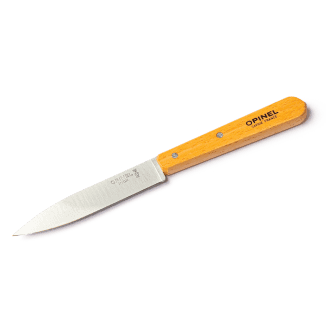
Opinel No.112 Stainless Steel Paring Knife

Several testers commented that this inexpensive, lightweight knife looked like a toy, better for a picnic or a vacation home rental than for serious use. “Alas,” as one user said, “Sometimes looks are not deceiving.” The knife’s blade was extremely narrow, so it might have been good for off-the-board jobs such as peeling apples or hulling strawberries—if only it had actually been sharp. Unfortunately, it was exceedingly dull, making every task a chore. The blade also has a bolster that renders part of the blade unsharpened and unusable, which testers found annoying. The handle was not much better. Made of poorly varnished wood, it was shorter than we prefer and the nails holding it together stuck out slightly, digging into our hands unpleasantly as we held it.

Model Number: 1913

Weight: 25 g

Spine Thickness: 1.2 mm

Blade Length: 3.75 in

Edge Angle: 15°

Heel Height: 0.6 in

Handle Length: 3.75 in

Blade Material: 12C27 Stainless Steel

Handle Material: PEFC Certified Beechwood

Price at Time of Testing: $12.00 for 2

  • Blade
  • Handle
  • Sharpness

Several testers commented that this inexpensive, lightweight knife looked like a toy, better for a picnic or a vacation home rental than for serious use. “Alas,” as one user said, “Sometimes looks are not deceiving.” The knife’s blade was extremely narrow, so it might have been good for off-the-board jobs such as peeling apples or hulling strawberries—if only it had actually been sharp. Unfortunately, it was exceedingly dull, making every task a chore. The blade also has a bolster that renders part of the blade unsharpened and unusable, which testers found annoying. The handle was not much better. Made of poorly varnished wood, it was shorter than we prefer and the nails holding it together stuck out slightly, digging into our hands unpleasantly as we held it.

Model Number: 1913

Weight: 25 g

Spine Thickness: 1.2 mm

Blade Length: 3.75 in

Edge Angle: 15°

Heel Height: 0.6 in

Handle Length: 3.75 in

Blade Material: 12C27 Stainless Steel

Handle Material: PEFC Certified Beechwood

Price at Time of Testing: $12.00 for 2

America's Test Kitchen Accolades Badge

Reviews You Can Trust

The mission of America’s Test Kitchen Reviews is to find the best equipment and ingredients for the home cook through rigorous, hands-on testing. We stand behind our winners so much that we even put our seal of approval on them. Have a question or suggestion? Send us an email at atkreviews@americastestkitchen.com. We appreciate your feedback!

Appears In

This item is featured in the following. Click the links to dig in!

*All products reviewed by America’s Test Kitchen are independently chosen, researched, and reviewed by our editors. We buy products for testing at retail locations and do not accept unsolicited samples for testing. We list suggested sources for recommended products as a convenience to our readers but do not endorse specific retailers. When you choose to purchase our editorial recommendations from the links we provide, we may earn an affiliate commission. Prices are subject to change.

Reviews You Can Trust.
See Why.

This is a members' feature.
America's Test Kitchen LogoCook's Country LogoCook's Illustrated Logo