


Our top-rated food processor is the Cuisinart Custom 14-Cup Food Processor. Powerful, precise, and compact, it takes up less space than most food processors despite having one of the largest capacities, all at a moderate price. Its smooth, simple bowl and blade design make it easy to handle, monitor during use, and clean. The motor is quiet, and the machine operates with just two control levers and three essential blades for chopping, shredding, and slicing that can all be stored inside the bowl, with no accessories box to deal with. (Additional blades are available separately.) For those who want all the bells and whistles and are willing to pay for and store them, we also recommend a strong performer, the Breville Sous Chef 16, which comes with a mini bowl and many more accessories, including a french fry slicer and the option to add a dicing kit.
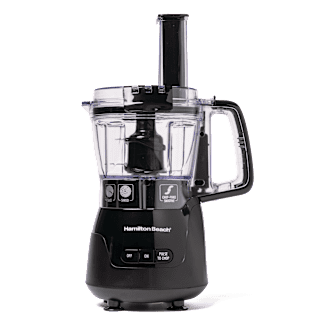
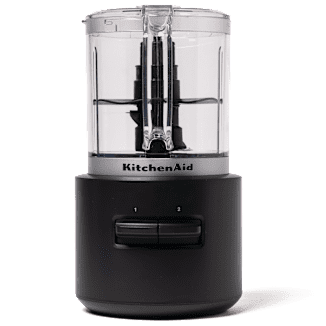
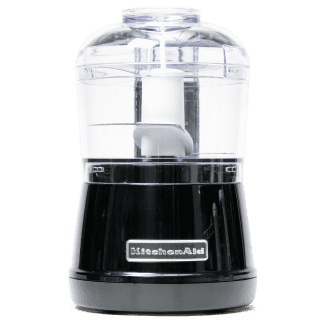
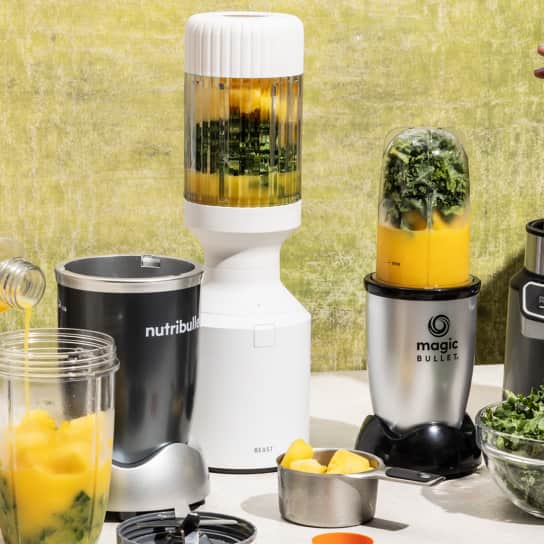
If you are interested in a tool that will chop and mix small quantities, check out our review of small food processors.
A good food processor makes a huge range of recipes faster, easier, and more approachable. It’s excellent for making salsa, pesto, and other chunky sauces. It’s perfect for big-batch cooking, grating pounds of carrots, zucchini, or potatoes to spare you the labor—and shredded fingertips—of a box grater; and slicing as quickly as a professional prep cook. It cuts cold fat into flour so you get the flakiest pie crust. It kneads pizza dough and even shreds cheese and purees sauce to top that pizza. Not to mention that it chops onions, makes bread crumbs, minces herbs, grinds beef into hamburger, and even whips up frosting or fresh mayonnaise in a minute flat.
How Food Processors Work
All the models we tested use the same approach: A workbowl sits on a motorized base, and a blade sits in the bowl on a central stem that passes through the bowl to the motor. Safety features keep the blade immobile if the lid isn’t fully attached. You add food to the bowl and put the lid on. Press a button, and the motor spins the blade, chopping your food. For slicing and shredding, you swap the primary blade for a horizontal, disk-shaped blade. The disk has either raised holes for shredding or a raised cutting edge for slicing. After securing the lid, you add food through the lid’s vertical feed tube, steadily pressing it down with a special feed-tube pusher onto the spinning disk. The feed tube can usually be modified with special inserts to hold bigger or smaller foods upright. This helps the machine shred or slice uniformly.
Surprisingly, while all our machines worked on these principles, they performed differently and took varying levels of effort to use and maintain.
What to Look For
- Large Capacity: We think food processors that hold at least 12 cups are the most useful and versatile for most home cooks, allowing you to easily chop, slice, and knead both small and large quantities of food.
- Powerful Motor: We made double batches of sticky pizza dough called Pissaladière in each machine to test their capacity and power. Top-rated machines made doughs that were silky, elastic, and thoroughly mixed, while one lower-ranked model stalled due to overheating. This was likely due to a number of factors. This particular model had the lowest wattage of the lineup, but as our senior science editor, Paul Adams, explained, wattage alone isn’t responsible for the power of a motor: a machine that overheats when kneading is simply “not designed to produce enough torque, or rotational force, to handle that kind of load.”
We compared the results of chopping 2-inch chunks of carrots, celery, and onion into ¼-inch dice. Most of the models we tested left behind larger chunks of vegetables.
- Responsive Pulse Control: The blade of a food processor should be able to chop, mix, or puree food to whatever consistency you need. A short, powerful pulse function is essential: It briefly tosses and chops food, then stops instantly, so you control the texture. Some machines struggled when we tried chopping onions, carrots, and celery into ¼-inch dice. But models with responsive pulse buttons gave us uniform, crisp cuts.
In a test of blending efficiency, we added yellow and blue food coloring to plain yogurt and ran the processors on high for 30 seconds. Some models sent yogurt flying around the bowl and left yogurt streaky and unmixed (left). Better models gave us evenly green, frothy yogurt that was perfectly blended (right).
- Long and Low Blades: Models with blades that reached closer to the bowls’ sides and sat closer to the bowls’ bottoms chopped and mixed more thoroughly and efficiently because food couldn’t escape. We put single drops of yellow and blue food coloring on plain yogurt and ran machines for 30 seconds. The best quickly processed the yogurt to solid green; the worst left the white yogurt streaked with yellow and blue. Efficient food processors had gaps of as little as 2.9 millimeters between blade tips and bowl sides. And from blade to bowl bottom, the best had gaps of just 2.2 millimeters.
- Sharp Blades: The best models had sharp blades that cut food into heaps of fluffy, uniform shreds and neat, crisp slices. When we sliced potatoes and tomatoes, a few models gave us juicier, more ragged slices, indicating duller blades, but our top picks worked so neatly and precisely that we could almost reassemble the potato or tomato afterward.
As we tested the models and their shredding capabilities, we looked for uniform shreds. Some didn't make the cut, leaving bigger chunks of carrots that would not be usable in recipes such as carrot cake.
- Simple Design: We appreciated when blades were easy to insert, with a minimum of pieces. Our favorite model had a one-piece chopping blade and a single stem that held up the slicing and shredding disks.
- Weighty Base, Compact Profile: The best bases save space and are heavy enough to keep the machine anchored during heavy mixing. Models with lower profiles were easier for shorter testers to use comfortably and could easily slide under cabinets.
- Versatile Feed Tubes: Feed tubes need to hold foods of different sizes securely. We liked models that allowed us to adjust the openings of the feed tube using special inserts; these could hold big and small foods upright, allowing for consistent, even slicing.
- Clearly Marked Liquid Maximum: Not all food processors can hold large volumes of liquids. When you turn on the machine, centrifugal force makes the liquid level climb, so it’s essential to have clear markings on the workbowl that show the maximum fill line in order to avoid leaks.
- Easy Cleaning: Chasing bits of sticky pizza dough and flour out of every nook and cranny of each food processor’s bowl, lid, and blades while trying not to cut ourselves confirmed our preference for models whose bowls and lids had simpler, smoother surfaces. We’ve noted in the chart which models have dishwasher-safe parts (a nice advantage, though some manufacturers warn that workbowls may become cloudy-looking after many dishwasher cycles). However, we often find ourselves using a food processor for a series of separate tasks, so waiting through a dishwasher cycle isn’t in the cards. Being able to easily hand-wash and fully dry the pieces is more important than you might think.
Anatomy of a Good Food Processor
1. Well-Designed Feed Tube
The feed tube should be big enough to minimize pretrimming and waste but narrow enough to hold food upright. Different-size inserts are also a plus, since they let you get a custom fit for a variety of foods.
2. Minimal Gaps Between Blade and Bowl
The space between the end of the blade and the side of the bowl, as well as the space between the base of the blade and the bottom of the bowl, should be small. This ensures more efficient, thorough mixing and food that is evenly chopped.
3. Weighty, Compact Base
The best base saves space and keeps the machine anchored during heavy mixing.
4. Responsive Pulse Button
A responsive pulse button enables a quick stop-start so that the ingredients are tossed around the bowl and into the cutting action. It gives you better control over the final size of the pieces, without overprocessing.
Nice to Have
- Holes for Drizzling: Some models come with feed-tube inserts that have a small hole in the bottom. You can fill these inserts with liquids that you want to drizzle gradually into the workbowl as the machine runs. We found this feature handy for making emulsions such as mayonnaise and sauces.
- Locks for Feed Tube Inserts: We liked models that have the ability to secure in place all the different-size pieces that make up the feed tube inserts so that they can operate as one solid piece. Locks ensured that none of the parts rode up when we pushed food through the tube or tumbled out when we turned over the workbowl lid.
- Sealed Workbowls: A few models had sealed workbowls for processing larger volumes of liquid. This is nice but not an essential feature; we prefer using a blender or an immersion blender for tasks such as pureeing batches of soup because they can blend liquids to a finer, smoother texture than food processors.
What to Avoid
- Weak Motors: When we kneaded double batches of pizza dough to push machines to their limits, some models rocked, and one stalled due to overheating. Our testing revealed which models had the power to push through heavy tasks. While this was an extreme test, we prefer models that are more capable of handling heavy loads if needed.
- Too-Short and Too-High Blades: Food can evade chopping blades that leave big gaps between the blade tips and the sides of the workbowl and between the blades and the bottom of the bowl. These models chopped and mixed unevenly and incompletely. Often we’d discover it too late—while emptying the bowl, we’d pull out the blade to reveal a puddle of unblended ingredients. Our measurements showed the lowest performers left a gap between blade and bowl that was twice as wide as the best models—as much as 6.1 millimeters between blade tips and bowl sides, and 5.4 millimeters between blades and the bowl bottom.
- Dull Blades: Chopping, slicing, and shredding blades that were too dull left us with bruised herbs; clumpy cheese shreds; and oozing, irregularly sliced vegetables.
- Lightweight Bases: Lighter models didn’t stay put on the counter. While some came with suction-cup feet to anchor them, we found those annoying. If we just wanted to scoot the machine forward or backward a few inches, we first had to hoist it up to rip the suction cups free.
- Less Responsive Pulse Control: Bad pulse buttons start too gently to toss food and keep running for too long, so some food gets over-chopped while the rest just rides around on the blade. We had carrot pieces that stayed chunky while the celery and onions in the bowl were nearly liquefied.
- Too-Wide or Too-Narrow Feed Tubes: If a feed tube is too wide, food slumps and droops, so you get odd-shaped slices, irregular shreds, and wasted chunks of food that ride around on top of the shredding or slicing disk. Too-narrow tubes are also a problem: You don’t want to have to pre-trim food extensively so that it will fit in the tube. One model had a ridiculously narrow tube, 1¾ by 2¾ inches. Nothing fit without trimming.
Minor Flaws
- Complicated Designs: We were frustrated by machines that had steep learning curves for assembly; we’d rather not consult the manual every time we needed to put the processor together. We also didn’t love machines that had lots of nooks and crannies, as these trapped food and liquid and took much longer to clean and dry components—a disadvantage when you want to use the machine a few times in a row for different tasks. And we especially disliked blades that had multiple parts. These were not only a pain to assemble, but they also got more gummed up with food than one-piece blades, and we worried about losing the individual parts.
Some food processors come with a large box of extra blades and attachments, but we've found that the majority of food-processing tasks can be accomplished with just three blades: those for chopping, slicing, and shredding. Our winning model conveniently stores all three inside its workbowl.
Other Considerations
- Accessories and Additional Functions: Many food processors come with multiple blades and attachments—usually packed in a plastic caddy box as big as the machine itself, with even more extras such as mini bowls that have to be stored separately. In our experience, the majority of food-processing tasks can be accomplished with just three blades: one each for chopping, slicing, and shredding. Our winning model conveniently stores all three inside its single workbowl (with a few optional blades sold separately). Extra accessories such as mini bowls and dicing attachments can work well, increasing a food processor’s versatility. But they drive up the price of most food processors, take up more space, and are usually finicky to clean. If you think you’ll use these extra accessories frequently—and have the space and money to spend—we recommend the Breville Sous Chef 16. It performs solidly on the basics and offers plenty of extra accessories and functions. It lets you slice and shred in a range of thicknesses and comes with a french fry cutter and a mini bowl for processing small quantities of food. A dicing attachment is available separately, and while it’s handy for big quantities, it’s overkill if you’re just prepping a single onion while cooking dinner.
The Tests
- Shred 8 ounces of cheddar cheese
- Shred carrots
- Mince fresh parsley
- Chop onion, carrot, and celery into mirepoix
- Chop raw steak and cold butter for Tender, Juicy Grilled Burgers
- Slice plum tomatoes
- Slice russet potatoes
- Process plain yogurt and drops of yellow and blue food coloring to achieve uniform green color
- Emulsify Homemade Mayonnaise
- Puree canned whole tomatoes
- Mix American Pie Dough
- Mix double batch of heavy, sticky dough for Pissaladière as an abuse and capacity test
- Hand-wash parts including bowls, lids, blades, and feed tube inserts after each test and evaluate design elements that aid or impede cleanup
How We Rated
- Performance: We evaluated the efficiency and results of each processor when mixing, chopping, emulsifying, pureeing, grinding, slicing, and shredding foods.
- Ease of Use: We considered how easy it was to lift and move the machines, place and remove parts, add and remove ingredients, and interpret and work the controls.
- Cleanup: We evaluated the effort required to clean and dry all parts.