Buckwheat Pasta with Swiss Chard, Potatoes, and Taleggio
By America's Test KitchenPublished on April 17, 2020
Time
1½ hours
Yield
Serves 6
Italian Name:
Pizzoccheri della Valtellina
Ingredients
Pizzoccheri
7½ ounces (213 grams/1½ cups) all-purpose flour, plus extra as needed2¾ ounces (78 grams/½ cup) buckwheat flour 3 large eggs, lightly beatenVegetables and Sauce
3 tablespoons unsalted butter 1 tablespoon minced fresh sage 1 garlic clove, minced2 pounds Swiss chard, stemmed and chopped coarse8 ounces (227 grams) russet potatoes, peeled and cut into ½-inch piecesSalt and pepper 6 ounces (170 grams) Taleggio cheese, rind removed, cut into ¼-inch piecesBefore You Begin
Buckwheat flour can be found in natural food stores and well-stocked supermarkets. You can find Taleggio at most well-stocked cheese counters. Our favorite pasta machine is the Marcato Altas 150 Wellness Pasta Machine; the pasta will be thin but opaque when rolled to setting 6.
Instructions
- For the pizzoccheri: Pulse all-purpose flour and buckwheat flour in food processor until combined, about 5 pulses. Add eggs and process until mixture forms cohesive dough that feels soft and is barely tacky to touch, about 45 seconds. (If dough sticks to fingers, add up to ¼ cup extra all-purpose flour, 1 tablespoon at a time, until barely tacky. If dough doesn't become cohesive, add up to 1 tablespoon water, 1 teaspoon at a time, until it just comes together; process 30 seconds longer.)
- Transfer dough to clean counter and knead by hand to form smooth, round ball, about 2 minutes. Cover tightly with plastic wrap and let rest at room temperature for at least 15 minutes or up to 2 hours.
- Transfer dough to clean counter, divide into 5 pieces, and cover with plastic. Flatten 1 piece of dough into ½-inch-thick disk. Using pasta machine with rollers set to widest position, feed dough through rollers twice. Bring tapered ends of dough toward middle and press to seal. Feed dough seam side first through rollers again. Repeat feeding dough tapered end first through rollers set at widest position, without folding, until dough is smooth and barely tacky. (If dough sticks to fingers or rollers, lightly dust with flour and roll again.)
- Narrow rollers to next setting and feed dough through rollers twice. Continue to progressively narrow rollers, feeding dough through each setting twice, until dough is thin but opaque; transfer to lightly floured counter. (If dough becomes too long to manage, halve crosswise.) Let pasta sheet sit uncovered until dry to touch and slightly stiffened, about 10 minutes. Repeat rolling and drying remaining dough.
- Using pizza cutter or sharp knife, cut pasta sheets into 2 by ¾-inch strips. Toss lightly with flour and transfer to rimmed baking sheet. (Pasta can be wrapped with plastic and refrigerated for up to 4 hours or chilled in freezer until firm, then transferred to zipper-lock bag and frozen for up to 1 month. If frozen, do not thaw before cooking.)
- For the vegetables and sauce: Melt butter in Dutch oven over medium-high heat. Add sage and garlic and cook until fragrant, about 1 minute. Add chard, one handful at a time, and cook, stirring occasionally, until wilted and most liquid has evaporated, about 8 minutes. Cover and keep warm over low heat.
- Meanwhile, bring 4 quarts water to boil in large pot. Add potatoes and 1 tablespoon salt and cook until just tender, 5 to 8 minutes. Using slotted spoon, transfer potatoes to bowl. Stir Taleggio, ¼ cup cooking water, and ½ teaspoon salt into chard until cheese is melted and sauce is smooth.
- Return cooking water to boil. Add pasta and cook, stirring often, until al dente, 2 to 3 minutes. Reserve ¼ cup cooking water, then drain pasta. Add pasta and potatoes to chard mixture and gently toss to combine. Season with salt and pepper to taste. Adjust consistency with reserved cooking water as needed before serving.


Time
1½ hoursYield
Serves 6Italian Name:
Pizzoccheri della ValtellinaIngredients
Ingredients
Ingredients
Why This Recipe Works
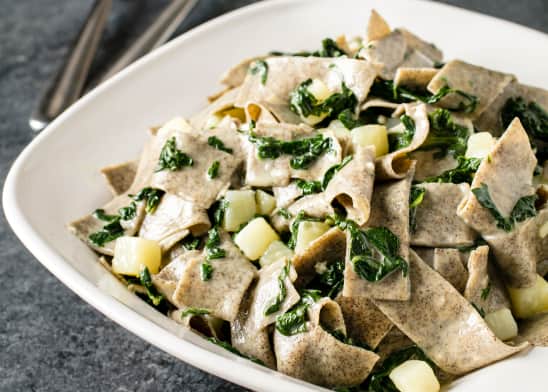
Earthy and toothsome, pizzoccheri are short ribbons of fresh buckwheat pasta (a local specialty) that mingle with melted cheese, bitter greens, and soft potatoes in this traditional wintry dish from Valtellina. Wheat doesn't grow locally in the mountainous areas of Lombardy and other northern Italian regions, but buckwheat does. Despite its name, buckwheat isn't related to wheat; it's an herb, and its seeds are ground to make flour, which local cooks have historically used to make pasta. Because buckwheat flour contains no gluten, modern pasta recipes combine it with white flour for a workable dough with pleasant chew. Rolling the pasta slightly thicker than most, like we do for lasagna noodles, and cooking the pasta briefly gave it a pleasant toothsomeness. Valtellina Casera, the alpine cheese commonly used in this dish, is hard to find in the United States. Taleggio, another cheese of Lombardy, was the perfect stand-in; it has a fruity tang and its strong yet milky flavor stood up to the earthy buckwheat; it also maintained a creamy consistency when melted. (Fontina, another frequently substituted cheese, became stretchy and rubbery when melted and wound up clumping in the greens.) Swiss chard and savoy cabbage are commonly used here; we loved chard's tender leaves and slightly bitter, vegetal flavor for our version. Finally, we cut russet potatoes into cubes; the starchy edges melted into and thickened the cheese sauce.
3 Comments