Red Currant and Fig Pie
By Leah ColinsPublished on October 14, 2020
Time
2¼ hours, 1 hour chilling, and 6 hours cooling
Yield
Serves 8
Ingredients
Before You Begin
Use a spice grinder to grind the tapioca. The method here produces a standard lattice top.
Instructions
- Roll 1 disk of dough into 12-inch circle on floured counter. Loosely roll dough around rolling pin and gently unroll it into 9-inch pie plate, letting excess dough hang over edge. Ease dough into plate by gently lifting edge of dough with your hand while pressing into plate bottom with your other hand. Leave any dough that overhangs plate in place. Wrap dough-lined plate loosely in plastic wrap and refrigerate until firm, about 30 minutes.
- Roll other piece of dough into 13 by 10½-inch rectangle on floured counter, then transfer to parchment paper–lined rimmed baking sheet; cover loosely with plastic and refrigerate until firm, about 30 minutes.
- Using pizza wheel, fluted pastry wheel, or paring knife, trim ¼ inch dough from long sides of rectangle, then cut lengthwise into eight 1¼-inch-wide strips. Cover loosely with plastic and refrigerate until firm, about 30 minutes. Adjust oven rack to middle position and heat oven to 400 degrees.
- Whisk sugar, tapioca, orange zest, and salt together in large bowl; set aside. Bring 1 pound (454 grams) currants to simmer in large saucepan over medium-high heat. Off heat, coarsely mash currants with potato masher. Return to simmer over medium-high heat and cook until currants are softened, about 3 minutes.
- Strain currants through fine-mesh strainer set over bowl with sugar mixture, pressing firmly on solids to extract as much liquid and pulp as possible; discard solids. Stir in figs, orange juice, and remaining 8 ounces (227 grams) currants and let sit for 15 minutes. Spread currant mixture into dough-lined plate.
- Remove dough strips from refrigerator; if too stiff to be workable, let sit at room temperature until softened slightly but still very cold. Space 4 strips evenly across top of pie, parallel to counter edge. Fold back first and third strips almost completely. Lay 1 strip across pie, perpendicular to second and fourth strips, keeping it snug to folded edges of dough strips, then unfold first and third strips over top. Fold back second and fourth strips and add second perpendicular strip, keeping it snug to folded edge. Unfold second and fourth strips over top. Repeat weaving remaining strips evenly across pie, alternating between folding back first and third strips and second and fourth strips to create lattice pattern. Shift strips as needed so they are evenly spaced over top of pie. (If dough becomes too soft to work with, refrigerate pie and dough strips until firm.)
- Trim overhang to ½ inch beyond lip of plate. Pinch edges of bottom crust and lattice strips together firmly to seal. Tuck overhang under itself; folded edge should be flush with edge of plate. Crimp dough evenly around edge of plate. (If dough is very soft, refrigerate for 10 minutes before baking.) Brush surface with egg wash.
- Place pie on aluminum foil–lined rimmed baking sheet and bake until crust is light golden, 20 to 25 minutes. Reduce oven temperature to 350 degrees, rotate sheet, and continue to bake until juices are bubbling and crust is deep golden brown, 30 to 50 minutes longer. Let pie cool on wire rack until filling has set, about 6 hours. Serve.


Time
2¼ hours, 1 hour chilling, and 6 hours coolingYield
Serves 8Ingredients
Test Kitchen Techniques
Ingredients
Test Kitchen Techniques
Ingredients
Test Kitchen Techniques
Why This Recipe Works
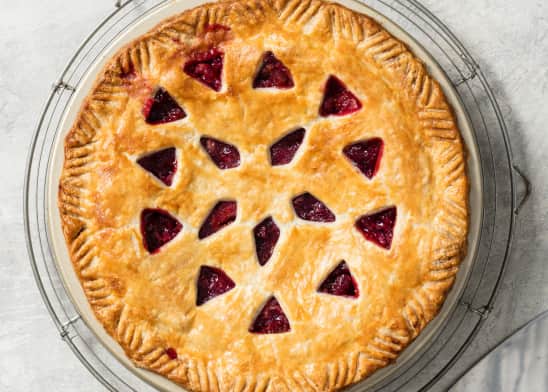
Although their season at the farmers' market is short, we wanted to capture their distinctive flavor in a special pie. For a thickened, jammy filling (and to make sure it wasn't overly seedy or peel-filled) we cooked down some of the berries and strained them through a fine-mesh strainer; we stirred the remaining berries in whole. Some orange zest and juice complemented their flavor and ensured it remained bright after cooking. But we thought the berries' intense flavor could use some taming and their texture some breaking up with the addition of another fruit. Fresh figs are in season at the same time and added a meatiness and caramel sweetness that made this filling exceptionally unique.


5 Comments