America's Test Kitchen LogoCook's Country LogoCook's Illustrated LogoAmerica's Test Kitchen LogoCook's Country LogoCook's Illustrated Logo

Oven-Poached Side of Salmon

By America's Test Kitchen

Published on August 22, 2007

Yield

Serves 8 to 10

Oven-Poached Side of Salmon

Ingredients

Vegetable cooking spray 1 side of salmon (about 4 pounds)Table salt 2 tablespoons cider vinegar 6 sprigs fresh tarragon leaves or dill2 lemons, sliced thin2 tablespoons minced fresh tarragon leaves or dill servings (for serving)1 lemon, cut into wedges (for serving)

Before You Begin

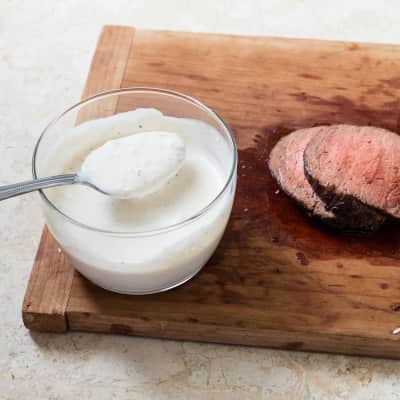
If serving a big crowd, you can oven-poach two individually wrapped sides of salmon in the same oven (on the upper- and lower-middle racks) without altering the cooking time. White wine vinegar can be substituted for the cider vinegar. Be sure to follow our directions for wrapping the salmon in foil—otherwise the fish's juices may leak onto the bottom of your oven, creating a pesky mess. To test the fish for doneness, simply poke an instant-read thermometer right through the foil. Serve with horseradish sauce if desired (see related recipe).

Instructions

  1. Adjust an oven rack to the middle position and heat the oven to 250 degrees. Following steps 1 and 2 below, assemble three sheets of foil and coat them with vegetable oil spray.
  2. Following the illustrations below (Preparing the Salmon) remove any pin bones and trim the belly from the salmon. Pat the salmon dry with paper towels then season both sides with salt. Lay the salmon, skin-side down, on top of the foil (step 3). Sprinkle with the vinegar and lay the herb sprigs on top. Arrange the lemon slices on top of the herbs. Crimp the foil down over the fish into a tight packet (step 4).
  3. Lay the foil-wrapped fish directly on the oven rack (without a baking sheet) and cook until the color of the flesh has turned from pink to orange, and the thickest part measures 135 to 140 degrees on an instant-read thermometer, 45 to 60 minutes.
  4. Remove the fish from the oven, open the foil packet, and discard the lemon slices and herbs. Let the salmon cool at room temperature, on the foil, for 30 minutes.
  5. Pour off any accumulated liquid, reseal the salmon in the foil, and refrigerate until cold, about 1 hour. (The poached salmon can be refrigerated for up to 2 days. Let the salmon sit at room temperature for 30 minutes before serving.)
  6. To serve, unwrap the salmon and brush away any gelled poaching liquid. Slide your hands under both ends of the salmon and carefully transfer the fish to a serving platter. Sprinkle the salmon with the minced tarragon. Serve with the lemon wedges.
Oven-Poached Side of Salmon

Oven-Poached Side of Salmon

Headshot of America's Test Kitchen
By America's Test Kitchen
Save

Yield

Serves 8 to 10

Ingredients

Vegetable cooking spray
1 side of salmon (about 4 pounds)
Table salt
2 tablespoons cider vinegar
6 sprigs fresh tarragon leaves or dill
2 lemons, sliced thin
2 tablespoons minced fresh tarragon leaves or dill servings (for serving)
1 lemon, cut into wedges (for serving)

Test Kitchen Techniques

Ingredients

Vegetable cooking spray
1 side of salmon (about 4 pounds)
Table salt
2 tablespoons cider vinegar
6 sprigs fresh tarragon leaves or dill
2 lemons, sliced thin
2 tablespoons minced fresh tarragon leaves or dill servings (for serving)
1 lemon, cut into wedges (for serving)

Test Kitchen Techniques

Ingredients

Vegetable cooking spray
1 side of salmon (about 4 pounds)
Table salt
2 tablespoons cider vinegar
6 sprigs fresh tarragon leaves or dill
2 lemons, sliced thin
2 tablespoons minced fresh tarragon leaves or dill servings (for serving)
1 lemon, cut into wedges (for serving)

Test Kitchen Techniques

Why This Recipe Works

Light and cool, with a hint of fresh lemon and herbs, poached salmon is a versatile dish, excellent over a simple salad, with a bagel or a piece of crusty bread, or on its own, perhaps with a dollop of creamy horseradish sauce. Moreover, a whole side of salmon displayed elegantly on a platter is a sure-fire way to impress your guests. We wondered if there was a way to moist-cook a whole side of salmon without requiring a specialized fish poacher. After struggling to fit the fish into a pot, we decided to get rid of the submersion step altogether and instead steam the salmon in its own moisture inside of a foil packet. We gained more control over the cooking process by placing the foil-wrapped salmon directly on the oven rack; this kept the bottom from cooking more rapidly than the top.

Before You Begin

If serving a big crowd, you can oven-poach two individually wrapped sides of salmon in the same oven (on the upper- and lower-middle racks) without altering the cooking time. White wine vinegar can be substituted for the cider vinegar. Be sure to follow our directions for wrapping the salmon in foil—otherwise the fish's juices may leak onto the bottom of your oven, creating a pesky mess. To test the fish for doneness, simply poke an instant-read thermometer right through the foil. Serve with horseradish sauce if desired (see related recipe).

Instructions

  1. Adjust an oven rack to the middle position and heat the oven to 250 degrees. Following steps 1 and 2 below, assemble three sheets of foil and coat them with vegetable oil spray.
  2. Following the illustrations below (Preparing the Salmon) remove any pin bones and trim the belly from the salmon. Pat the salmon dry with paper towels then season both sides with salt. Lay the salmon, skin-side down, on top of the foil (step 3). Sprinkle with the vinegar and lay the herb sprigs on top. Arrange the lemon slices on top of the herbs. Crimp the foil down over the fish into a tight packet (step 4).
  3. Lay the foil-wrapped fish directly on the oven rack (without a baking sheet) and cook until the color of the flesh has turned from pink to orange, and the thickest part measures 135 to 140 degrees on an instant-read thermometer, 45 to 60 minutes.
  4. Remove the fish from the oven, open the foil packet, and discard the lemon slices and herbs. Let the salmon cool at room temperature, on the foil, for 30 minutes.
  5. Pour off any accumulated liquid, reseal the salmon in the foil, and refrigerate until cold, about 1 hour. (The poached salmon can be refrigerated for up to 2 days. Let the salmon sit at room temperature for 30 minutes before serving.)
  6. To serve, unwrap the salmon and brush away any gelled poaching liquid. Slide your hands under both ends of the salmon and carefully transfer the fish to a serving platter. Sprinkle the salmon with the minced tarragon. Serve with the lemon wedges.


Gift This Recipe

Enjoyed this dish? Let others know by sharing it as a gift recipe.

This is a members' feature.