Grill-Roasted Duck on a Gas Grill
By America's Test KitchenPublished on August 14, 2009
Yield
Serves 3 to 4

Ingredients
Before You Begin
The meat on a duck that is grill-roasted on a gas grill will be more moist than meat cooked on a charcoal grill, but the skin on the gas grill-roasted bird will be a touch less crisp. Make sure that yo use a drip pan under the bird to prevent a grease fire in the grill, as an excessive amount of fat will render from the duck. If you don't have an aluminum pan, fashion one out of heavy-duty aluminum foil. Even so, keep a squirt bottle handy in case of flare-ups. Use a sharp knife to trim away any skin that is not directly above meat or bone. Pull back any remaining skin in the neck cavity and cut away pieces of fat on the underside of the skin to expose the backs of the wing joints. The excessive amount of fat under the skin of the duck is rendered through two cooking processes: steaming and then grill-roasting. This method produces very thin, crisp skin and meat that is cooked through but still moist.
Instructions
- Soak the wood chips in cold water to cover for 30 minutes, drain, and place the wood chips in a foil tray (see STEP BY STEP). Place the foil tray with the soaked wood chips on top of the primary burner (STEP BY STEP). Turn on all the burners to high and heat with the lid down until the chips are smoking heavily, about 20 minutes.
- Meanwhile, using the tip of a paring knife, make several pricks in the skin over the entire body of the duck, making sure not to cut into the meat. Set a V-rack inside a large roasting pan (you can also set a round rack inside a wok large enough to contain the entire duck). Place the duck, breast-side up, onto the rack. Place the roasting pan over two burners (or one burner if using a wok) and add enough water to come just below the bottom of the duck. Bring the water to a boil over high heat, cover tightly with aluminum foil (or the pan cover, if available), and adjust the heat to medium. Steam, adding more hot water to maintain the water level, if necessary, until the fat beads on the pores of the duck and the bird is partially cooked through, 30 minutes. Lift the duck from the rack, pat the skin gently, so as not to break it, with paper towels to remove excess fat and moisture. Season the bird with salt and pepper to taste.
- Open the grill and turn off all but the primary burner, which should be left on high. Use a grill brush to scrape the cooking grate clean. Position the duck, breast-side up, directly over the drip pan. Cover and grill-roast, allowing the fat to render, until the duck just begins to brown, about 30 minutes. The average temperature should be between 325 and 350 degrees. Turn the secondary burner(s) to low and grill-roast until the skin is dark brown and crisp, 40 to 50 minutes. (The average temperature will be between 425 and 450 degrees during this period.)
- Meanwhile, bring the orange juice, lime juice, and honey to a boil in a small saucepan. Reduce the heat to medium-low and simmer until slightly thickened and reduced to 1/4 cup, 25 to 30 minutes.
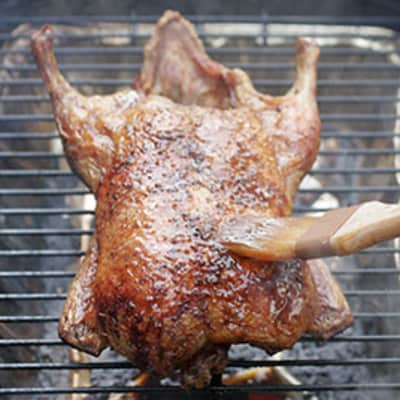
- Brush the duck generously with the orange glaze. Cover the grill and cook until the glaze heats through, 3 to 5 minutes. (Make sure the glaze does not burn.)
- Transfer the duck to a cutting board, tent with foil, and let rest for 10 minutes. Carve and serve.


Yield
Serves 3 to 4Ingredients
Test Kitchen Techniques
Ingredients
Test Kitchen Techniques
Ingredients
Test Kitchen Techniques
Why This Recipe Works
While developing our grill-roasted duck recipe, we found that steaming the duck before transferring it to the grill for roasting helped reduce the total cooking time. Too much steaming made the meat dry and stringy, so we cut back the steaming time from 60 to 30 minutes. Since we couldn’t render all the fat by steaming, we had to prick the skin to help render the rest of the fat on the grill and thereby produce the wonderful crispy skin that we desired for our grill-roasted duck recipe.

8 Comments