America's Test Kitchen LogoCook's Country LogoCook's Illustrated LogoAmerica's Test Kitchen LogoCook's Country LogoCook's Illustrated Logo

Oven Poached Whole Salmon

By America's Test Kitchen

Published on August 22, 2007

Time

2¼ to 3¼ hours

Yield

Serves 10 to 12
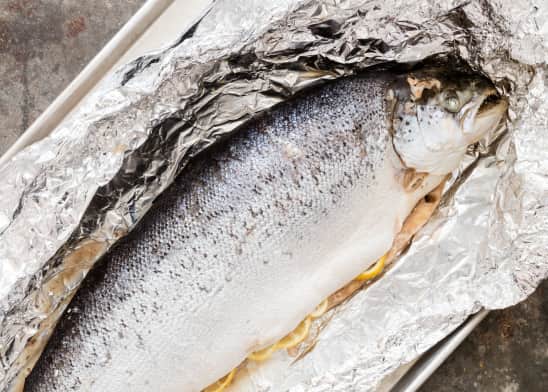
Oven Poached Whole Salmon

Ingredients

1 whole salmon (5 to 8 pounds), gutted, scaled, washed well, and fins trimmed away with kitchen shears3 tablespoons cider vinegar, rice vinegar, or white-wine vinegar1 tablespoon table salt ½ teaspoon table salt 2 lemons, one sliced and the other squeezed to yield 3 tablespoons juice

Before You Begin

Because the fish should lay flat as it cooks, measure your oven diagonally and make sure to buy a fish that will fit. If you do not have a thermometer to determine the internal temperature, gently insert the tip of a paring knife through the foil and into the fish. The flesh will separate easily and appear just barely translucent for medium-rare, or very light opaque pink for medium.

Instructions

  1. Adjust oven rack to middle position and heat oven to 250 degrees. Using a pastry brush, generously brush fish with vinegar and sprinkle with 1 tablespoon salt, on both sides and in cavity; arrange lemon slices in cavity.
  2. Following illustrations 1-3 below, wrap fish in heavy-duty foil. (Cut three pieces of heavy-duty foil about a foot longer than the fish. Lay one piece down and the other two on top so they meet in the center; fold over to seal. Center the fish on top of the foil, then wrap the fish with the foil, making a seam with the top edges of the top sheets and folding downward. Roll up the ends. Do not close the foil too tightly.)
  3. Transfer wrapped fish to oven rack and bake until an instant-read thermometer inserted through foil into thickest part of fish registers 125 to 130 degrees, between 1 1/2 and 2 1/2 hours, depending on weight of fish. Transfer fish to rimmed baking sheet, remove foil, and pour off liquid. At this point, fish can be covered loosely with plastic wrap and cooled to room temperature or refrigerated overnight.
  4. Skin, bone, and prepare salmon for serving. Season bottom fillet with half the lemon juice and half the remaining salt. Replace both sections of top fillet to reassemble now-boneless fish. Season top fillet with remaining lemon juice and salt. Wipe platter edges, garnish fish and platter as desired, and serve, passing sauce separately.
Oven Poached Whole Salmon

Oven Poached Whole Salmon

Headshot of America's Test Kitchen
By America's Test Kitchen
Save

Time

2¼ to 3¼ hours

Yield

Serves 10 to 12

Ingredients

1 whole salmon (5 to 8 pounds), gutted, scaled, washed well, and fins trimmed away with kitchen shears
3 tablespoons cider vinegar, rice vinegar, or white-wine vinegar
1 tablespoon table salt
½ teaspoon table salt
2 lemons, one sliced and the other squeezed to yield 3 tablespoons juice

Test Kitchen Techniques

Ingredients

1 whole salmon (5 to 8 pounds), gutted, scaled, washed well, and fins trimmed away with kitchen shears
3 tablespoons cider vinegar, rice vinegar, or white-wine vinegar
1 tablespoon table salt
½ teaspoon table salt
2 lemons, one sliced and the other squeezed to yield 3 tablespoons juice

Test Kitchen Techniques

Ingredients

1 whole salmon (5 to 8 pounds), gutted, scaled, washed well, and fins trimmed away with kitchen shears
3 tablespoons cider vinegar, rice vinegar, or white-wine vinegar
1 tablespoon table salt
½ teaspoon table salt
2 lemons, one sliced and the other squeezed to yield 3 tablespoons juice

Test Kitchen Techniques

Why This Recipe Works

Because most pots can’t fit a whole salmon, and fish poachers are expensive, we decided to get rid of the water altogether and steam the salmon in its own moisture. Our “poached” salmon recipe didn’t require special equipment and resulted in an impressive whole fish decorated with cucumber slices and dill. For our poached salmon recipe, we wrapped the seasoned fish in heavy-duty aluminum foil and placed it directly on the oven rack, cooking it low and slow: 250 degrees for about two hours.

Before You Begin

Because the fish should lay flat as it cooks, measure your oven diagonally and make sure to buy a fish that will fit. If you do not have a thermometer to determine the internal temperature, gently insert the tip of a paring knife through the foil and into the fish. The flesh will separate easily and appear just barely translucent for medium-rare, or very light opaque pink for medium.

Instructions

  1. Adjust oven rack to middle position and heat oven to 250 degrees. Using a pastry brush, generously brush fish with vinegar and sprinkle with 1 tablespoon salt, on both sides and in cavity; arrange lemon slices in cavity.
  2. Following illustrations 1-3 below, wrap fish in heavy-duty foil. (Cut three pieces of heavy-duty foil about a foot longer than the fish. Lay one piece down and the other two on top so they meet in the center; fold over to seal. Center the fish on top of the foil, then wrap the fish with the foil, making a seam with the top edges of the top sheets and folding downward. Roll up the ends. Do not close the foil too tightly.)
  3. Transfer wrapped fish to oven rack and bake until an instant-read thermometer inserted through foil into thickest part of fish registers 125 to 130 degrees, between 1 1/2 and 2 1/2 hours, depending on weight of fish. Transfer fish to rimmed baking sheet, remove foil, and pour off liquid. At this point, fish can be covered loosely with plastic wrap and cooled to room temperature or refrigerated overnight.
  4. Skin, bone, and prepare salmon for serving. Season bottom fillet with half the lemon juice and half the remaining salt. Replace both sections of top fillet to reassemble now-boneless fish. Season top fillet with remaining lemon juice and salt. Wipe platter edges, garnish fish and platter as desired, and serve, passing sauce separately.


Gift This Recipe

Enjoyed this dish? Let others know by sharing it as a gift recipe.

This is a members' feature.