White Coffee Chip Ice Cream
By Dan SouzaPublished on July 11, 2016
Yield
Serves 8 (Makes about 1 quart)
Ingredients
Before You Begin
Nonfat dry milk powder supplies protein and lactose without added water. The protein helps prevent large ice crystals by binding up water. Lactose is only about 20 percent as sweet as sucrose (granulated sugar), but it depresses the freezing point to the same degree. By using a substantial amount of nonfat dry milk powder, we can make a smooth, creamy, scoopable ice cream without making it too sweet. Mixing the milk powder with the sugar in step 1 helps prevent the milk powder from clumping when it gets wet. We prefer Carnation Instant Nonfat Dry Milk for this recipe.
Heavy cream is our primary source of fat. This is a 14 percent fat ice cream mix, one of the most popular formulations for premium commercial ice cream. Corn syrup is about 30 percent as sweet as granulated sugar. It contains fragments of starch chains that increase the viscosity of the mix and help prevent ice crystals from growing larger and coarser during hardening and storage. Cornstarch binds up water, effectively decreasing the amount of freezable water in the mix. It also acts as a stabilizer, helping to slow the rate of ice crystal growth during hardening and storage. Jeni Britton Bauer uses cornstarch (and cream cheese) to great effect in her ice cream base recipe in Jeni’s Splendid Ice Cream’s At Home (2011).
If using a canister-style ice cream maker, be sure to freeze the empty canister for at least 24 hours and preferably for 48 hours before churning. For self-refrigerating ice cream makers, prechill the canister by running the machine for 5 to 10 minutes before pouring in the custard.
Some ice cream base may stick to the bottom of the saucepan when pouring it into the bowl in step 3; simply scrape it into the bowl with the rest of the base and whisk until smooth. If the chocolate rehardens while the ice cream churns in step 4, microwave it in 10-second increments until just pourable. This ice cream can be stored for five days with little loss of quality.
Instructions
- In small bowl, whisk together milk powder, sugar, and salt. Whisk sugar mixture, milk, cream, and corn syrup together in large saucepan. Cook over medium-high heat until tiny bubbles form around edge of saucepan and mixture registers 190 degrees F/87.8 degrees C, whisking frequently to dissolve sugar and break up any clumps, 5 to 7 minutes. Remove from heat, stir in coffee beans, cover, and let steep for 1 hour.
- Using slotted spoon, discard coffee beans. Return mix to 190 degrees F/87.8 degrees C over medium-high heat. Whisk remaining milk and cornstarch together in small bowl.
- Reduce heat to medium. Whisk cornstarch mixture to recombine, then whisk into saucepan. Cook, constantly scraping bottom of saucepan with rubber spatula, until mixture thickens, about 30 seconds. Immediately pour ice cream base into large bowl and let cool until no longer steaming, about 20 minutes. Cover bowl, transfer to refrigerator, and chill to 40 degrees F/ 4.4 degrees C, at least 6 hours or up to 8 hours. (Base can be chilled overnight. Alternatively, base can be chilled in about 90 minutes by placing it over ice bath of 6 cups ice, ½ cup water, and ⅓ cup salt).
- Microwave chocolate in bowl, stirring frequently, until fully melted, about 2 minutes; set aside to cool. Churn base in ice cream maker until mixture resembles thick soft-serve ice cream and registers 21 degrees F/-6.1 degrees C. With machine running, slowly drizzle chocolate into ice cream and continue to churn until incorporated, 1 to 2 minutes longer. Transfer to airtight container, cover, transfer to freezer, and freeze until hard, at least 2 hours or up to 8 hours.


Yield
Serves 8 (Makes about 1 quart)Ingredients
Ingredients
Ingredients
Why This Recipe Works
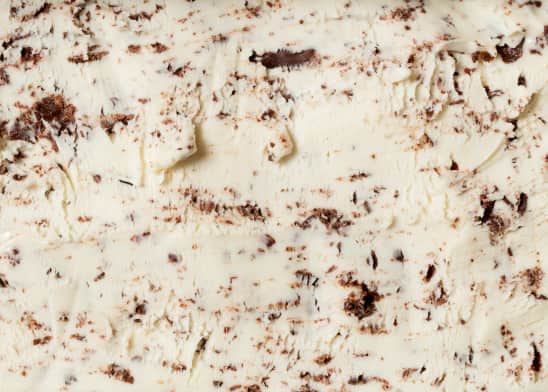
Because ice cream is frozen it gives off very little aroma (go ahead, smell your next scoop of ice cream). That’s one reason many ice cream shops also sell coffee or make their own waffle cones throughout the day—to give you something enticing to smell when you walk in the door. Before ice cream hits your tongue, the only real clue to its flavor is visual. We played around with that here in this recipe, where we call for steeping whole coffee beans so that they contribute great coffee flavor without adding any of the classic coffee color. It’s a fun trick we first saw at Gracie’s in Somerville, Massachusetts. We also pay homage to legendary Ohio-based Graeter’s by adding melted chocolate during churning instead of chocolate chips.




33 Comments